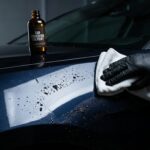
If your pressure washer rinse still leaves a grey, greasy haze on the paint after a contact wash, your soap is not the problem. The chemistry is. pH-neutral shampoos are genuinely useful products, but they were never designed to break down the heavy hydrocarbon compounds that traffic film is made of. Using one on a car coated in winter road grime is like trying to clean a frying pan with plain water. The physics simply do not allow it.
This article explains exactly what traffic film is made of, why alkalinity is the only practical solution, and how to apply an alkaline pre-wash safely without damaging your clear coat.
Key Takeaways
- Traffic film is oil-based, not water-based. Winter road grime bonds to clear coat through a hydrocarbon mechanism that a pH-7 soap cannot overcome without heavy scrubbing.
- Alkaline pre-washes (pH 10–12) saponify surface oils, converting them into a water-soluble compound that lifts cleanly off the paint under rinse pressure — zero contact required.
- Contact time is the critical safety variable. High-pH chemistry must come off the panel within 3–5 minutes to prevent strip-washing your existing protection and risking clear coat stress.
What Traffic Film Actually Is
Most people assume a dirty car is just dusty. In winter conditions, that assumption will cost you.

Traffic film is a composite contamination layer. It is built from atomized diesel and petrol combustion byproducts, rubber tyre particles, road salt, carbon soot, and — critically — petroleum-based oils thrown up from the tarmac surface and undercarriage splash. These compounds do not sit loosely on top of your paint like dry dust. They adhere to the clear coat through a chemical bonding process driven by shared hydrocarbon polarity.
In simple terms: oil sticks to oil. Your clear coat, especially an older or heat-cycled one, has microscopic surface texture. The oily components of traffic film find those recesses and lock in.
This is the exact mechanism that makes traffic film so resistant. It is not a surface deposit you can agitate away with foam. It requires a chemical reaction to break.
Why pH-Neutral Soaps Fail Here
A pH-neutral shampoo sits at pH 7. That is, by definition, neither acidic nor alkaline. These products are formulated to be kind to wax coatings, ceramic sealants, and delicate paint finishes. That gentleness is their design feature. It is also their hard limitation.
At pH 7, a car shampoo lacks the ionic charge needed to attack hydrocarbon bonds. It can lift loose particulate contamination — bird drop residue that has already been loosened, light dust, fresh road spray on a relatively clean car. But when a hydrocarbon compound has bonded to the clear coat, a neutral soap simply surrounds it without breaking it down.

You can feel this in the wash bucket. The water goes grey fast, the suds collapse quickly around greasy panels, and when you rinse, the paint still feels slightly tacky or looks hazy in raking light. That is the oil layer remaining intact.
Here is what most detailing guides get wrong: they tell you to apply more pressure, use more product, or make more wash mitt passes. That advice creates a new problem. Every additional contact pass you make over a panel that still has abrasive grit trapped in an unbroken oil film is a pass that introduces micro-marring into the clear coat. You are not cleaning more effectively. You are polishing the contamination into the paint.
The biggest mistake I see beginners make in the shop is reaching for a second bucket and a fresh mitt when the pre-rinse has clearly not done its job. More contact on a contaminated panel is never the answer. The chemistry needs to do the work first.
The Alkaline Mechanism: Saponification Explained
Alkaline pre-washes work through a process called saponification. It sounds technical, but the concept is direct.
When a high-pH solution (typically pH 10–12) contacts an oil or fat molecule, the hydroxide ions in the alkaline solution break the ester bonds that hold the oil’s chemical structure together. The oil molecule is converted into two separate compounds: a fatty acid salt (soap) and glycerol. Both of these new compounds are water-soluble.
The practical result: the oil that was bonded to your clear coat is chemically converted into a substance that water can simply wash away. No scrubbing. No agitation. No contact.

When you are standing over the bonnet of a car that has been sitting in a pre-wash foam for two minutes, you can actually watch this happen. The foam initially sits bright white. As it reacts with the traffic film, it darkens — sometimes to a pale brown or grey — as the saponified contamination is drawn into the solution. When you rinse, that contaminated foam sheets off the panel and takes the film with it. The surface underneath feels noticeably smoother to the back of your hand. Not perfectly decontaminated, but dramatically cleaner than any neutral wash could achieve.
pH Comparison: Choosing the Right Pre-Wash for the Job
Not all alkaline products are the same. The pH level you choose should match the severity of contamination on the vehicle.
| Contamination Level | Typical Scenario | Recommended Pre-Wash pH | Contact Time |
|---|---|---|---|
| Light | Weekly-washed car, light dust | pH 7–8 (Shampoo) | Standard wash time |
| Moderate | 2–3 weeks of urban driving | pH 8.5–9.5 (Snow foam) | 2–4 minutes |
| Heavy | Winter film, rural driving, fleet vehicles | pH 10–11 (Alkaline pre-wash) | 3–5 minutes max |
| Extreme | Heavy plant vehicles, commercial fleet | pH 11–12 (Traffic film remover) | 2–3 minutes, do not let dry |
The risk scales with pH. A pH-8.5 snow foam on a ceramic-coated car will do no damage even with slightly extended dwell time. A pH-12 traffic film remover left on a panel for 8 minutes on a hot day can begin stripping a wax or sealant layer, and on a car with a compromised clear coat, it can cause chemical stress.
How to Apply an Alkaline Pre-Wash Without Causing Damage
Choose the Right Dilution First
Most alkaline pre-washes are sold as concentrates. Dilution ratio changes the effective pH of the working solution. A product labelled pH 12 at concentrate may deliver pH 10.5 at a 1:10 dilution. Always check the manufacturer’s dilution chart against the contamination level you are dealing with. Do not assume neat application is always more effective — it shortens your safe working window.
Temperature and Timing
Cold panels in winter slow down the saponification reaction. Warm panels in summer accelerate it. A product that needs 4 minutes of contact at 5°C may need only 90 seconds at 25°C on a sun-warmed bonnet.
Work in sections on heavily contaminated vehicles. Do not apply to the entire car at once and then start your timer — by the time you reach the boot lid, the bonnet has been dwelling for three minutes already. Apply roof and bonnet first, rinse first.
Never let an alkaline pre-wash dry on the surface. If product dries in direct sunlight on a dark-coloured car, you risk tide marks and potential chemical etching in the upper pH ranges. This is non-negotiable.
The Correct Application Sequence

- Rinse the car with a pressure washer first to knock off loose grit.
- Apply alkaline pre-wash from the bottom up using a foam lance or pump sprayer. Bottom-up application prevents drips running through already-treated sections.
- Allow the product to dwell without agitation. Watch the foam — when it begins to discolour or collapse in patches, the reaction is working.
- Rinse thoroughly from the top down with strong pressure before the product approaches its maximum dwell time.
- Only then move to your contact wash with a pH-neutral shampoo.
The contact wash after a proper pre-wash is almost a formality on a moderately dirty car. The mitt should glide without resistance. If you still feel grit or drag, the pre-wash either did not have enough dwell time or the dilution was too conservative for the contamination level.
What Alkaline Pre-Washes Will Strip From Your Car

This is the section most product marketing glosses over.
| Protection Type | Vulnerability to Alkaline Pre-Wash |
|---|---|
| Carnauba Wax | High — saponification attacks natural wax esters directly |
| Synthetic Sealant | Moderate — repeated use degrades bonding layer over time |
| Ceramic Coating (SiO2) | Low — chemically resistant to pH 10–12 in single application |
| Paint Protection Film (PPF) | Low — resistant, but check manufacturer guidance for pH limits |
| Bare/Unprotected Clear Coat | Low single-use risk, elevated risk with repeated aggressive use |
A single correct application of a pH 10–11 pre-wash will not destroy a well-maintained carnauba wax layer. Repeated weekly use at high concentration will absolutely degrade it faster than normal. If you are maintaining a wax-protected car, alkaline pre-washes are an occasional tool for heavy contamination, not a routine product.
On a ceramic-coated car, in most cases, a properly diluted alkaline pre-wash is well within safe operating parameters and is actually the recommended pre-wash approach by most coating manufacturers.
FAQs
Can I use an alkaline pre-wash every week on my daily driver?
Weekly use at high pH on a waxed or sealed car will accelerate protection degradation. For routine maintenance, a pH 8–9 snow foam is a better fit. Save the pH 10–12 products for sessions when visible traffic film is present.
What happens if I let the pre-wash dry before rinsing?
Depending on the product pH and ambient temperature, dried alkaline pre-wash can leave mineral deposits, streaking, or in worst cases with very high-pH products on hot panels, contribute to chemical stress on the clear coat. Set a timer. Do not leave the car and come back.
Do I still need to clay bar after an alkaline pre-wash?
Yes, in most cases. Alkaline pre-washes remove bonded oil-based contamination through saponification. They do not remove embedded metallic fallout, tar spots, or industrial deposits. A clay bar or iron fallout remover addresses those separate contamination types.
Will an alkaline pre-wash damage rubber trim or plastic?
Most diluted alkaline pre-washes are safe on rubber and plastic seals at the working concentrations recommended for painted surfaces. Prolonged contact at neat concentration, particularly with budget products that use harsh surfactant blends, can cause fading on unprotected matte plastics over time. Rinse these areas promptly.
Your Next Step
Check the pH of whatever product you are currently using as a pre-wash. If it is marketed as “pH-balanced” or “pH-neutral,” it is working against you on any car with visible traffic film.
Pick a dedicated alkaline pre-wash in the pH 10–11 range, start at the manufacturer’s recommended dilution for moderate contamination, and run one session comparing the rinse result before and after contact wash. The difference will be immediate and visible.
That is the test. The chemistry either works or it does not. On a properly applied alkaline pre-wash, it works every time.