
You applied a polysilazane coating, stepped back, and saw it. A smear. A drag mark. A high spot catching the light at the wrong angle. Now you have a clock ticking on a coating that is already bonding to your paint.
This article tells you precisely what to do, why the chemistry gives you a narrow window, and how to avoid the mistakes that turn a fixable problem into a machine-compounding job.
Key Takeaways
- Cross-linking in polysilazane coatings begins within 3–5 minutes of application, which means your window to level a high spot starts closing almost immediately.
- A 30% Isopropyl Alcohol (IPA) wipe is the correct leveling tool within the first 60 minutes — it disrupts the early polymer network without stripping the base layer entirely.
- Once 24 hours have passed, you are past the chemical window. Removing a cured high spot requires abrasion equivalent to greater than 1500-grit, which risks going through your clear coat if done carelessly.
What Actually Happens When Polysilazane Flashes
Most applicators know they need to wipe the coating. Very few understand why timing matters at a molecular level, which is exactly why they make expensive mistakes.
Polysilazane is a silicon-nitrogen polymer. When it contacts atmospheric moisture, it begins a hydrolysis and condensation reaction. The silicon-nitrogen bonds convert into silicon-oxygen bonds — the same Si-O network found in glass. This is what gives the coating its hardness and chemical resistance.
Cross-linking begins within 3–5 minutes. That is not a manufacturer exaggeration. At room temperature and standard humidity, the surface layer starts forming rigid bonds almost immediately after the solvent evaporates.
By the 30-minute mark, a thin but increasingly dense silica-like network exists on the surface. It is not fully cured — but it is far from liquid. Think of it like partially set concrete. You can still reshape it, but you need the right tool. After 60 minutes, the network is dense enough that a standard IPA wipe will smear rather than dissolve the excess material cleanly.
After 24 hours of ambient cure, the cross-linking is extensive enough that the coating bonds to your clear coat with real mechanical grip. Removing it at that stage requires abrasion exceeding 1500-grit equivalency — we are talking light machine polishing at minimum, which introduces its own risks to the paint below.
The 60-Minute IPA Window: How to Use It Correctly

A 30% IPA solution is the correct concentration for leveling within the first hour. This is not negotiable based on preference.
Higher concentrations — say, 70% or isopropyl straight from the hardware store — will act too aggressively on the partially cured network and can strip the coating unevenly or pull up the bonded base layer. Lower concentrations do not carry enough solvent activity to effectively dissolve and redistribute the excess polymer. The 30% solution hits the target: enough solvent to soften and redistribute high spots, not enough to obliterate your coating.
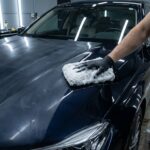
How the wipe should feel: Use a clean, high-pile microfiber — the kind that feels almost fluffy in your hand, not a flat glass-wipe towel. Fold it into a quarter panel. Spray two light passes of your 30% IPA across the surface of the towel, not directly onto the coating. Then wipe with a single, flat, even pass using moderate hand pressure.
When you are actually standing over the hood of a car, the right pressure feels like you are wiping condensation off a window — deliberate, even, without pressing down. If you push too hard, you will feel the microfiber start to drag and skip across the surface. That drag tells you the cross-linking is more advanced than you expected. Back off. Use a fresh section of towel and lighter pressure.
Identifying High Spots Before They Cure
Speed matters here. You need to catch a high spot during the flash — ideally within the first 20 minutes — not after you have moved on to the next panel.
The best way to spot a high spot in the flash phase:
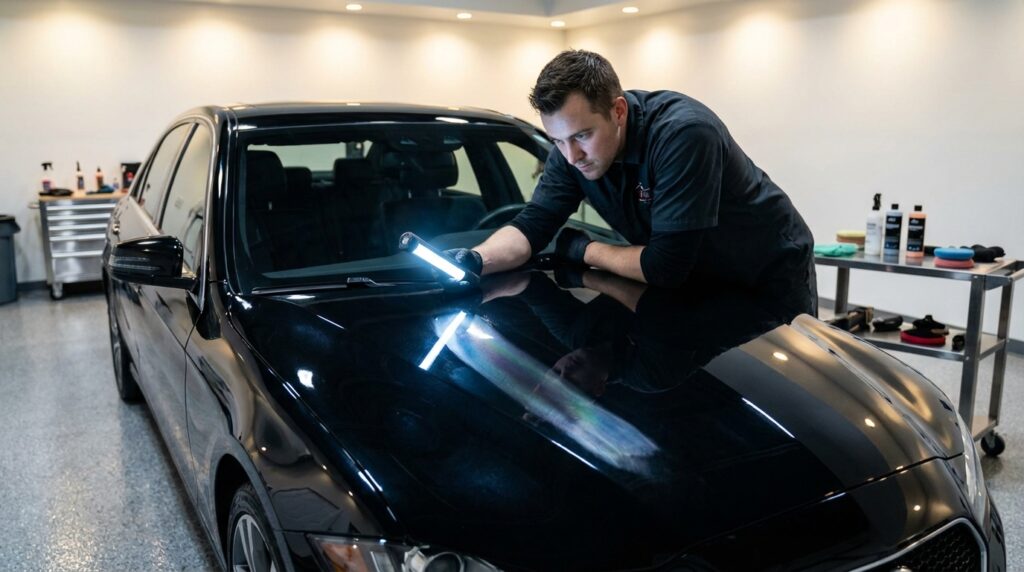
- Use a single-point LED detailing light held at a low, raking angle across the panel.
- High spots will show as a slight haze, a thick-looking smear, or a visible drag line that does not blend into the surrounding coating.
- Run a dry, clean fingertip very lightly across a suspect area. A high spot will feel slightly raised or tacky compared to the flat, evenly-flashing sections.
The biggest mistake I see beginners make in the shop is waiting until the entire car is coated before doing their first inspection pass. By the time they circle back to the first panel, the cross-linking on that section is already 20–30 minutes ahead of where they think it is. Always inspect each panel before moving to the next one.
What To Do Based on How Much Time Has Passed
Time elapsed and available repair methods are directly linked. Here is how to read the situation.
| Time Since Application | Coating State | Correct Action |
|---|---|---|
| 0–10 minutes | Solvent still active, very early cross-linking | Dry microfiber buff with light pressure |
| 10–30 minutes | Surface flash beginning, soft network forming | 30% IPA wipe, single flat pass |
| 30–60 minutes | Network increasingly dense but solvent-responsive | 30% IPA wipe with fresh towel, light pressure, may need 2 passes |
| 1–24 hours | Partially cured, limited solvent response | IPA will not correct cleanly; attempt with caution or leave and assess at 24 hours |
| 24+ hours | Full ambient cure in progress | Requires machine polish at 1500+ grit equivalency minimum |
One important caveat: humidity and temperature shift all of these windows. In a hot, humid environment — above 75°F with humidity over 70% — cross-linking can accelerate significantly. In cooler, dry conditions, you may have slightly more time. Do not assume you have the full 60 minutes without accounting for your shop conditions.
The 24-Hour Mark: What “Exceeding 1500-Grit” Actually Means

This is where professionals get honest about the consequences of missing the leveling window.
A polysilazane coating that has cured for 24 or more hours has formed a genuine glass-like silicon-oxygen matrix. According to MIT’s materials science resources on silicon chemistry, the Si-O-Si network in fully cured polysilazane-derived coatings shares structural characteristics with amorphous silica — the same class of material used in optical glass. You are not wiping off a wax. You are abrading a very thin layer of glass that has bonded to your clear coat.
Removing it requires abrasion equivalent to 1500-grit sandpaper or finer cutting compounds at high-speed rotation. A 1500-grit equivalent in polishing terms typically means a medium-cut compound on a cutting pad at 1200–1800 RPM on a dual-action polisher, or a light-cut compound on a rotary.
The risk is real. Most factory clear coats are between 35 and 50 microns thick. A single aggressive machine polish pass can remove 1–3 microns. That sounds trivial until you consider that you need enough clear coat depth remaining to refine the surface after removing the high spot. Pushing too hard to remove a coating high spot can take you to the point of clear coat failure.
The Paint Finishing Information database at the Society of Tribologists and Lubrication Engineers (STLE) is a useful reference for understanding abrasion mechanics and clear coat thickness tolerances if you want to go deeper on this.
If you are in this situation, use a paint depth gauge before you start. Measure multiple points around the affected area. If you are reading below 90 microns total on an OEM finish, proceed with extreme care and use the least aggressive compound that will still move the cured material.
Why Generic Advice About “Just Buff It Out” Misses the Point
Most online guides tell applicators to buff high spots with a microfiber towel and call it done. That advice is correct for the first 10 minutes. After that, it becomes increasingly wrong — and past the 60-minute mark, it is genuinely harmful.
Dry-buffing a partially cured polysilazane high spot after 30 minutes does not remove the excess material. It smears it. The partially cross-linked polymer redistributes unevenly across the surface and creates a wider, thinner high spot that is even harder to see under artificial light but shows clearly in direct sunlight as a haze or uneven gloss patch.
Worse, aggressive dry buffing at this stage can abrade the still-soft coating network and create micro-marring in the coating itself — shallow scratches in the cured surface that catch light and cannot be buffed out without addressing the coating layer directly.
The IPA wipe works because the alcohol temporarily softens the polymer network enough to allow the excess to be redistributed and wiped clear in one motion. It does not strip the bonded base layer because the bonded layer has already cross-linked directly to the clear coat surface. The high spot — the material that pooled or dragged — sits above that bonded layer and has weaker mechanical adhesion. The IPA exploits that difference.
Frequently Asked Questions
Can I use a higher IPA concentration if I am past the 45-minute mark? No. A higher concentration increases the risk of stripping the base layer unevenly. If you are past 45 minutes, use 30% IPA with a fresh, clean microfiber and accept that you may need two careful passes. Stronger is not better here.
What if the high spot covers a large area, like a full quarter panel? Work in sections of about 18 inches. Spray the towel lightly, wipe one section, flip to a clean face of the towel, and move to the next. Never re-wipe a section you have already touched with a contaminated towel face — you will drag dissolved coating material back onto the surface.
Does surface temperature affect how quickly the IPA wipe works? Yes. On a warm panel — above 80°F — the solvent activity of the IPA increases slightly, which can make the wipe more effective but also increases the risk of over-stripping if you apply too much product. On cold panels, the IPA works more slowly and you may need slightly more dwell time — one to two seconds — before wiping.
If the high spot is small, can I skip machine polishing and use a hand applicator with compound after 24 hours? In most cases, no. A hand applicator with a cutting compound will not generate enough pressure or heat to effectively abrade a fully cured polysilazane matrix. You will spend significant effort with minimal result. A dual-action machine polisher with a cutting pad and medium compound is the practical minimum for post-cure correction.
Your Next Move
Check your shop environment right now — temperature and humidity. Before your next coating application, set a visible timer for 10-minute intervals starting from the moment product touches paint. Do your first inspection pass on each panel at the 10-minute mark, not after the whole car is done.
If you are already past the window on a current job, measure your clear coat depth first. Then choose the least aggressive compound that will address the high spot. Work in small sections, measure between passes, and stop as soon as the surface looks even under a raking light.
The chemistry is precise. Your process should match it.