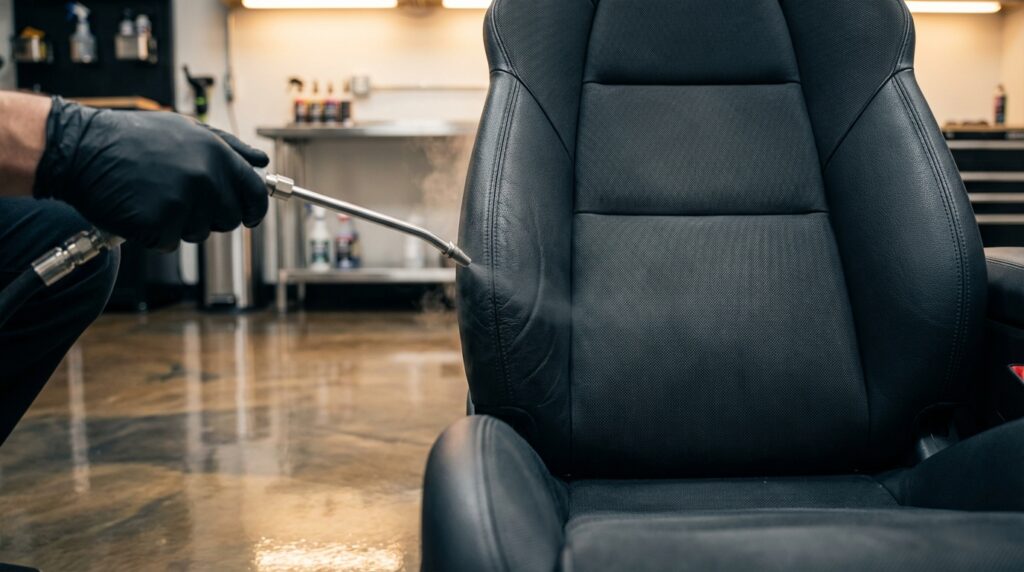

Your driver’s seat bolster looks deflated. It probably feels that way too — soft in the wrong places, sunken where it used to grip. That is not a worn-out seat. That is collapsed foam cell structure, and in most cases, you can bring it back without touching a sewing needle or a replacement kit.
This article shows you exactly how dry vapor steam revives compressed polyurethane foam inside seat bolsters, what temperature you need, where to inject the steam, and how to avoid the mistakes that make the foam worse instead of better.
Key Takeaways
- Seat bolster foam collapses at the cell level, not the fabric level. Most bolsters use open-cell polyurethane foam that loses its shape through repeated compression — not wear. The foam itself can still respond to heat and moisture.
- Dry vapor steam at 140°C (284°F) is the active ingredient. That specific temperature forces the collapsed cells to expand and reactivate their memory. Too cool and nothing happens. Too hot and you risk deforming the foam permanently.
- Technique matters more than equipment. Penetration angle, dwell time, and immediate reshaping are what separate a restored bolster from a soggy one.
Why Seat Bolster Foam Collapses in the First Place

Automotive seat bolsters are built with open-cell polyurethane foam. Think of the structure like a sponge — thousands of tiny interconnected chambers that flex, compress, and spring back. That spring-back property is called foam memory.
Every time you slide in and out of a car, your hip and thigh load the bolster laterally. The outer cells compress. Over time — especially in performance seats with aggressive bolster geometry — those cells stop fully rebounding. They stay partially crushed.
The foam does not disappear. It flattens. That is the key distinction, because flattened open-cell foam can still be rehydrated and thermally expanded. Replaced foam, on the other hand, requires cutting and sewing.
This is also why the driver’s side bolster always looks worse than the passenger’s. It takes 100% of the load, every single time.
Understanding Dry Vapor Steam vs. Wet Steam

Before you touch any equipment, get this wrong and you will ruin the foam. There is a significant difference between wet steam and dry vapor steam.
Wet steam carries excess water droplets in the vapor. Push that into foam and you are essentially soaking it. Soaked foam takes hours to dry, can grow mold inside the seat cushion, and does not deliver the focused thermal energy you need to reactivate cell memory.
Dry vapor steam is superheated to the point where most of the water has converted to gas. At 140°C (284°F), the vapor is dry enough to penetrate the foam without saturating it, but hot enough to thermally agitate the cell walls. That heat is what makes the cells expand.
| Steam Type | Temperature Range | Water Content | Risk to Foam |
|---|---|---|---|
| Wet steam | 100°C – 110°C | High (visible droplets) | Saturation, slow dry time, mold risk |
| Dry vapor steam | 130°C – 160°C | Very low (true vapor) | Minimal if used correctly |
| Superheated dry vapor | 160°C+ | Near zero | Cell deformation if over-applied |
The sweet spot is 140°C. Most professional-grade automotive steam machines will display boiler temperature. If yours only shows pressure, cross-reference the manufacturer’s PSI-to-temperature chart. Do not guess.
Equipment You Need Before You Start

You do not need a commercial steamer the size of a refrigerator. A purpose-built automotive dry vapor steamer in the 1,500–2,000 watt range will reach and hold 140°C reliably.
What you need:
- A dry vapor steam machine capable of reaching 140°C with a stable output
- A detail nozzle or injection nozzle — a narrow tip that concentrates steam into a single point of entry rather than dispersing it across the surface
- A microfiber towel rated for high heat (not standard shop towels)
- Heat-resistant gloves — the injection nozzle at 140°C will cause a burn in under a second
What you do not need:
- A steam cleaner designed for floors or kitchen surfaces — these typically run wet at 100°C–110°C
- A heat gun — dry heat without moisture does not rehydrate the cells
- Fabric conditioners or sprays applied beforehand — they interfere with vapor penetration
The Steam Hydration Process, Step by Step
Step 1: Assess the Compression Depth
Press firmly on the bolster with the flat of your hand. A healthy bolster pushes back with noticeable resistance. A collapsed one feels like you are pressing into soft putty with almost no rebound.
Run your hand across the seat surface. You will feel the transition point — where the foam still has volume versus where it has packed down. That depression zone is your primary target area.
Mark the boundaries loosely with masking tape on the fabric if it helps you stay organized. You are not treating the whole seat. You are targeting the collapsed zone.
Step 2: Heat the Machine to Operating Temperature
Let the steamer reach full operating temperature before you open the valve. A machine that has not fully pressurized will release wet steam for the first 30–60 seconds. This is the most common mistake beginners make — they start steaming before the boiler is ready and they immediately over-wet the fabric.
Wait for the ready indicator. Then purge a short burst of steam into the air, away from the seat, to clear any residual moisture from the nozzle line.
Step 3: Inject Steam at the Right Angle

Attach the injection nozzle. This narrow tip is critical — it channels the steam into a concentrated stream instead of misting across the fabric surface.
Hold the nozzle approximately 1–2 cm from the fabric. Do not press it against the seat. You want the steam to penetrate through the fabric and into the foam, not pool on the surface.
Work at a 45-degree angle, pointing the nozzle toward the collapsed area. Move in slow, deliberate 5 cm passes. You are not scrubbing. You are delivering controlled bursts of thermal energy.
Dwell time per pass: 2–3 seconds maximum. After that, move on. If the fabric feels wet to the touch, your steam is too cool or you are holding the nozzle too close.
The foam beneath will start to feel different under your free hand — slightly warmer and marginally firmer as the cells begin to respond. That is the signal you are looking for.
Step 4: Apply Manual Pressure and Reshape Immediately
This is the step most guides skip entirely. Steam alone does not fully restore the shape. You have to physically assist the expansion.

While the foam is still thermally active — within 15–20 seconds of each steam pass — press firmly against the base of the bolster with your palm and push upward and outward. You are essentially coaching the foam back into its original geometry.
The biggest mistake I see beginners make in the shop is treating this like a passive process. They steam the area, walk away to refill the machine, and come back expecting a restored bolster. The foam has to be shaped while it is hot. If you miss that window, you need another steam pass.
Alternate between steam passes and manual reshaping. Three to four cycles is typical for a moderately compressed bolster.
Step 5: Allow Proper Drying and Evaluate
After your final pass, do not sit in the seat. Give the foam a minimum of 2 hours to cool and dry at room temperature, assuming standard garage temperatures around 20°C–25°C. In humid climates, allow more time.
Once dry, press the bolster again with your palm. You should feel measurably more resistance than when you started. In most cases, you will see visible volume return — the collapsed zone will sit higher and the bolster profile will look more symmetrical.
Severely collapsed foam — particularly in seats with over 100,000 kilometers of use — may need a second full treatment session after 24 hours. The cells need time to stabilize before you re-stress them with another hydration cycle.
What Can Go Wrong and How to Read the Signs
| Problem | Likely Cause | Fix |
|---|---|---|
| Foam stays wet after 2 hours | Steam too cool / too much water | Purge line better, raise boiler temp |
| No visible improvement after 3 cycles | Foam cell structure permanently degraded | Steam treatment has reached its limit |
| Fabric surface shows water marks | Nozzle too close / steam too wet | Increase nozzle distance, check temp |
| Foam feels crunchy or stiff after drying | Steam too hot, cell walls deformed | Lower temperature, shorten dwell time |
One thing worth knowing: steam hydration has a ceiling. Open-cell polyurethane foam that has undergone severe long-term compression — particularly in seats that have also been exposed to years of UV heat cycling — may have lost enough cell-wall elasticity that even perfect steam technique produces only partial recovery. In those cases, you will get improvement, not a full restoration. That is an honest outcome.
Frequently Asked Questions
Can you use this technique on leather seats without damaging the leather?
Yes, in most cases, as long as the leather is in good condition with no cracks or delamination. Dry vapor at 140°C is within the safe thermal range for most automotive-grade leather. The risk goes up significantly on dry, aged, or conditioner-starved leather. Always test on a hidden area first and reduce dwell time.
How many steam treatment sessions can a bolster take before the foam degrades?
There is no universal number, but treating the same area more than three times within a 48-hour window increases the risk of over-softening the cell walls. Space sessions at least 24 hours apart and evaluate the firmness after each drying period before deciding to repeat.
Does the type of fabric covering the bolster change how you apply steam?
It does. Thin synthetic covers let steam penetrate quickly — shorter passes and slightly more distance from the nozzle. Thicker woven fabrics or Alcantara-style materials slow penetration, which means you can hold the nozzle marginally closer for 1–2 extra seconds per pass. Never hold the nozzle stationary over Alcantara — move it constantly to avoid watermarking.
Will this work on the base cushion of the seat, or only the bolster?
The same technique applies to any area of open-cell polyurethane foam beneath intact fabric. Base cushions that feel flat and unsupportive respond well to steam hydration. The process is identical. The main difference is access — on a base cushion, you work from the front edge and use wider, sweeping passes rather than the focused injection angle you use on a vertical bolster face.
Your Next Step
Pull the driver’s seat forward in your vehicle and press both bolsters firmly with your palm right now. If one side feels noticeably softer or looks visually lower than the other, you have a compression problem that steam can address.
Check your steamer’s boiler temperature spec before you do anything else. If it cannot reach and sustain 140°C, it is not the right tool for this job. Source the correct equipment first — using a low-temperature machine on this process wastes your time and risks soaking the seat.
Once you have the right equipment at temperature, purge the line, attach the injection nozzle, and start with one five-pass test on the most compressed point. Let it dry for two hours. That first result will tell you exactly how much recovery potential your foam still has.