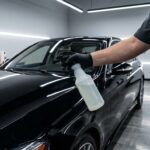
You mix your rinseless wash, load a microfiber, and start wiping. The towel grabs. It drags. You hear a faint squeak that makes your stomach drop. That is not technique failure. That is chemistry failure — and the culprit is sitting right there in your bucket.
Water temperature is not a side note in rinseless washing. It is the single variable that either activates or cripples the polymer system you paid good money for. Get it wrong, and you are essentially wiping with expensive, slightly slippery water. Get it right, and the solution behaves exactly as the label promises.
This article breaks down the exact science of why temperature matters, the safe working range, and how to manage it practically across different seasons and climates.
Key Takeaways
- Rinseless washes work through substantive cross-linking polymers, not surfactants. These polymers need adequate heat energy to dissolve and expand fully. Cold water leaves them partially coiled, which destroys lubricity.
- Water below 10°C (50°F) drastically slows polymer dissolution, meaning your solution never reaches its rated protection level — even if you used the correct dilution ratio.
- The optimal activation window is 25°C–30°C (77°F–86°F). At this range, the polymers expand fully, encapsulate dirt particles effectively, and provide the slick glide the manufacturer designed for.
What Is Actually Happening Inside a Rinseless Wash Solution

Most detailers understand that rinseless washes are different from traditional soap. What fewer people understand is how different the chemistry really is.
A traditional wash relies on surfactant action — molecules that surround dirt and lift it through micelle formation. Rinseless wash formulas take a different path entirely. They use substantive cross-linking polymers — long-chain molecules that physically encapsulate abrasive particles, binding them within a polymer matrix rather than lifting them off with foam.
Think of it this way: surfactants are the bucket brigade throwing water on a fire. Polymers are the net that catches every spark before it hits the paint.
For that net to work, the polymer chains need to be fully extended, flexible, and active. That activation is driven almost entirely by heat energy in the water.
The Polymer Coiling Problem

In cold water, polymer chains do not fully extend. They stay partially coiled — tightly wound structures that cannot surround and capture a sharp silica particle the way an open, expanded chain can. You can still see the solution looking clear and seemingly dissolved. But the molecular architecture is compromised at low temperatures.
The result is reduced encapsulation, reduced lubricity, and a microfiber that is physically dragging abrasive particles across your clear coat with far less cushion between them than you think.
The Critical Temperature Thresholds You Need to Know
| Water Temperature | Polymer Behavior | Real-World Effect |
|---|---|---|
| Below 5°C (41°F) | Minimal dissolution, chains tightly coiled | Near-zero lubricity, high scratch risk |
| 5°C–10°C (41°F–50°F) | Slow, incomplete dissolution | Noticeable drag, poor encapsulation |
| 10°C–20°C (50°F–68°F) | Partial activation | Acceptable lubricity, reduced performance |
| 20°C–25°C (68°F–77°F) | Good activation | Near-rated performance |
| 25°C–30°C (77°F–86°F) | Full expansion, optimal cross-linking | Maximum lubricity and encapsulation |
| Above 40°C (104°F) | Potential polymer degradation | Reduced effectiveness, possible residue |
That bottom row matters. Hot does not mean better. Polymers have an upper comfort range too. Exceeding 40°C risks destabilizing the polymer structure, which can leave smearing or uneven residue on the panel. Stay in the 25°C–30°C sweet spot.
Why “Room Temperature” Is Not a Safe Default
Here is what most rinseless wash guides get wrong: they tell you to mix at room temperature and leave it at that.
Room temperature in a garage in Karachi in July is very different from room temperature in a detailing bay in Scotland in February. “Room temperature” is not a standard. It is a variable. And when your room sits at 8°C, you are working in the polymer failure zone.
This is especially true in winter detailing scenarios where the bucket itself pulls heat out of the water rapidly, or where the car panels are cold to the touch. Even if you mixed at 22°C, a cold metal panel draws heat away from the solution on contact. The polymer’s working temperature at the point of application — not just in the bucket — is what counts.
What Cold Panels Do to Your Solution
When you press a soaked microfiber onto a panel that has been sitting in 5°C air, the solution at the contact point chills almost instantly. The polymer that was adequately dissolved in your warm bucket partially contracts on impact. The effective lubrication window at the paint surface is shorter and thinner than what you measured in the bucket.
In practice, this looks like: a microfiber that feels fine in your hand but suddenly grabs or stutters mid-wipe.
The Right Way to Manage Temperature in Practice
Pre-Warming Your Water

The most direct fix is intentional temperature management. Use a thermometer — a basic candy or probe thermometer works fine. Mix your rinseless wash concentrate into water that is sitting at 27°C–29°C. This gives you a working buffer as the solution cools in the bucket during the job.
Do not use a kettle to boil water and mix directly. Near-boiling water exceeds 90°C and will denature the polymers before you even start. Instead:
- Mix tap hot and cold water in your bucket until you hit 27°C–30°C
- Confirm with a thermometer, not your hand
- In cold environments, use an insulated bucket or wrap the bucket in a towel to slow heat loss
Seasonal Adjustments

Summer (ambient above 25°C): Your main risk is overheating, not underperformance. Pre-mixed solution sitting in direct sun can climb above 40°C. Mix fresh batches and work in shade.
Winter (ambient below 15°C): Active temperature management is non-negotiable. Start with warmer water, work faster, and consider splitting the job into sections, remixing fresh warm solution for each section.
Intermediate seasons: This is where most detailers get complacent. A 16°C autumn morning feels comfortable to work in but puts your water in partial activation territory. Slight warm-up is still worth doing.
How Temperature Affects Dilution Ratio Performance
Here is something most product labels do not tell you clearly: dilution ratios are tested at optimal temperatures.
When a rinseless wash label says “1:256” or “1:64,” that performance benchmark assumes you are working in the 25°C–30°C range. Diluting at cold temperatures means the polymer concentration in your bucket may be chemically correct but functionally weaker than rated.
In practice, two approaches work well for cold-weather use:
- Increase the concentration slightly — not dramatically, but moving from 1:256 to 1:200 in cold conditions compensates partially for reduced polymer activation.
- Prioritize warm water — a correctly diluted solution at 28°C outperforms a concentrated solution at 8°C. Temperature beats concentration.
| Condition | Standard Dilution | Adjusted Approach |
|---|---|---|
| 27°C water, warm panels | 1:256 (per label) | No change needed |
| 15°C water, cool panels | 1:256 | Move to 1:200, or warm water |
| Sub-10°C water | 1:256 | Warm water is priority — adjust to 1:180 if warming is not possible |
Lubricity vs. Encapsulation: Two Different Jobs, Same Temperature Dependency
It helps to separate two things that temperature affects differently:
Lubricity is how slick the solution feels under the microfiber. This is the immediate, tactile protection against surface scratching during the wipe.
Encapsulation is the polymer’s ability to surround, capture, and hold a dirt particle so it cannot scratch the surface during removal.
Cold water hurts both, but it hurts them in different ways.
Lubricity drops first — you notice the drag before anything else. Encapsulation is harder to feel but arguably more important. A dirt particle that is not fully encapsulated has a partially exposed edge. That edge contacts your clear coat. Even if the wipe feels acceptably smooth, sub-optimal temperatures mean some abrasive particles are only partially coated.
Over dozens of washes, that matters. Especially on soft European clear coats that show micro-marring easily.
The biggest mistake I see beginners make in the shop is judging rinseless wash performance purely by feel. If it does not drag, they assume everything is fine. But when you do a paint inspection under a light source after a series of cold-water washes, you often see a pattern of very fine micro-marring that was not there before. Cold-water polymer failure is often invisible in the moment and only reveals itself under proper lighting.
Spotting Polymer Failure During a Job

You do not always have a thermometer handy. These are the in-use signs that your temperature is working against you:
- Microfiber drag or stuttering on a panel that should wipe clean smoothly
- Streaking or uneven hazing — partially dissolved polymers leave uneven residue as water evaporates
- Increased product consumption — you instinctively re-soak the towel more often because the slickness runs out faster
- Visible swirl visibility under portable lighting after wiping — a sign encapsulation failed on a particular pass
If you notice any of these mid-job, stop. Mix a fresh batch with warmer water, wring and re-soak your microfibers, and restart that panel.
FAQs
Can I microwave water to bring it to the right temperature faster?
Yes, this works well for small prep batches. Microwave a separate container of water to approximately 40°C, then mix it into your bucket with cold water until you hit the 27°C–30°C target. Do not microwave the rinseless wash solution itself after mixing — concentrated heat on a pre-mixed solution is harder to control and risks localized polymer damage.
Does the type of rinseless wash formula change how sensitive it is to cold water?
It does, to a degree. Polymer-heavy, high-lubricity formulas (often marketed as “ultra-slick” or high-dilution products) tend to be more temperature-sensitive because they rely more heavily on full polymer expansion. Lighter, lower-concentration formulas show less dramatic performance loss in cold water — but they also offer less protection to begin with. In most cases, the product that performs best at optimal temperature also suffers most at low temperature.
If I add more product to compensate for cold water, can I just use the solution without warming?
Increasing concentration helps marginally, but it does not solve the core problem. Polymer chains that are cold-coiled will not fully extend regardless of concentration. You end up wasting product. The fix is thermal, not chemical.
Is there a risk of leaving water spots if the solution is too warm?
Yes. Water above 35°C evaporates faster, which shortens your working time per panel and increases the risk of dried polymer residue — especially in direct sunlight or low-humidity environments. This shows up as a faint white haze that requires a quick follow-up wipe with a dry microfiber. Working at 27°C–30°C in shade minimizes this risk while keeping the polymer fully active.
Your Next Immediate Action
Before your next rinseless wash session, find a thermometer. It does not need to be anything special — a kitchen probe thermometer from a grocery store works fine.
Mix your next bucket to 27°C–29°C and pay attention to how different the microfiber glide feels compared to what you are used to. The difference between a 10°C bucket and a 28°C bucket is not subtle. It is immediate, tactile, and will likely reframe how you approach every rinseless wash you do from this point forward.
Adjust your dilution to match the season. Warm your water intentionally. Respect what the polymer actually needs to work — and it will protect your paint the way it was designed to.