You grabbed the door handle, slid into the driver’s seat, and now there’s a chalky, grayish smear across your black polyurethane upholstery that won’t budge. You’ve already tried an all-purpose cleaner. Maybe even dish soap. The stain is still sitting there, mocking you.
Here’s why: the sunscreen on your skin did not just sit on top of the seat. The zinc oxide inside it physically wedged itself into the micro-texture of the PU surface. Standard cleaners cannot dissolve it. This article walks you through exactly how to get it out — without damaging the finish.
Key Takeaways
- Zinc oxide is a particulate, not a dye — it physically embeds in the artificial grain of polyurethane leather. Degreasers and APC sprays are designed to cut oil and grease. They fail on zinc because zinc is a mineral, not a hydrocarbon.
- A mildly acidic cleaner at pH 5.5, paired with a natural boar’s hair brush, is the correct tool combination. The light acidity begins to destabilize the mineral particulate. The boar’s hair lifts it without abrading the PU coating.
- Black PU leather shows sunscreen staining more aggressively than any other color. The white mineral residue contrasts sharply against the dark surface and can also leave behind a faint gray haze if the first cleaning attempt is wrong.
Why Sunscreen Destroys Black PU Seats Differently Than You Think
Most people assume a sunscreen stain is an oil stain. The logic makes sense — sunscreen feels greasy. So they reach for a degreaser. The oily carrier agents in the sunscreen do respond to that. The white or gray residue that stays behind after cleaning? That’s the zinc oxide.
Zinc oxide is the active UV-blocking mineral in physical (also called mineral) sunscreens. It does not dissolve in water. It does not dissolve in alcohol. It does not respond to pH-neutral or alkaline cleaners. What it does is act like fine particulate dust — and it lodges into every micro-groove and texture line in the artificial grain of your PU leather surface.
Polyurethane leather is not smooth at a microscopic level. Manufacturers emboss a grain pattern into it to mimic the look of animal hide. Those ridges and valleys are exactly where zinc oxide particles accumulate and pack in under pressure — specifically, the pressure of a person sitting down.
Titanium dioxide, found in a smaller percentage of mineral sunscreens, behaves the same way. Same physics. Same problem.
Why Your Go-To Cleaner Is Making It Worse
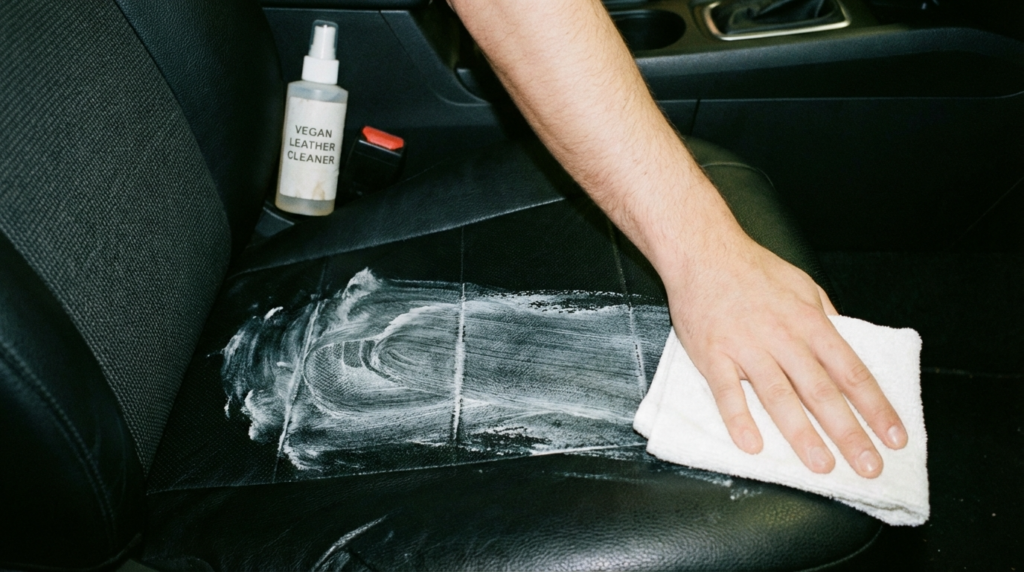
The biggest mistake I see beginners make in the shop is treating every stain like a grease problem. They saturate the area with an all-purpose cleaner, wipe hard with a microfiber, and then wonder why the stain looks smeared and lighter but won’t fully clear.
Here’s what’s actually happening. A high-pH alkaline APC does nothing to a mineral particulate. It may lift the greasy carrier oil from the sunscreen, which is why the stain looks better after one wipe. But the zinc oxide particles stay embedded, and now they’re spread across a slightly wider area because you pushed them around with the cloth.
Wiping harder makes it worse. Polyurethane coatings are more abrasion-sensitive than most people realize. Aggressive scrubbing with a stiff synthetic brush or a rough microfiber can micro-scratch the surface coating, leaving a dull zone that catches light differently. On black seats, this shows up as a permanent matte patch.
Stop scrubbing. That’s the rule.
The Correct Cleaning Protocol: Step by Step
What You Need Before You Start
Gather everything before touching the seat. Working with the wrong tool mid-process is how mistakes happen.
| Item | Specification | Why It Matters |
|---|---|---|
| Leather/vinyl cleaner | pH 5.0–5.5 (mildly acidic) | Destabilizes zinc oxide particulate |
| Boar’s hair detailing brush | Soft, natural bristle | Lifts particulate without scratching PU coating |
| Microfiber towel | 300–400 GSM, clean | Low-abrasion wipe for residue removal |
| Distilled water | Room temperature | Avoids mineral deposit from tap water |
| UV light (optional) | Standard UV pen light | Reveals full extent of sunscreen transfer |
One note on the pH requirement: a cleaner at pH 5.5 is only mildly acidic — close to the acidity of black coffee. It is not aggressive. It will not damage a healthy PU coating. What it does is begin to chemically destabilize the zinc particulate’s bond with the surface, making the boar’s hair’s job possible.
Step 1 — Identify the Full Stain Zone
In a normally lit garage, you may only see the obvious white smear. Under a UV light, sunscreen shows up as a bluish-white glow, revealing how far the transfer actually spread. In most cases, the invisible zone extends several inches beyond what you can see with the naked eye. Mark the full area mentally before you start.
Step 2 — Pre-Loosen With Distilled Water
Lightly mist the stained area with distilled water. Do not soak it. This step re-hydrates any dried zinc particulate and makes the cleaner’s job easier. Let it sit for 30 seconds.
Step 3 — Apply the Acidic Cleaner
Spray your pH 5.5 cleaner directly onto the stained zone. Use two or three passes — you want the surface visibly wet, not dripping. Let it dwell for 60 to 90 seconds. This dwell time is not optional. The cleaner needs contact time to work on the mineral particulate. Skipping ahead is the most common error here.
Step 4 — Work the Boar’s Hair Brush in Tight Circles
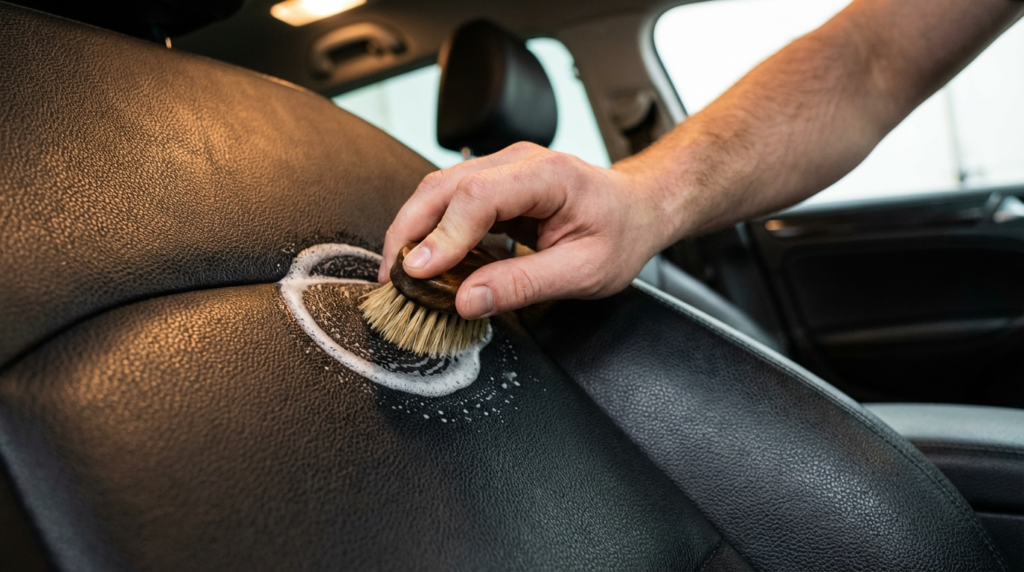
Pick up your boar’s hair brush. When you are actually standing over the seat working this step, the brush should feel soft against the back of your hand — almost like a fine paintbrush. That’s correct.
Work in small, tight circular motions. The bristles are reaching down into the grain of the PU surface and physically sweeping the loosened particulate up and out. You should see a light white foam begin to form. That’s the cleaner reacting with the zinc. Keep moving in circles — do not scrub in one direction.
Do not press hard. Let the brush do the work. The bristle stiffness is already calibrated for this task.
Step 5 — Wipe and Inspect
Using your clean microfiber, fold it to a fresh side and wipe the area with a single, controlled pass. Do not rub back and forth. Pick up the residue, flip the cloth, and make one more pass.
Now inspect. In most cases with a fresh stain, one full cycle removes the visible residue. If the stain is old or was set in by heat, repeat the process — dwell time extended to 2 minutes on the second pass.
Comparing Cleaner Types: What Works and What Fails
| Cleaner Type | pH Range | Effect on Zinc Oxide | Safe for PU Leather? |
|---|---|---|---|
| All-Purpose Cleaner (APC) | 9–12 (alkaline) | None — spreads particulate | Yes, but ineffective here |
| Dish Soap / Hand Soap | 7–9 (neutral-alkaline) | Removes carrier oil only | Yes, but incomplete result |
| Isopropyl Alcohol (70%) | ~7 (neutral) | Minimal effect on zinc | Use cautiously, can dry PU |
| pH 5.5 Leather/Vinyl Cleaner | 5.0–5.5 (mildly acidic) | Destabilizes zinc particulate | Yes — correct choice |
| Harsh Acid Cleaners (pH <4) | <4 (strongly acidic) | Effective but destructive | No — damages PU coating |
Protecting the Seat After Cleaning
Once the stain is gone, the PU surface is clean but slightly vulnerable. Apply a quality water-based PU conditioner or a dedicated vinyl protectant. This step rehydrates the surface layer and, depending on your product, deposits a light barrier coat that makes future sunscreen transfer easier to clean on the next occurrence.
Some detailers also keep a small bottle of pH 5.5 cleaner in the car during summer. A quick 30-second treatment the moment sunscreen transfers — before it dries and sets — takes virtually no effort compared to addressing a stain that’s been cooked onto black PU seats in a parked car.
FAQs
Can I use white vinegar instead of a commercial pH 5.5 cleaner?
Diluted white vinegar sits around pH 2.5–3.0, which is significantly more acidic than the safe range for PU leather. Repeated use will dry out and crack the surface coating. Use a purpose-formulated cleaner with a measured, stable pH instead.
My seats have a matte finish — will this process dull them further?
A pH 5.5 cleaner with a soft boar’s hair brush is safe for matte PU finishes. The risk of dulling comes from abrasive tools or high-alkaline cleaners, not from this protocol. After cleaning, apply a matte-finish protectant rather than a glossy conditioner to preserve the factory look.
How long before a sunscreen stain becomes permanent on black PU leather?
There is no fixed timer, but heat accelerates setting. A seat left in a parked car in direct sun with a fresh zinc stain can lock the particulate in more deeply within a few hours. Treat the stain the same day whenever possible. Week-old stains may require two or three cleaning cycles.
Does this protocol work on steering wheels and door panels made from the same PU material?
Yes, assuming the surface is the same polyurethane construction. The grip texture on steering wheels can hold more particulate per square inch than flat seat panels, so expect to spend a bit more time on that surface with the brush. Use the same cleaner, same dwell time, same tool.
Your Next Move
Get a pH-tested cleaner on order today if you don’t already have one in your kit. Check the label — “leather cleaner” alone tells you nothing about pH. Call the manufacturer or check the technical data sheet. If the pH is not listed, assume it’s neutral or alkaline and look for something else.
The boar’s hair brush matters just as much. A stiff nylon brush will scratch the PU coating on contact. Natural boar’s hair is the correct bristle for this work, and a quality one costs very little.
Do the protocol once, correctly, and you’ll see results in under 10 minutes. Do it wrong — with the wrong cleaner and too much pressure — and you’re looking at a faded, micro-scratched patch that no amount of re-cleaning will reverse.