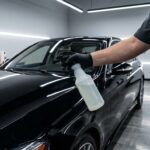
You load up the foam cannon, pull the trigger, and instead of that thick, clingy white blanket you saw in the YouTube video, you get a watery, runny mess that slides off the paint in seconds. Your technique is fine. Your cannon is adjusted correctly. The problem is your water.
Hard water kills snow foam at the chemical level — and most detailers never figure out why.
Key Takeaways
- Hard water minerals above 120 PPM react with your foam soap’s active ingredients, turning them into insoluble salts instead of bubbles. This is a chemistry failure, not a technique failure.
- Chelating agents in professional-grade soaps bind to calcium and magnesium ions before they can destroy the surfactant structure. Knowing whether your soap contains them changes which product you buy.
- Dilution ratio adjustments and water softening at the source are your two most reliable fixes. One costs almost nothing. The other requires a small upfront investment.
What Hard Water Actually Does to Your Foam

Snow foam is built on anionic surfactants. These are negatively charged cleaning molecules that do two jobs simultaneously: they surround dirt particles to lift them off the paint, and they trap air to create stable foam.
Hard water contains dissolved calcium and magnesium ions. In most regions classified as “hard,” that concentration sits above 120 PPM (parts per million). In many parts of the American Southwest, parts of the UK, and much of the Middle East, levels frequently exceed 250–400 PPM.
Here is the problem: calcium and magnesium carry a positive charge. Anionic surfactants carry a negative charge. Opposite charges attract. When these ions collide in your foam solution, they bond — and the resulting compound is an insoluble salt. Chemists call it soap scum. You call it a ruined foam job.
The surfactant molecule is now chemically neutralized. It cannot trap air. It cannot cling to paint. It just drips off.
This is not a foam cannon problem. This is not a soap concentration problem. It is a water chemistry problem.
The Symptom Checklist: Is Hard Water Actually Your Issue?

Before changing anything, confirm the diagnosis. Hard-water foam failure has a specific pattern.
| Symptom | Hard Water? | Other Cause? |
|---|---|---|
| Foam appears runny straight from the cannon | Very likely | Possibly diluted too thin |
| Foam slides off vertical panels in under 60 seconds | Very likely | Also: too-hot paint surface |
| White mineral rings left after water dries | Yes, classic hard water marker | — |
| Foam is thick in the bucket but collapses on contact with rinse water | Yes, rinse water is also hard | — |
| Foam is thin even with higher soap concentration | Strong indicator | Low-quality soap possible |
| Problem is worse in summer | Yes, evaporation concentrates minerals | — |
If you are checking three or more boxes on the left column, hard water is your primary issue.
The Chemistry Behind Chelation (And Why It Matters to You)

High-end snow foams include chelating agents — most commonly EDTA (ethylenediaminetetraacetic acid), citric acid, or gluconates. These molecules work by wrapping around calcium and magnesium ions and holding them in a stable, soluble complex before they get a chance to attack the surfactant.
Think of a chelating agent as a trap set before the damage happens.
When the calcium ion is already bound to the chelate, it is chemically unavailable to react with the anionic surfactant. The surfactant stays intact. The foam stays thick.
The catch: chelating agents are consumed in proportion to the mineral load in your water. If your water is at 400 PPM, a soap formulated for 150 PPM water will exhaust its chelate reserve almost instantly. You will still get flat foam — just slightly less flat than without any chelation at all.
This is why the same soap that works brilliantly for a detailer in Seattle performs terribly for a detailer in Phoenix. The soap is not bad. The water is simply overwhelming its chemistry.
How to Read a Snow Foam Label for Hard Water Compatibility
Most manufacturers do not advertise chelating agents clearly on the bottle. Here is how to identify them anyway.
Look for these ingredients in the INCI or technical data sheet:
- Tetrasodium EDTA or Disodium EDTA — most common and effective
- Citric Acid — weaker chelation, often used in “eco” formulas
- Sodium Gluconate — biodegradable option, effective at moderate hardness levels
- Sodium Hexametaphosphate (SHMP) — excellent for very hard water, older formulation
If none of these appear and the manufacturer only lists “surfactant blend” or “cleaning agents,” assume the soap has no meaningful hard water protection.
The biggest mistake I see beginners make in the shop is buying the most expensive foam soap on the shelf without checking whether it is formulated for their local water profile. A $40 bottle designed for soft water will underperform a $15 bottle with proper chelation in a 300 PPM region every single time.
Practical Fixes, Ranked by Cost and Effort

Fix 1 — Adjust Your Dilution Ratio Upward (Free, Immediate)
Most foam cannon soaps are recommended at 1:10 to 1:15 dilution for soft water. In hard water, start at 1:5 or even 1:4.
You are compensating by overwhelming the mineral content with more surfactant than the calcium can neutralize. It is not elegant chemistry, but it works. You will use more product per wash, but you will get a functional foam blanket.
This is a temporary fix. It does not solve the underlying chemistry — it just outguns it.
Fix 2 — Pre-Treat Your Water with a Citric Acid Rinse (Low Cost)
Add food-grade citric acid powder to your foam cannon water before adding soap. A starting point is roughly 1 gram per liter of water in the cannon bottle.
Citric acid lowers the pH slightly and begins chelating calcium and magnesium before the surfactant even enters the mix. The result is noticeably better foam stability.
Mix the citric acid into the water first, let it dissolve completely, then add your soap. Sequence matters here.
Fix 3 — Use a Dedicated Hard Water Pre-Spray (Moderate Cost)
Several professional chemical suppliers sell hard water pre-treatment concentrates containing EDTA or SHMP. You add these to your cannon water at very low doses (often 0.5–1% by volume).
These products are designed specifically to buffer the water before surfactant chemistry begins. When you are standing over the hood of a car after treating the cannon water this way, the foam visibly clings differently — it grabs the surface and holds its structure instead of sheeting away.
Fix 4 — Deionized or Reverse Osmosis Water at the Source (Higher Cost, Best Long-Term)
A reverse osmosis (RO) system or deionized (DI) water supply strips minerals from water before it ever reaches your cannon. Water at under 50 PPM behaves essentially like soft water for surfactant chemistry purposes.
A basic RO system for a detailing garage runs between $150 and $400 depending on flow rate. For professional shops washing multiple cars per day, the foam quality improvement — combined with the elimination of water spotting at the rinse stage — typically justifies the cost within a few months of use.
For home detailers, a countertop RO unit that fills a storage jug works fine.
| Fix Method | Cost Level | Effectiveness in Very Hard Water (300+ PPM) | Speed of Result |
|---|---|---|---|
| Higher dilution ratio | Free | Moderate | Immediate |
| Citric acid pre-treatment | Very low | Good | Immediate |
| EDTA/SHMP hard water additive | Low–moderate | Very good | Immediate |
| Chelation-formulated foam soap | Moderate | Good–very good | Immediate |
| RO/DI water supply | High upfront | Excellent | After install |
What Happens at the Rinse Stage (People Ignore This)

Most detailers focus all their effort on the foam application and forget that rinse water carries the same hard water problem.
When you rinse hard water over a panel, you are depositing calcium and magnesium across the entire surface in a thin film. As the water evaporates — especially in direct sun — that film concentrates and bonds to the paint or coating. This is water spotting. In most cases, it has nothing to do with your foam soap and everything to do with your rinse water quality.
If you are treating your foam water but not your rinse water, you have solved half the problem.
For spot-free rinse performance, a DI-filtered final rinse is the professional standard. Even a small 10-inch DI resin vessel inline with your rinse hose will drop water to near-zero TDS and eliminate mineral deposition on the final rinse.
FAQs
Will a water softener work as well as a reverse osmosis system for foam performance?
A traditional ion-exchange water softener replaces calcium and magnesium with sodium. Sodium ions do not interfere with anionic surfactants the way calcium and magnesium do, so foam performance improves significantly. However, softened water still contains dissolved solids and will still cause spotting on paint if allowed to air-dry. For foam cannon performance specifically, a softener helps. For spot-free results, you still need DI or RO for the final rinse.
Does water temperature change how hard water affects foam?
Yes, meaningfully. Hot water accelerates the reaction between calcium ions and anionic surfactants, which means foam collapses even faster in warm weather or when washing a sun-warmed panel. Depending on your local summer temperatures, the same foam product that works adequately in March may become nearly non-functional in July using identical technique and ratios. Foam early in the morning when both the car and water are cooler.
Can I mix different snow foam soaps to improve hard water performance?
Not reliably. Mixing two anionic surfactant-based soaps in hard water doubles the available target for calcium ions without necessarily doubling the chelating capacity. You risk the same collapse, just with more product wasted. A better approach is adding a standalone chelating pre-treatment to one quality soap than blending two soaps together.
How do I find out my actual PPM level without buying a testing kit?
Your local municipal water authority is required to publish an annual water quality report in most countries. Search for your city’s name plus “water quality report” or “consumer confidence report.” These documents list hardness in either PPM, mg/L, or grains per gallon (multiply grains per gallon by 17.1 to get PPM). This is the most accurate starting point and costs nothing.
Your Next Immediate Action
Look up your local water hardness report today — right now, before the next wash. If you are above 150 PPM, every foam session you run with an unchelated soap is a chemistry battle you are losing before the trigger is even pulled.
Once you know your PPM, match your fix to the severity. Mild hardness (120–200 PPM) responds well to ratio adjustment and a chelation-capable soap. Moderate hardness (200–350 PPM) needs a dedicated hard water additive or a citric acid pre-treatment in the cannon bottle. Severe hardness above 350 PPM is an RO/DI problem, and there is no soap-side workaround that fully compensates at that mineral load.
Fix the water first. The soap does the rest.