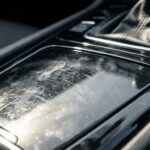
You applied a silica-based sealant, waited the flash time, buffed it off clean — and then it rained. Or a sprinkler hit the car. Now you’re looking at white, hazy mineral deposits sitting on a coating that hasn’t even finished curing yet. You can’t ignore them. But you also can’t just grab any cleaner and go.
This article shows you exactly how to remove calcium carbonate deposits from a silica sealant that is still in its cure window — without stripping the bond you just built.
Key Takeaways
- Most silica (SiO2) sealants need up to 7 full days to develop complete chemical resistance. Anything you apply to the surface during that window can interrupt the curing process if you choose the wrong product.
- Calcium carbonate deposits dissolve at a pH of 3–4. You need a mild acid — nothing stronger, nothing weaker. The sweet spot is narrow and it matters.
- Alkaline cleaners will actively break down the SiO2 bonds while they’re still forming. A single pass with the wrong product can set the cure back significantly or compromise the layer entirely.
Why Fresh Silica Coatings Are Uniquely Vulnerable

Most detailers understand that a silica sealant needs time to cure. What they underestimate is what exactly is happening during that window.
SiO2 sealants cure through a condensation reaction. The silanol groups in the product crosslink with each other and bond to the paint surface, gradually forming a rigid, glass-like network. This process starts the moment you apply the product, but it does not complete in a few hours. In most real-world conditions — standard garage temperatures around 65–75°F and moderate humidity — full chemical resistance takes up to 7 days.
During the first 24–72 hours, that network is still open. The crosslinks are forming but they have not locked in completely. This is where the problem lives.
When mineral-laden water hits the surface and evaporates, it leaves behind calcium carbonate and magnesium-based deposits. These deposits sit on top of the partially cured sealant layer. The temptation is to grab whatever you have under the bench and knock them off. That is exactly where things go wrong.
The Chemistry You Need to Understand Before You Touch the Car
Here is the core conflict you are managing:
Calcium carbonate is alkaline by nature. It does not dissolve in water alone. It requires an acidic environment — specifically a pH between 3 and 4 — to break down efficiently.
Silica sealants, however, are sensitive to alkaline and strongly acidic attack while curing. High-pH cleaners (alkaline degreasers, some all-purpose cleaners, many spray detailers) will interfere with the crosslinking process. They can soften the partially formed SiO2 network and cause premature bond failure.
This creates a specific, narrow target: you need an acid strong enough to dissolve the deposit, but gentle enough not to aggressively attack a sealant that hasn’t fully hardened. A product at pH 3–4 hits that window. Anything below pH 2.5 introduces real risk of etching into the semi-cured layer. Anything above pH 5.5 starts losing effectiveness against calcium carbonate.
Know your product’s pH before you use it. If the label does not list it, contact the manufacturer or test it with a cheap pH strip kit.
What Most People Recommend (And Why It Falls Short)
The common advice floating around detailing forums is to use a diluted white vinegar solution. It’s cheap, it’s available, and it is acidic. In some situations it works fine on fully cured coatings.
The problem on a fresh sealant is consistency. White vinegar typically sits around pH 2.4–2.5, which crosses the line from “mineral dissolving acid” into “potentially damaging acid” when your SiO2 network is still open. The margin for error disappears quickly, especially on thin or lightly applied sealant layers.
The better approach is a purpose-formulated spray detailer or rinse aid that carries a verified pH of 3–4. Several dedicated coating maintenance sprays are engineered precisely for this scenario. They are buffered to stay in the safe zone, they contain no surfactant alkalinity, and they evaporate cleanly without leaving new residue behind.
The Correct Removal Process, Step by Step

What you need:
- A pH-verified mild acid spray (pH 3–4), confirmed safe for use on sealants
- Two clean, soft microfiber towels (one damp, one dry)
- A pH-neutral rinse water source
- Optional: pH test strips to verify your product
Step 1: Do not dry-wipe first. The biggest mistake I see beginners make in the shop is trying to wipe off water spots before rehydrating them. On a freshly coated surface, the crystallized calcium carbonate acts like fine grit. Dragging it across a semi-cured sealant layer without softening it first creates micro-scratches in the coating. Always wet it first.
Step 2: Lightly mist the affected area with your pH 3–4 spray. Let it sit for 30–45 seconds. You are not scrubbing. You are giving the mild acid time to react with the carbonate deposits and soften the bond between the deposit and the sealant surface. The deposit will not visibly dissolve — it just releases its grip.
Step 3: Fold a damp microfiber into quarters and use light, overlapping passes. You should feel almost no resistance. If you feel the towel dragging or catching, the deposit has not fully released. Mist again. Do not apply more pressure to compensate.
Step 4: Follow immediately with a pH-neutral water rinse. This stops the acid action. Do not let the product dry on the surface. On a partially cured sealant, even a pH 3–4 product left to sit and concentrate as it dries could create a local low-pH environment that exceeds your target range.
Step 5: Pat dry with a second clean microfiber. Do not wipe. Light pressure. The sealant surface at day 2 or 3 is not fully hardened. Firm wiping friction generates heat and mechanical stress on a network that hasn’t finished bonding.
Comparing Your Options: Product Selection at a Glance
| Product Type | Typical pH | Safe on Curing SiO2? | Effectiveness on Calcium Carbonate |
|---|---|---|---|
| Alkaline APC (diluted) | 9–11 | No | Poor |
| Spray detailer (unknown pH) | Variable | Risky | Variable |
| White vinegar | ~2.4–2.5 | Marginal risk | Good — but pH too low |
| Purpose-built coating maintenance spray (pH 3–4) | 3–4 | Yes | Good |
| Strong wheel acid cleaner | <2 | No | Excellent — but dangerous |
| pH-neutral car shampoo | ~6–7 | Safe | Ineffective on deposits |
After Removal: Protecting the Cure Window
Once the deposits are off, give the sealant the best possible conditions to finish curing.
- Keep the car dry for at least 24 hours after treatment. The surface is now clean but the sealant is still crosslinking.
- Park indoors or under cover for as much of the 7-day cure window as possible. Sprinkler water, rain, and condensation reintroduce mineral exposure.
- Do not apply any additional product to the coating during this window unless it is specifically listed as cure-safe by the manufacturer. Even some silica-based spray toppers carry enough solvent content to soften a partially cured layer.
- Avoid automated car washes entirely. The high-pH presoak chemicals used in touchless and brush washes are almost universally alkaline. They are exactly what you are trying to avoid.
Timing Matters More Than Most People Realize
| Days Since Application | Sealant State | Safe to Use pH 3–4 Acid Spray? | Risk Level |
|---|---|---|---|
| 0–12 hours | Initial flash, extremely soft | Not recommended | High |
| 12–48 hours | Early crosslinking | Use with caution, minimal dwell time | Moderate |
| 48–96 hours | Active curing, partial hardness | Yes, with proper technique | Low-Moderate |
| 96 hours – 7 days | Late-stage cure | Yes | Low |
| 7+ days | Full chemical resistance achieved | Yes, standard protocol | Minimal |
When you are actually standing over the hood of a car at the 36-hour mark, the sealant still has a faint softness you can almost sense through a very light finger touch near the edge of a panel. This is not the time for aggressive dwell times. Keep your acid spray contact under 45 seconds and rinse immediately.
Frequently Asked Questions
Can I use a clay bar to remove water spots from a freshly coated surface?
No. Clay bars work by physically abrading and pulling contaminants off the surface. On a sealant that is still in the crosslinking phase, clay will mechanically damage the semi-cured layer. Save the clay for bare paint prep, not coating maintenance.
My water spots came back after one treatment. What went wrong?
In most cases, this means the deposit was not fully dissolved before you wiped. The surface looked clear, but a thin calcium residue remained. It then rehydrated with the next morning’s dew and became visible again. Re-treat with a fresh application of your pH 3–4 spray, extend the dwell time to 60 seconds, and use slightly more product to ensure full coverage.
What if I accidentally used an alkaline spray on a 3-day-old sealant?
Rinse it off immediately with clean water, then let the sealant continue to cure. A single short exposure to a mild alkaline product may not destroy the layer entirely, but it will likely reduce long-term durability. Assess the surface after the full 7-day cure is complete. If the coating beads and sheets water normally, the damage was likely minimal. If water sticks flat and spreads, the surface bond was compromised and reapplication is probably necessary.
Is it safe to use a pH 3–4 acid spray on sealants applied over matte or satin finishes?
Depending on the specific matte finish, mild acids can alter the micro-texture that creates the flat appearance. Test in a small, hidden area first. Matte-specific care products often carry different pH buffers designed with this sensitivity in mind, so verify your spray is compatible before full-panel treatment.
Your Next Move
Check the pH of every product you currently have on your shelf. Do it now, before the next job. A $4 pack of pH strips tells you immediately whether a product belongs near a curing sealant. If you don’t have a purpose-formulated coating maintenance spray with a verified pH of 3–4, add one to your kit before you apply your next silica sealant. The 7-day cure window is non-negotiable, and mineral water is not going to wait for the chemistry to finish.
The fix for water spots on fresh sealants is not complicated. It just requires using the right acid at the right concentration, moving gently, and rinsing completely. Get the pH right and the chemistry does the work for you.