
You are minutes away from laying down a ceramic coating or paint protection film, and you reach for the isopropyl alcohol. Stop. The bottle in your hand could be the single thing that ruins the surface you just spent four hours correcting.
Using the wrong IPA concentration on bare clear coat does not just leave a residue. It physically swells the clear coat, causes hazing, and creates a compromised surface that no coating can bond to properly. This article gives you the exact math, the exact method, and the reasoning behind why the industry settled on one specific dilution window.
Key Takeaways
- 100% isopropyl alcohol is a direct threat to modern automotive clear coats. Undiluted IPA causes swelling and hazing that you cannot always see until the coating flashes — and by then, it is too late.
- The industry-accepted safe dilution is 15% to 25% IPA mixed with distilled water. This range removes polish oils and contamination without attacking the clear coat binder.
- Evaporation rate is the hidden variable that makes this dilution work. At 15–25%, the solution evaporates fast enough to prevent moisture entrapment beneath the coating layer.
Why Pure IPA Is the Wrong Tool for the Job
Most beginners assume that stronger means cleaner. A 99% IPA solution feels aggressive, cuts through oils fast, and flashes off quickly. It seems perfect.
It is not.
Modern automotive clear coats — particularly the soft, flexible urethane clears used on European and Japanese vehicles — are chemically reactive to concentrated alcohol. When undiluted IPA contacts the clear coat surface, it penetrates the top layer and causes the polymer chains to absorb it unevenly. The result is localized swelling. You will see this as a milky haze, a slightly frosted texture, or under certain lighting, a surface that looks like it has fine texture where there was none before.
This is not a myth or an exaggeration. It is a documented behavior in how urethane chemistry responds to high-concentration solvents.
The worst part? This swelling can be subtle. You wipe the panel, it looks clean, you apply the coating — and two hours later under direct sunlight, you are chasing a hazy panel that should have been perfect.
The 15–25% Rule: What It Means in Real Numbers
The safe operating window is 15% to 25% IPA by volume, with the remainder being distilled water. Tap water is not acceptable here. Municipal water contains minerals and chlorides that leave ionic contamination on the surface — exactly what you are trying to eliminate before coating.
Here is how the math translates into practical mixing:
| Target Dilution | IPA (mL) | Distilled Water (mL) | Total Volume |
|---|---|---|---|
| 15% | 75 mL | 425 mL | 500 mL |
| 20% | 100 mL | 400 mL | 500 mL |
| 25% | 125 mL | 375 mL | 500 mL |
| 20% | 200 mL | 800 mL | 1,000 mL |
| 25% | 250 mL | 750 mL | 1,000 mL |
Mix in a clean spray bottle — preferably chemical-resistant HDPE — and label it clearly. Do not eyeball this. A $2 measuring cup removes all guesswork.
For most modern vehicles with soft clear coats, 15–20% is the correct target. The 25% end of the range is more appropriate for harder, older OEM clear coats or for cutting through heavier polish residue after aggressive compounding. When in doubt, go lower.
Why Distilled Water Does Not Ruin the Flash-Off
A common concern is this: “If I add water, won’t I trap moisture under the coating?”
It is a fair question. The answer is no — provided you are working within normal garage temperatures (roughly 60°F to 85°F / 15°C to 29°C) and you allow adequate flash time.
At 15–25% concentration, the IPA content controls the evaporation behavior of the entire solution. IPA has a significantly lower boiling point than water (around 180°F vs. 212°F), and in a diluted solution, it drives the evaporation of the water alongside it through a process called azeotropic behavior. In plain terms, the IPA pulls the water off the surface with it as it evaporates.
At standard workshop temperatures, a properly applied IPA wipe on a panel will flash fully dry within 60 to 90 seconds. You do not need to bake the panel or fan it aggressively. A single light pass with a clean microfiber to remove the solution, followed by a 60-second wait, is sufficient before coating application in most cases.
This is where cold shop conditions matter. Below 55°F (13°C), evaporation slows considerably. If you are working in an unheated garage in winter, give the panel 2 to 3 minutes of flash time minimum, or use a heat gun on low from 12–18 inches away to gently assist evaporation. Do not rush this step.
How to Actually Do the Wipe-Down: Panel by Panel

Technique matters as much as dilution ratio. A correct mixture applied the wrong way still leaves contamination.
What you need:
- Your 15–25% IPA solution in a labeled spray bottle
- Two clean, low-pile microfiber cloths per panel (one wet application cloth, one dry follow-up cloth)
- A well-lit, dust-controlled workspace
The two-cloth method:
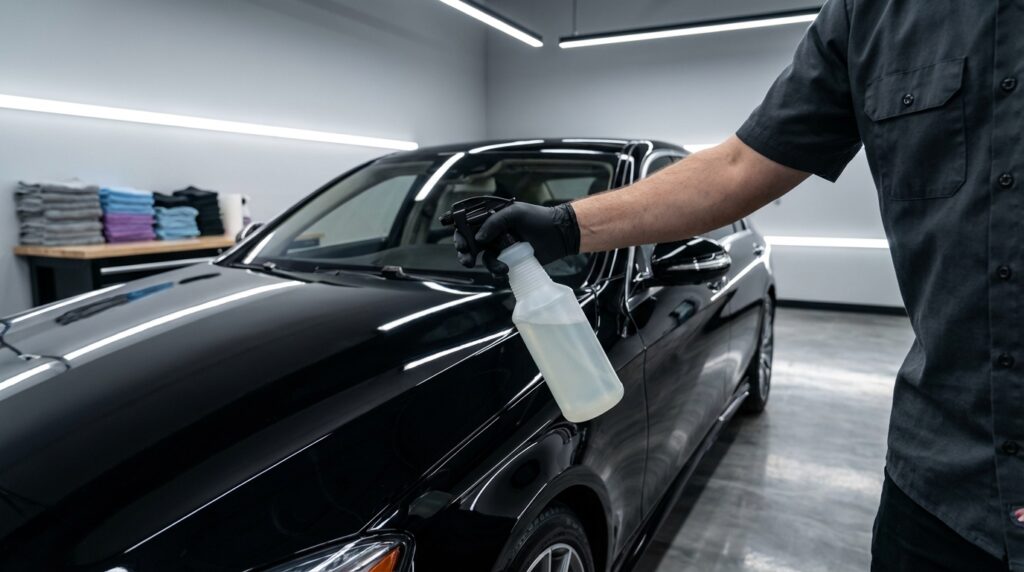
- Mist the panel section lightly — do not soak it. Two to three sprays for a door panel is plenty.
- With your first microfiber, wipe in straight, overlapping passes. Use moderate pressure. The cloth should feel slightly damp, not dripping.
- Immediately follow with the dry second microfiber. Wipe in the same direction. This picks up any solution before it can pool at panel edges or trim lines.
- Wait 60–90 seconds. Look at the panel under a LED or halogen light at a low angle. The surface should look completely uniform — no streaks, no wet spots, no oily reflection.
The biggest mistake I see beginners make in the shop is wiping the entire car with one cloth until it is visibly dirty, then doing a single follow-up pass and calling it done. By panel three, that cloth has collected enough polish oil to re-deposit contamination on every panel after it. Use fresh microfibers. This is not optional.
Soft Clear Coat vs. Hard Clear Coat: Does It Change the Ratio?
Not significantly — but it changes your margin for error.
| Clear Coat Type | Examples | IPA Tolerance | Recommended Dilution |
|---|---|---|---|
| Soft / Flexible Urethane | BMW, Mercedes, Porsche, most modern JDM | Low | 15–18% |
| Medium Hardness | Most domestic OEM (Ford, GM, Chrysler) | Moderate | 18–22% |
| Harder / Older Clear | Pre-2005 vehicles, some fleet coatings | Higher | 20–25% |
| Matte / Satin Clear | Factory matte finishes | Very Low | 10–15% |
Matte and satin clear coats deserve special attention. These surfaces achieve their appearance through micro-texture in the clear coat. Concentrated IPA can smooth or distort that texture, changing the finish appearance. Stay at 10–15% for matte panels, and verify compatibility on a test area first.
What a Bad IPA Wipe Actually Looks Like

When you are standing over the hood of a car under proper inspection lighting, contamination looks like a slight variation in gloss across the panel — almost like an uneven sheen. Polish oil residue gives the surface a mild glow in reflected light that should not be there.
A good IPA wipe produces a panel that looks almost clinical. The reflection should be sharp, uniform, and consistent edge to edge. No variation. No soft spots. If you see any inconsistency, wipe the area again with a fresh cloth and fresh solution.
If the panel came out of heavy compounding, do not skip an intermediate decontamination step. One IPA wipe may not be sufficient after aggressive cutting compound use. Two passes — allowing full flash time between them — is a reasonable protocol for heavily corrected surfaces.
FAQs
Can I use 70% rubbing alcohol from the pharmacy instead of 99% lab-grade IPA?
No. Pharmacy-grade 70% isopropyl alcohol contains additives and denaturants that leave residue on automotive surfaces. It also contains tap water in most formulations. Always use 99% pure isopropyl alcohol as your starting point, then dilute it yourself with distilled water to reach the 15–25% target.
How long does a mixed IPA solution stay usable in a spray bottle?
In a sealed HDPE spray bottle, a properly mixed solution stays effective for several weeks. IPA does not expire quickly. The main risk is contamination — if you spray it on a dirty cloth or backwash into the bottle, it is compromised. Label the bottle with the mix date and dilution percentage.
Should I wipe down the car in direct sunlight?
No. Direct sunlight heats the panel surface, which causes the IPA solution to flash off unevenly and can leave streaking across the clear coat. Work in the shade or indoors. Panel surface temperature should be below 90°F (32°C) for a clean, consistent wipe-down result.
Is one IPA wipe-down enough, or should I do multiple passes?
For a lightly contaminated panel after light polishing, one thorough pass with the two-cloth method is sufficient in most cases. After heavy compounding, do two passes with full flash time in between. If your microfiber cloth picks up visible yellow or brown residue on the second pass, do a third. Stop when the cloth comes away clean.
Your Next Step Is Simple
Mix your solution before your next detail session — not during it. Pre-mix a 500 mL bottle at 20% IPA and label it. Test the wipe process on a single door panel before moving to the full vehicle. Watch for haze under inspection light after the panel flashes. If the surface looks clean and uniform, your process is dialed in.
Get the dilution right once. Do it the same way every time after that.