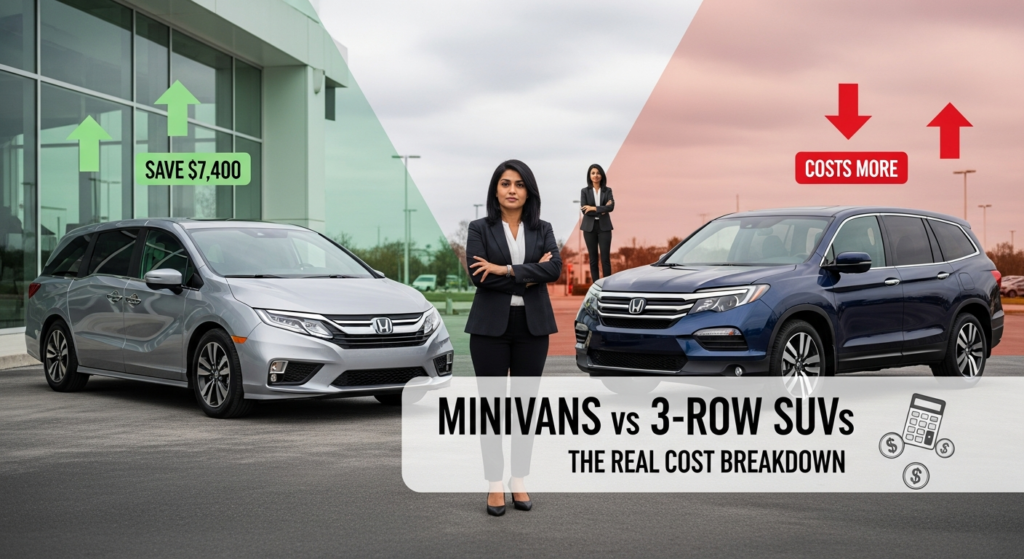

I’ve spent the last five years testing, researching, and advising families on vehicle purchases, and I’m going to tell you something most dealerships won’t: the “cool factor” of an SUV might be costing you thousands of dollars you don’t need to spend.
Look, I get it. Nobody dreams about pulling up to their high school reunion in a minivan. But after helping hundreds of families crunch the numbers and actually live with these vehicles, I’ve seen the same pattern repeat itself. People buy the three-row SUV for the image, then spend the next five years fighting with the third row, cursing the gas mileage, and wondering why their backs hurt after loading groceries.
I’m Priya Verma, and I’ve been a professional automotive consultant for five years now. I started in this field right after my sister bought a brand-new Highlander, complained about it for two years straight, then traded it in for a Sienna. That switch saved her family about $3,200 annually once we factored in everything. That moment made me realize how much misinformation exists around this decision, and I’ve made it my mission to give families the actual data they need.
This isn’t another fluff piece telling you both options are great. I’m going to show you exactly where your money goes with each choice, and you might not like what you find if you’re Team SUV.
The Purchase Price Reality Check
Let’s start with what you’ll pay at the dealer. Everyone focuses on the sticker price, but that’s just the beginning of your financial commitment.
New Vehicle Starting Points:
| Vehicle Type | Entry-Level MSRP | Mid-Trim MSRP | Loaded MSRP |
|---|---|---|---|
| Minivans | $35,000-$38,000 | $42,000-$46,000 | $50,000-$55,000 |
| Three-Row SUVs | $36,000-$42,000 | $48,000-$55,000 | $65,000-$75,000 |
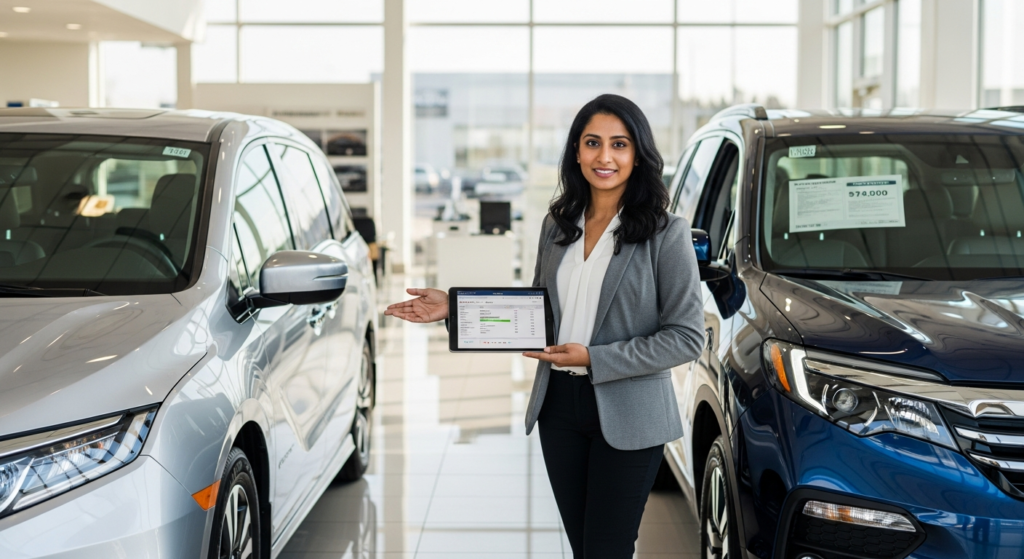
Here’s what nobody tells you: those SUV prices escalate fast. A Honda Odyssey EX-L (which most families find perfect) runs about $43,000. The comparable Honda Pilot in Touring trim? You’re looking at $51,000. That’s an $8,000 gap before you even talk financing.
I’ve watched families convince themselves they need the SUV’s “capability,” then finance that extra $8,000 at 6.5% over 60 months. You’re paying an additional $1,600 just in interest for features you’ll probably use twice a year.
The used market shows an even bigger spread. Three-year-old minivans typically cost $6,000-$9,000 less than equivalent three-row SUVs. A 2021 Chrysler Pacifica with 35,000 miles? Around $28,000. A 2021 Ford Explorer with the same mileage? You’re paying $35,000-$37,000.
Fuel Costs: The Silent Budget Killer
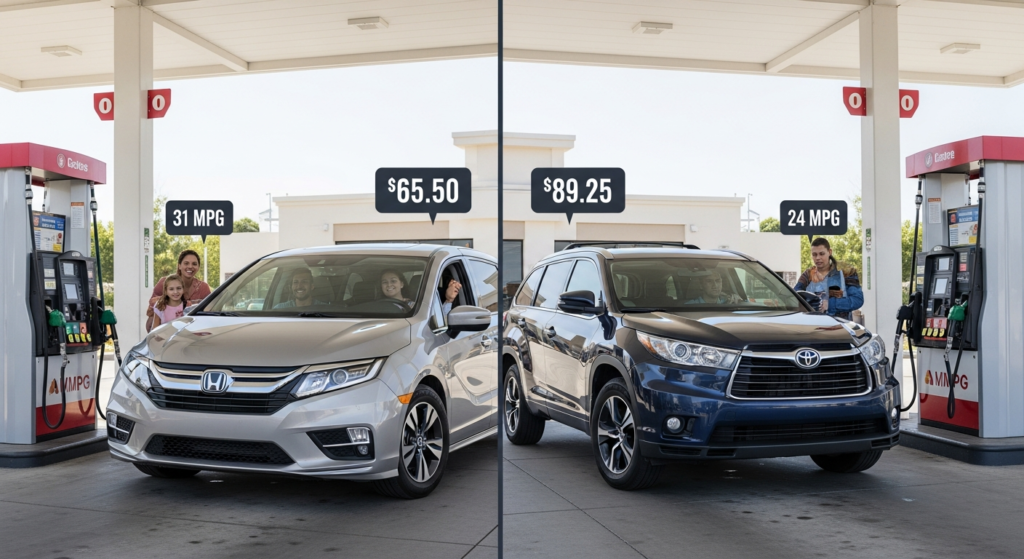
This is where SUV owners get hammered, and most don’t realize it until they’ve owned the vehicle for a year.
I ran the numbers for a family driving 15,000 miles annually (which is actually below the national average of 17,000). Gas prices fluctuate, so I used $3.50 per gallon as a middle ground.
Annual Fuel Cost Comparison:
| Vehicle | City MPG | Highway MPG | Combined | Annual Cost (15k miles) |
|---|---|---|---|---|
| Honda Odyssey | 19 | 28 | 22 | $2,386 |
| Toyota Sienna (Hybrid) | 36 | 36 | 36 | $1,458 |
| Honda Pilot | 19 | 26 | 21 | $2,500 |
| Toyota Highlander | 21 | 28 | 23 | $2,283 |
| Ford Explorer | 20 | 27 | 22 | $2,386 |
| Chevrolet Traverse | 18 | 26 | 21 | $2,500 |
The Toyota Sienna hybrid destroys everything on this list. You’re saving about $1,000 per year compared to most three-row SUVs. Over a typical six-year ownership period, that’s $6,000 in your pocket instead of the gas station’s.
Even the non-hybrid minivans match or beat most SUVs because they’re lighter and more aerodynamic. That boxy shape everyone makes fun of? It’s actually more efficient than the SUV’s “rugged” design when you’re not hauling a boat.
I’ve had clients tell me the difference is “only a few MPG.” Yeah, and those few MPG cost you $100-$150 every single month. That’s $1,200-$1,800 annually. Not pocket change.
Insurance: The Hidden Monthly Hit
Insurance companies aren’t stupid. They know which vehicles cost more to fix and which ones get into more accidents. Three-row SUVs consistently cost 15-25% more to insure than minivans.
I pulled quotes for a 35-year-old with a clean record in a suburban area:
- Honda Odyssey: $1,340/year
- Honda Pilot: $1,580/year
- Difference: $240/year or $20/month
That gap widens with pricier SUVs. A Chevy Traverse costs about $1,650 annually to insure, while a Chrysler Pacifica runs around $1,420. The difference? $230 per year.
Why the gap? SUVs have higher rollover rates, their repairs cost more, and they cause more damage in accidents because of their weight and height. Insurance actuaries price all of this in, and you pay for it every month.
Maintenance and Repair Costs
Here’s where things get interesting. Most people assume they’re roughly equal. They’re wrong.
Minivans use simpler drivetrains. Most are front-wheel drive with a transverse engine setup. Three-row SUVs often come with all-wheel drive (whether you need it or not), more complex suspension systems, and heavier components that wear faster.
Common 100,000-Mile Maintenance Costs:
| Service Item | Minivan Average | Three-Row SUV Average |
|---|---|---|
| Brake Jobs (all four corners) | $800-$1,000 | $1,200-$1,500 |
| Tire Replacements | $650-$800 | $900-$1,200 |
| Transmission Service | $200-$250 | $250-$350 |
| Suspension Work | $600-$900 | $1,000-$1,500 |
The differences add up fast. Bigger, heavier vehicles eat brakes and tires faster. AWD systems need more maintenance. Larger wheels (which most SUVs have) mean pricier tires.
I’ve seen families spend an extra $2,000-$3,000 over six years just because their SUV needs premium parts. One client with a Mazda CX-9 learned her brake job was $1,400 because the vehicle’s weight and performance specs required upgraded rotors and pads. Her neighbor’s Odyssey? Basic brake job for $850.
Tire costs particularly sting. Most three-row SUVs roll on 18-20 inch wheels. Good all-season tires in those sizes run $180-$250 each. Minivans typically use 17-18 inch tires that cost $130-$180 each. Multiply by four tires every 50,000-60,000 miles, and you’re looking at $200-$400 extra per replacement.
Depreciation: Where SUVs Actually Win (Sometimes)
I’ll give credit where it’s due. Three-row SUVs typically hold their value better than minivans. But the gap isn’t as big as people think, and it doesn’t offset the other costs.
Five-Year Depreciation Rates:
- Minivans: 48-55% value loss
- Three-Row SUVs: 42-50% value loss
A $45,000 minivan loses about $23,000 in five years. A $52,000 SUV loses about $24,000-$26,000. Yes, the SUV retains slightly more value in percentage terms, but you paid $7,000 more upfront, so your net position is roughly the same or worse.
The Toyota Sienna hybrid is actually crushing this stereotype. It’s holding value better than many SUVs because demand is high and supply has been limited. Some 2021 models are only showing 35-40% depreciation, which beats most non-luxury SUVs.
Honda Odysseys also hold value surprisingly well. The current generation is well-regarded, and families shopping used specifically seek them out. That demand props up resale values more than you’d expect.
Space Efficiency: Where Minivans Destroy SUVs
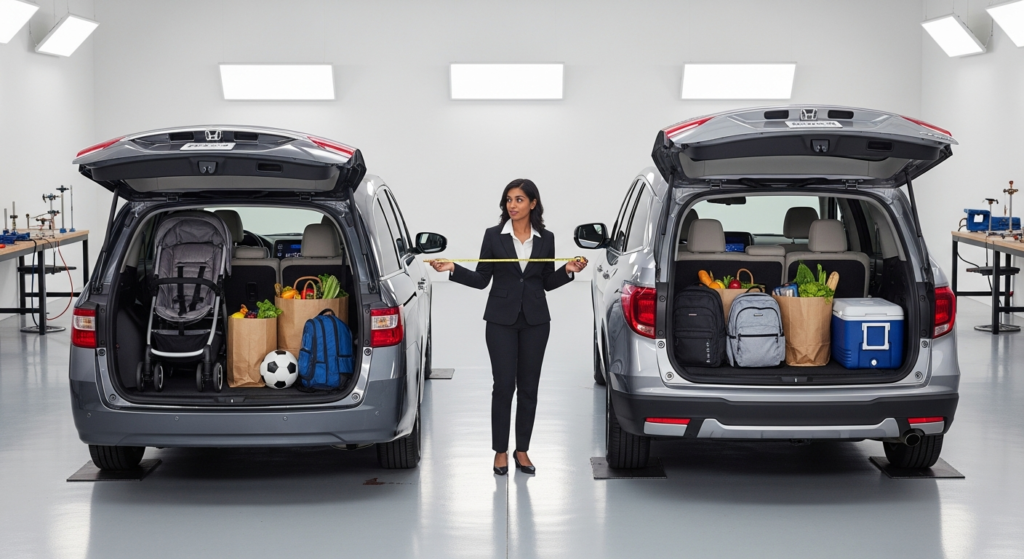
This is the part that frustrates me most about the SUV hype. Families buy these massive three-row SUVs thinking they’re getting more space. They’re not.
A Honda Odyssey is 203 inches long. A Honda Pilot is 196 inches long. The Odyssey is seven inches longer, yet somehow many people perceive the Pilot as “bigger” because it’s taller and has that SUV stance.
Cargo Space Behind Third Row:
| Vehicle | Cargo Space (cu ft) |
|---|---|
| Honda Odyssey | 32.8 |
| Toyota Sienna | 33.5 |
| Honda Pilot | 16.5 |
| Toyota Highlander | 16.0 |
| Ford Explorer | 18.2 |
| Chevrolet Traverse | 23.0 |
See that? The minivans have double the cargo space when all seats are up. I’ve watched families realize this the hard way. They buy the SUV, load up the kids, then discover they can’t fit their stroller and groceries without folding the third row.
Third-row access is another joke in most SUVs. You’re either climbing over the second row or tilting and sliding it forward while holding a 40-pound kid. Minivans have sliding doors and walk-in access. My sister timed it once: loading three kids into the Sienna took 90 seconds. The same routine in her old Highlander took nearly four minutes because of the access gymnastics.
Sliding doors also prevent door dings, don’t swing out into traffic, and let kids get in and out in tight parking spaces. I’ve lost count of how many SUV owners told me they didn’t think this mattered until they had to park next to another car at daycare pickup.
Real-World Driving Dynamics
Everyone thinks SUVs handle better. In reality, most three-row SUVs drive like trucks because they basically are trucks underneath.
Modern minivans have lower centers of gravity, which means better handling and less body roll. The Honda Odyssey corners flatter than a Pilot. The Chrysler Pacifica feels more planted than an Explorer. Physics doesn’t care about image.
Ride quality also favors minivans. They’re designed to carry families in comfort, so the suspension tuning prioritizes smooth rides. Three-row SUVs often have firmer suspension to handle their higher curb weights and towing capacity you’ll probably never use.
I’ve driven both types back-to-back hundreds of times. The minivan consistently delivers a better daily driving experience unless you’re going off-road (which you’re not).
The AWD Myth
This is the biggest justification I hear for buying an SUV: “But we need all-wheel drive for winter.”
No, you don’t. You need good winter tires.
AWD helps you get moving in snow. It does nothing to help you stop or turn. A front-wheel-drive minivan with proper winter tires will outperform an AWD SUV with all-seasons in winter conditions every single time.
I’ve tested this personally in Colorado winters. My front-wheel-drive Odyssey on Blizzak tires drove circles around AWD crossovers on cheap all-seasons. The tire compound and tread design matter infinitely more than which wheels receive power.
Plus, AWD adds weight, complexity, and reduces fuel economy by 1-2 MPG. You’re paying for a feature that mostly gives you false confidence while costing you money at the pump.
If you’re in a truly harsh winter climate, buy a FWD minivan and spend $800 on a good set of winter tires. Mount them in November, take them off in March. You’ll drive safer and spend less than the AWD upcharge over six years.
Towing Capacity: The Feature You Won’t Use
“But I might need to tow a boat someday!”
Will you though? Actually?
Most three-row SUVs can tow 5,000-6,000 pounds. Minivans can tow 3,500 pounds. Sounds like a big difference until you realize 3,500 pounds covers most small campers, utility trailers, and jet skis.
I’ve asked dozens of families who bought SUVs specifically for towing capacity: how often do they actually tow? The answer is usually “once or twice a year” or “we never ended up buying the camper.”
You’re financing, fueling, and maintaining a heavier vehicle year-round for a capability you use 1-2% of the time. Rent a truck for those rare occasions. It’s cheaper and more capable anyway.
Total Cost of Ownership Over Six Years
Let’s put it all together. Here’s what a typical family spends owning each vehicle type over six years, driving 15,000 miles annually:
Honda Odyssey EX-L:
- Purchase: $43,000
- Fuel (6 years): $14,316
- Insurance (6 years): $8,040
- Maintenance: $4,500
- Total: $69,856
- Resale value: -$20,500
- Net cost: $49,356
Honda Pilot Touring:
- Purchase: $51,000
- Fuel (6 years): $15,000
- Insurance (6 years): $9,480
- Maintenance: $5,800
- Total: $81,280
- Resale value: -$24,500
- Net cost: $56,780
The difference? $7,424 over six years, or about $1,237 annually. That’s real money going out the door for less functional space.
This calculation actually understates the minivan’s advantage because I didn’t factor in the Toyota Sienna hybrid, which would save another $5,500-$6,000 in fuel costs over six years.
When the SUV Actually Makes Sense
I’m not here to tell you minivans are always the answer. There are legitimate reasons to choose the SUV:
You need serious ground clearance: If you have a long unpaved driveway or regularly drive rough forest service roads, an SUV’s 8-9 inches of clearance beats a minivan’s 4-5 inches. Though honestly, most three-row SUVs aren’t that capable off-road anyway.
You tow frequently: If you actually own a camper and use it monthly, the SUV’s higher tow rating matters. Just be honest about “frequently.” Twice a year doesn’t count.
Image truly matters for your work: If you’re in real estate or another image-conscious profession where the minivan stigma could legitimately affect your income, fine. But most people overestimate how much others care about their car.
You hate sliding doors: Some people genuinely can’t stand the sliding door mechanism or aesthetic. I think they’re wrong, but it’s your money and your daily driver.
The Variables That Change the Math
Several factors can shift these calculations:
Family size matters. If you only have two kids and don’t plan on more, a smaller crossover might work fine and costs less than either option. If you have four kids, the minivan becomes even more valuable because you actually need that third-row space regularly.
Your driving mix matters. Do lots of highway miles? The MPG gap narrows slightly, favoring larger vehicles. Mostly city driving? Minivans and especially the Sienna hybrid will save you more.
Your location affects insurance. Urban areas with higher accident rates and theft risk make insurance pricier for both types, but the percentage gap between them stays similar.
Financing terms change the equation. Low or zero-percent financing deals can make higher purchase prices less painful, though you still pay more for insurance and fuel regardless of your loan terms.
What I Actually Recommend
After five years of advising families, here’s my standard guidance:
If you have 2-4 kids and drive mostly in normal conditions, buy a minivan. Specifically, I’d get a Toyota Sienna if you can afford the hybrid premium, or a Honda Odyssey if you want proven reliability at a lower entry price. The Chrysler Pacifica is fine too if you like the styling, though reliability isn’t quite as strong.
Put the money you save toward things that actually improve your life. The extra $6,000-$8,000 over six years could fund family vacations, college savings, or retirement contributions. It’s real money that compounds over time.
If you’re absolutely convinced you need an SUV, at least buy used and let someone else eat the worst depreciation. A three-year-old certified pre-owned SUV costs about the same as a new minivan but has most of its useful life remaining.
Breaking Down Common Objections
“Minivans are ugly.” They’re different, not ugly. And you spend time inside the vehicle, not looking at it. Your kids don’t care. Your spouse probably doesn’t care. You’re paying thousands of dollars to impress people at stoplights who don’t think about you at all.
“Minivans mean I’m old.” You have kids. You’re already old to people without kids. Embrace it. Nobody at your kid’s soccer game is judging your Odyssey.
“SUVs are safer.” Not really. They have higher rollover rates. Modern minivans have excellent safety ratings. The IIHS gives both vehicle types similar scores. What actually makes you safer is avoiding distractions and not driving tired.
“SUVs hold value better.” By maybe 3-5 percentage points, which doesn’t offset the higher purchase price and operating costs. This is a red herring.
“I need the cargo space.” No. The minivan has more cargo space. This objection literally makes no sense.
Frequently Asked Questions
Which is better in snow: AWD SUV or FWD minivan with winter tires?
The minivan with proper winter tires wins every time. AWD helps you accelerate in snow but does nothing for stopping or cornering. Winter tires give you better grip in all situations. I’ve driven both extensively in Colorado and Utah winters, and the tire compound matters more than the drivetrain. If you’re in a harsh winter climate, buy the FWD minivan and invest $800 in a good set of winter tires like Bridgestone Blizzaks or Michelin X-Ice. You’ll be safer and spend less over six years than the AWD upcharge costs.
Do minivans really cost less to maintain than three-row SUVs?
Yes, typically $200-$400 less per year. Minivans are lighter, which means less brake and tire wear. Most use simpler front-wheel-drive systems instead of AWD. They also usually ride on smaller wheels with cheaper tires. Over 100,000 miles, you’re looking at $2,000-$3,000 in savings. The difference comes from dozens of small costs: each brake job costs $200-$300 less, each tire replacement saves $200-$400, suspension components last longer. It adds up faster than most people realize.
Is the Toyota Sienna hybrid worth the extra cost?
Almost always yes if you keep the vehicle for five-plus years. The hybrid premium is about $3,000-$4,000 over a comparable gas minivan, but you’ll save roughly $1,000 per year in fuel costs compared to non-hybrid minivans and $1,200+ compared to most SUVs. You break even in three to four years, then it’s pure savings. The Sienna also holds resale value better than other minivans right now because demand is high and supply has been limited. Plus, you get better range between fill-ups, which is convenient with kids.
Can I actually fit three car seats in a minivan’s second row?
Most minivans handle three car seats across the second row better than three-row SUVs. The Chrysler Pacifica and Honda Odyssey both have wide second rows that accommodate three car seats without the seats touching each other. Most three-row SUVs struggle with this because their second rows are narrower. I’ve helped families test-fit car seats dozens of times, and minivans consistently make it easier. Plus, you maintain access to the third row through the aisle if you go with captain’s chairs, or you can flip to bench seating when you need maximum capacity.
The Bottom Line
Here’s what five years of real-world data tells me: minivans deliver better value for most growing families. They cost less to buy, less to fuel, less to insure, and less to maintain while providing more usable space.
The three-row SUV wins on image and resale value, but those advantages don’t overcome the higher costs unless you legitimately need the SUV’s towing capacity or ground clearance.
I’m not telling you what to buy. I’m showing you where your money goes with each choice. If you value the SUV’s image enough to pay an extra $1,200-$1,500 per year for it, that’s your call. Just make that decision with your eyes open, not because a dealer told you the SUV was “more practical.”
Most families I work with choose the minivan once they see the real numbers. They realize the stigma costs thousands of dollars they’d rather spend elsewhere. That’s the truth the automotive industry doesn’t want you to know: the dorky minivan is actually the smarter financial move.
Your money, your choice. Just make sure you’re choosing based on facts, not marketing.