
You’ve got a car wearing a degraded polymer sealant. It’s streaky, contaminated, and past its protective life. Before any corrective work, that layer needs to come completely off. The problem? Most people either under-strip with a regular car shampoo, or they reach for Dawn dish soap and cause a different set of problems entirely.
This article gives you the exact formulation — pH range, APC ratio, and mixing method — to chemically strip old waxes and polymer sealants from your paint safely and completely.
Key Takeaways
- Dawn dish soap is not a safe shortcut. Its aggressive degreasers do strip sealants, but they also leach moisture from rubber seals and exterior plastic trim, leaving them brittle and faded over time.
- A proper strip-wash uses a high-pH shampoo (pH 9–10) combined with 2 oz of APC per 5 gallons of water. This combination breaks down the aliphatic resin chains in polymer sealants without the collateral damage.
- pH matters more than suds. A product that lathers like a bubble bath can still leave behind sealant residue if its pH isn’t high enough to attack resin bonds.
Why Your Regular Shampoo Won’t Do the Job

Most standard car shampoos sit between pH 6 and pH 8 — roughly neutral. That range is engineered to clean dirt and road grime without disturbing whatever protection sits beneath. That’s a feature, not a bug, for weekly maintenance washing.
It becomes a problem when you’re trying to remove the protection.
Polymer sealants bond to paint through aliphatic resin chemistry. These resins are resistant to water and mild detergents by design. A neutral-pH shampoo will clean the surface of the sealant, not the sealant itself. You’ll pull the car out of the wash bay and it will still bead water. The old, degraded layer is still right there.
You need something that actually breaks that resin structure apart. That requires alkalinity.
Why Dawn Dish Soap Is the Wrong Tool

Dawn gets recommended constantly in beginner forums and YouTube comment sections. The logic sounds reasonable: it’s strong, it strips grease, it’s cheap.
Here’s the problem. Dawn contains concentrated degreasing surfactants designed to cut through cooked-on food fats. Those same surfactants are aggressive enough to strip the natural oils and plasticizers from rubber door seals, window gaskets, and unpainted plastic trim panels.
The biggest mistake I see beginners make in the shop is treating “harsh enough to strip wax” and “safe for the entire vehicle” as the same requirement. They are not. You can strip a sealant without burning rubber.
After a few Dawn washes, black rubber trim turns gray. Gaskets lose flexibility. The damage isn’t always visible immediately, but it compounds. On a newer car, that’s an expensive and unnecessary problem to create.
The Correct Strip-Wash Formulation

This is the formulation that actually works without the side effects:
Base Formula (per 5-gallon wash bucket):
| Component | Amount | Purpose |
|---|---|---|
| High-pH automotive shampoo (pH 9–10) | Per product label | Breaks aliphatic resin bonds in polymer sealants |
| All-Purpose Cleaner (APC) | 2 oz | Boosts surfactant aggression; cuts residual oils |
| Water (room temp or slightly warm) | Fill to 5 gallons | Dilution carrier and activation medium |
The high-pH shampoo does the heavy lifting. An automotive shampoo formulated at pH 9–10 is alkaline enough to attack the resin structure of polymer sealants while being buffered to stay safe on clear coat and surrounding surfaces. It is not the same as dish soap. The buffering is the critical difference.
The 2 oz of APC acts as a secondary surfactant boost. It helps break down any oily residue left behind by degraded wax or sealant, and it assists the shampoo in reaching into texture and panel gaps where resin can hide. Do not exceed this ratio thinking more will work faster — you’ll push the mix into territory that gets close to the same trim-damage risk you were trying to avoid.
Choosing the Right High-pH Shampoo
Not every product that markets itself as a “strip wash” or “prep shampoo” actually hits the pH 9–10 range. Some sit at pH 8.5 and underperform. Others are marketed as “heavy-duty” but use fragrance-heavy formulas that don’t prioritize actual chemistry.
What to look for:
- Published pH on the label or product data sheet. Any reputable brand will list this. If it’s not published, that’s a red flag.
- “Wax-stripping” or “pre-polish” labeling. This indicates the formula was built for this purpose.
- No conditioning agents or “paint gloss enhancers” in the formula. These are designed to leave something behind on the paint — the opposite of what you want before polishing.
Specific product names shift with availability and regional distribution, so look at the data sheet, not the marketing copy.
Choosing the Right APC
All-purpose cleaners vary widely in concentration and pH. For this application, you want an APC in the pH 10–11 range at full concentration that dilutes safely when added at 2 oz to 5 gallons of water.
A few practical rules:
- Read the dilution chart. Most APCs are sold as concentrates. At 2 oz per 5 gallons, you’re working with a very low dilution ratio. An APC that’s pH 13 at full concentration can still be pH 9.5 at this dilution — totally appropriate.
- Avoid citrus-heavy APCs for this task. Citrus solvents can leave a film that interferes with subsequent paint inspection under lighting.
- Water-based, surfactant-forward APCs work best here. You’re not dissolving tar or adhesive. You’re amplifying the shampoo’s surfactant action.
How to Mix and Apply It Correctly
The order of mixing matters. Add your APC to the bucket first, then add your high-pH shampoo, then fill with water. This prevents the APC from sitting undiluted against any surface.
Step-by-step:

- Add 2 oz of APC to the bottom of your empty wash bucket.
- Add the high-pH shampoo per label instructions (typically 1–2 oz per 5 gallons, but check your product).
- Fill with water at a moderate stream to generate foam and mix thoroughly.
- Let the bucket sit for 60 seconds before using — this gives the chemicals time to fully integrate.
When you apply this to the car, work panel by panel. Don’t let it sit on the surface for extended periods in direct sunlight or on hot paint. In most cases, one to two minutes of dwell time is enough. The goal is chemical action, not soak time.
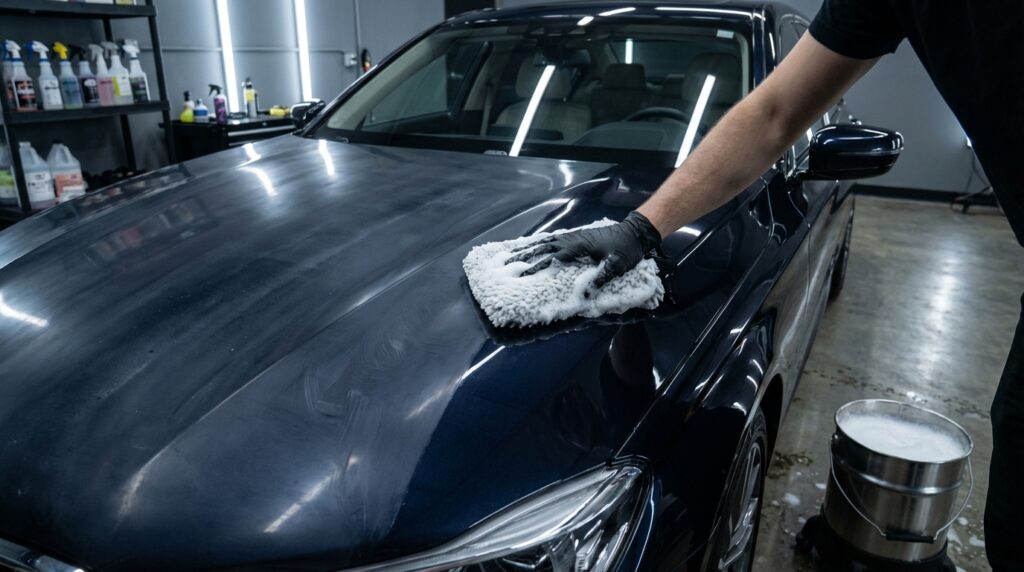
The wash mitt will feel different on stripped paint. As the sealant breaks down, the surface starts to feel slightly draggy or rough under the mitt compared to the slick feel of an intact wax layer. That texture change tells you the stripping action is working.
Rinse fully. Residual alkaline chemistry left behind will interfere with whatever you apply next, whether that’s a fresh sealant, a coating primer, or a correction product.
How to Confirm the Strip Was Successful
Visual inspection alone isn’t enough. A panel can look clean and still have residual sealant resin in low spots and texture. Use these two checks:
The Water Sheet Test: After rinsing and before drying, run fresh water slowly across a horizontal panel. Properly stripped paint will sheet water with no beading or discrete droplets. If water still beads, the sealant is still there — partially or fully.
The Isopropyl Wipe Test: Wipe a clean panel with a 70% isopropyl alcohol solution on a fresh microfiber. If the microfiber picks up any color, haze, or residue, the strip wasn’t complete. A clean wipe on a clean microfiber means you’re ready for the next step.

Run both checks before moving forward. Do not skip the IPA wipe — it catches what the water test misses.
Strip-Wash vs. Clay vs. Chemical Decontamination: What Each One Actually Does
These three processes get confused constantly. They are not the same and they don’t replace each other.
| Process | What It Removes | What It Does NOT Remove |
|---|---|---|
| Strip-wash | Waxes, polymer sealants, light oils | Bonded iron particles, paint overspray, tar |
| Clay bar / clay mitt | Bonded surface contamination (iron, fallout, overspray) | Sealants, waxes, deep oxidation |
| Chemical decontamination (iron remover, tar remover) | Iron fallout, tar, industrial deposits | Waxes, sealants |
A full prep sequence before correction work runs: strip-wash first, then chemical decon, then clay. In that order. The strip-wash opens the surface so decontamination chemicals can work directly on the paint rather than through a sealant film.
Frequently Asked Questions
Can I use a strip-wash on a car that has a ceramic coating instead of a sealant?
A properly cured ceramic coating will not be removed by a pH 9–10 strip-wash. Ceramic coatings bond through a silica matrix that is far more chemically resistant than polymer sealants. If you’re trying to remove a ceramic coating, a strip-wash is not the right tool. That requires dedicated ceramic coating remover products or machine polishing.
How often can I do a strip-wash without damaging the clear coat?
The clear coat itself is not the concern — a buffered high-pH shampoo at pH 9–10 is safe on automotive clear coat. The more relevant limit is on surrounding rubber and trim. In most cases, once per preparation cycle (before polishing or recoating) is the intended use. It’s not a routine maintenance wash formula.
My sealant still beads after two strip washes. What am I doing wrong?
Check your shampoo’s actual pH. If you’re using a product that markets itself as a strip wash but sits at pH 8.5 or below, it may not be aggressive enough for thicker or newer polymer sealants. Verify the pH with a paper test strip or a digital pH meter, and confirm your APC is actually mixing into the bucket properly before use.
Does water temperature affect how well the strip-wash works?
Slightly warm water (not hot) activates surfactants more efficiently than cold water. In most shop environments, water around 70–80°F gives you better chemical activity than cold tap water at 50°F. Hot water above 110°F can cause the shampoo to lose foam structure too quickly and shorten dwell time on vertical panels before you’ve worked the section.
Your Next Immediate Step
Before anything else, pull the data sheet on whatever shampoo you’re currently calling a “strip wash.” Confirm the pH is in the 9–10 range. If it isn’t, you’ve been washing the top of your sealants clean instead of removing them.
Pick up a digital pH meter or pH test strips if you don’t have one — they’re inexpensive and eliminate all the guesswork. Mix your bucket correctly: APC first, then shampoo, then water. Run the water sheet test and the IPA wipe before you declare the job done.
That sequence — confirmed pH, correct APC ratio, proper mixing order, verified result — is what separates a true prep wash from an expensive waste of time.