
I’ve spent the last five years buying, selling, and analyzing used cars, and I can tell you right now that most people get mileage completely wrong when they’re shopping. They’ll walk away from a great deal because a car has 85,000 miles instead of 60,000, or they’ll overpay for a low-mileage car that’s been sitting idle for years with dry-rotted seals and corroded components.
The obsession with low mileage is costing buyers thousands of dollars, and I’m tired of watching it happen.
My name is Priya Verma, and I’ve been working in the used car market since 2020. I started by flipping cars on the side, then moved into consulting for a dealership group, and now I help individual buyers navigate purchases. I’ve personally evaluated over 500 vehicles, and I’ve seen every trick dealers use to manipulate mileage perception. What I’m sharing here isn’t theory from some automotive blog—it’s what actually matters when you’re standing on a lot with your checkbook.
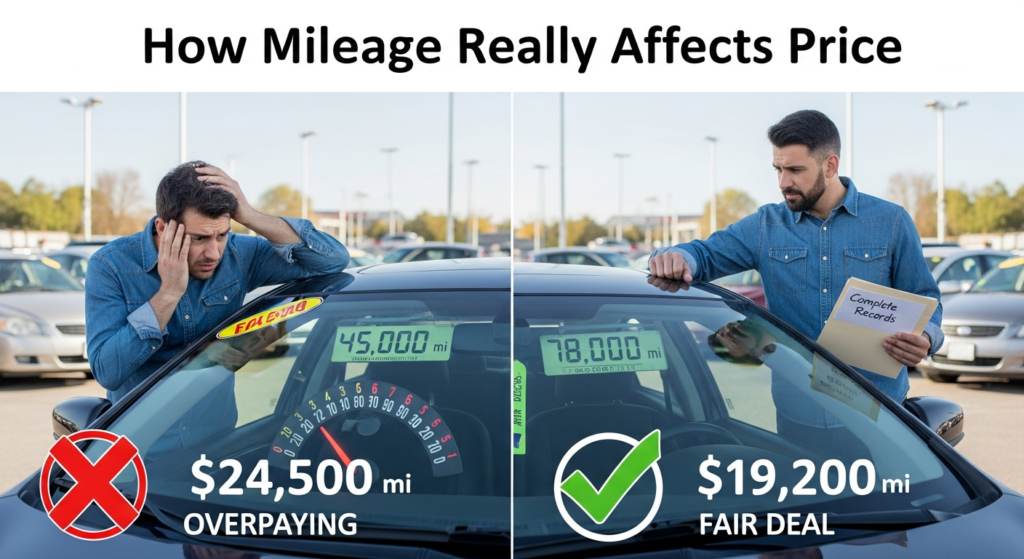
Here’s what nobody tells you: mileage is just one variable in a complex equation. The condition, maintenance history, driving patterns, and even the specific model year matter more than the odometer reading. But dealers know that shoppers fixate on that number, so they price accordingly. A car with 45,000 miles might be listed $3,000 higher than the same model with 75,000 miles, even though the real value difference is closer to $1,200.
I’m going to show you exactly how mileage affects pricing, what the actual depreciation rates look like, and how to use this information to negotiate better deals.
Understanding the Mileage-Price Relationship

The relationship between mileage and price isn’t linear, and that’s where most buyers mess up. They assume that if a car with 50,000 miles costs $20,000, then one with 100,000 miles should cost $10,000. Wrong.
Depreciation follows a curve, not a straight line. The first 30,000 miles hit harder than the next 30,000. Here’s why: buyers perceive low-mileage cars as having more “life left,” even though a well-maintained car at 80,000 miles can easily run another 100,000 miles without major issues.
The Real Depreciation Pattern:
- 0 to 30,000 miles: Highest depreciation per mile (around $0.25 to $0.40 per mile depending on the vehicle)
- 30,000 to 60,000 miles: Moderate depreciation (around $0.15 to $0.25 per mile)
- 60,000 to 100,000 miles: Lower depreciation (around $0.08 to $0.15 per mile)
- 100,000+ miles: Minimal per-mile depreciation but psychological barriers kick in
I’ve tracked pricing data across different vehicle types, and these ranges hold true whether you’re looking at a Honda Accord or a Ford F-150. The exact numbers shift based on the model’s reliability reputation, but the curve stays consistent.
What Mileage Brackets Actually Mean
Let me break down what different mileage ranges tell you about a used car, because the common wisdom is mostly garbage.
Under 30,000 Miles:
You’re paying a premium for barely-used status. This might be worth it if you’re buying a luxury car that someone else already took the depreciation hit on, or if you want the longest possible ownership period. But for most practical buyers, this is where you overpay the most. The car still has a significant portion of factory warranty, and any issues would’ve shown up by now. You’re essentially paying for the privilege of being the “almost first” owner.
30,000 to 60,000 Miles:
This is the sweet spot I tell most buyers to target. The initial depreciation is done, but the car is nowhere near needing major maintenance. Most vehicles won’t need significant work until 80,000 to 100,000 miles—things like timing belts, transmission services, or suspension components. At this mileage, you get a much better price without taking on meaningful mechanical risk.
60,000 to 100,000 Miles:
Here’s where smart buyers clean up. The market panics around 75,000 miles because people think the car is “getting old,” but modern vehicles are just getting broken in at this point. I personally prefer buying in this range because the price drop is disproportionate to the actual condition decline. You can save $4,000 to $6,000 compared to a 40,000-mile example, and if the maintenance records are clean, you’re getting essentially the same car.
100,000 to 150,000 Miles:
This is specialist territory. You need to know the specific model’s weak points and verify that preventive maintenance was done. Some cars are bulletproof at this mileage—Toyota Camrys, Honda Civics, certain Lexus models. Others are ticking time bombs. The pricing advantage is massive, but only if you’re willing to do homework and accept some repair costs down the road.
Over 150,000 Miles:
I only recommend this if you’re mechanical, buying a known-reliable model, or need a short-term vehicle. The depreciation basically flatlines here—a car with 180,000 miles isn’t worth much less than one with 150,000. You’re buying years of service, not resale value.
The Mileage-Per-Year Calculation Dealers Don’t Want You to Know
Here’s a trick that’s saved me thousands: calculate the annual mileage and use it as leverage.
The average driver puts 12,000 to 15,000 miles per year on a car. Anything significantly below that is actually a red flag, not a benefit.
Let me explain. A 2018 car with 30,000 miles in 2025 averages about 4,300 miles per year. That car has been sitting. Sitting damages cars—seals dry out, fluids degrade, batteries die, and corrosion forms in places you can’t see. I’ve seen low-mileage cars need $2,000 in repairs just from sitting idle.
On the flip side, a 2018 car with 100,000 miles averages about 14,300 miles per year. That’s highway commuting, which is actually easier on a car than short trips. Highway miles mean the engine runs at optimal temperature, fluids circulate properly, and components wear evenly.
Here’s the table dealers hope you never create:
| Vehicle Age | Low Annual Miles (<8,000/yr) | Average Annual Miles (12,000-15,000/yr) | High Annual Miles (>18,000/yr) |
|---|---|---|---|
| 3 years | Possible sitting damage, verify condition | Ideal usage pattern | Check for commercial use |
| 5 years | Likely garage queen or minimal use | Expected wear, easiest to assess | Verify maintenance intensity |
| 7 years | Seals and fluids major concern | Still plenty of life left | May need major service soon |
| 10+ years | Restoration candidate or problem vehicle | Acceptable if well maintained | End-of-life for most vehicles |
When I’m looking at cars, I pull out my phone calculator right in front of the salesperson and do this math. If the annual mileage is weird—either too low or too high—I ask pointed questions and adjust my offer accordingly.
How to Calculate Fair Price Adjustments for Mileage
Let’s get practical. You found two similar cars, one has 45,000 miles for $22,000, and another has 75,000 miles for $19,000. Which is the better deal?
First, ignore the asking prices. Start with the baseline value of the vehicle in excellent condition at average mileage. Use resources like Kelley Blue Book or Edmunds, but take their numbers with skepticism—they lag behind real market conditions.
Here’s my method:
Step 1: Find the approximate value of the vehicle at 60,000 miles (the market’s psychological midpoint). Let’s say it’s $21,000.
Step 2: Calculate the mileage difference from 60,000 miles for each vehicle.
- Car A: 45,000 miles = 15,000 miles under
- Car B: 75,000 miles = 15,000 miles over
Step 3: Apply the depreciation rate for that mileage bracket.
- For miles under 60,000, use roughly $0.18 per mile
- For miles over 60,000, use roughly $0.12 per mile
Step 4: Calculate adjusted values.
- Car A: $21,000 + (15,000 × $0.18) = $23,700
- Car B: $21,000 – (15,000 × $0.12) = $19,200
Now compare asking prices to adjusted values:
- Car A asking $22,000 vs. value $23,700 = $1,700 under market
- Car B asking $19,000 vs. value $19,200 = $200 under market
Car A is the better deal, even though it costs more upfront. But here’s the catch—you still need to verify condition. These calculations assume comparable condition and maintenance.
Model-Specific Mileage Considerations
Not all cars age the same way. I’ve seen Honda Accords running strong at 200,000 miles and BMWs needing expensive repairs at 80,000. The vehicle’s reputation for reliability dramatically affects how mileage should influence your decision.
High-Mileage Friendly Models:
- Toyota Camry, Corolla, and most Toyota/Lexus vehicles
- Honda Accord, Civic, and CR-V
- Mazda3 and CX-5
- Subaru Outback (if head gaskets were addressed)
- Ford F-150 with the 5.0L V8 or 3.5L EcoBoost
These vehicles can handle 150,000+ miles without major issues if maintained. When buying these high-mileage, you’re looking at oil change records and timing belt replacement (if applicable). The price drop at 100,000 miles is a gift.
Mileage-Sensitive Models:
- Most German luxury brands (BMW, Mercedes-Benz, Audi)
- Land Rover and Jaguar
- Chrysler, Dodge, and Jeep (with some exceptions)
- Nissan with CVT transmissions
- Mini Cooper
For these vehicles, I strongly recommend staying under 75,000 miles unless you have an independent mechanic relationship and a repair fund. The depreciation past 80,000 miles is steep for good reason—repair costs spike.
Maintenance History Matters More Than Mileage
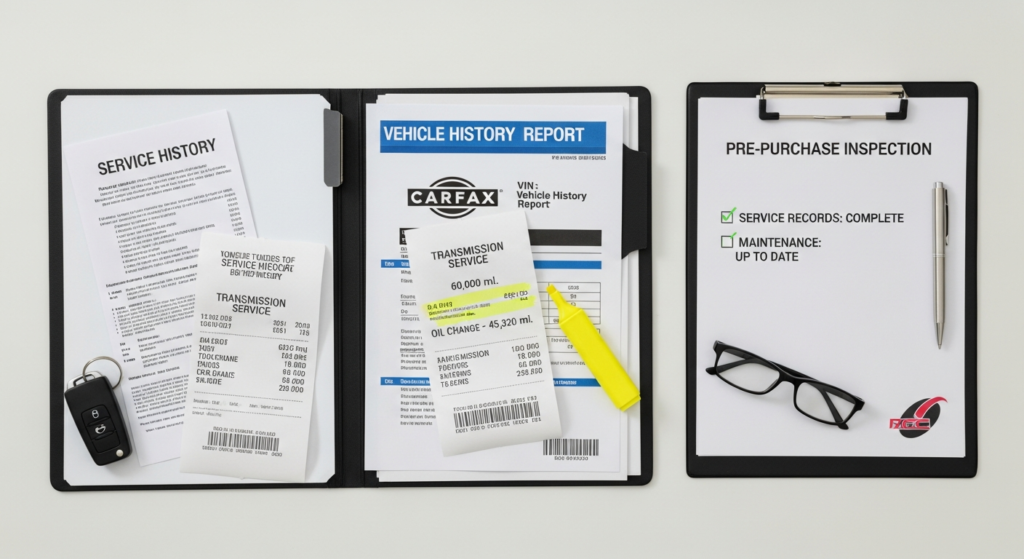
I’ve bought cars with 120,000 miles that ran better than 60,000-mile examples, and the difference always comes down to maintenance records.
When you’re evaluating a used car, the mileage should send you looking for specific service records:
Critical Services by Mileage:
| Mileage Milestone | Expected Maintenance | Red Flag if Missing |
|---|---|---|
| 30,000 miles | Oil changes every 5,000-7,500 miles | No service records at all |
| 60,000 miles | Transmission fluid, brake fluid, cabin filter | Skipped transmission service |
| 90,000 miles | Timing belt (if applicable), spark plugs, coolant flush | No timing belt on interference engines |
| 120,000 miles | Second transmission service, suspension components | Original transmission fluid |
A car with 90,000 miles and complete service records is worth more than a car with 70,000 miles and no history. Period.
I walked away from a “great deal” on a 65,000-mile Nissan Altima because the owner couldn’t produce oil change records. Three months later, I saw the same car on a mechanic’s lot with a blown CVT transmission. The odometer said 67,000 miles. That’s a $4,000 repair that could’ve been prevented with proper fluid changes.
The Psychology of Round Numbers
Dealers know that buyers perceive huge value differences at arbitrary mileage milestones—50,000, 75,000, and especially 100,000 miles. These are psychological barriers, not mechanical ones.
A car doesn’t know when it hits 100,000 miles. Nothing magical happens. But buyer demand drops sharply, so prices fall.
Use this to your advantage. A car with 98,000 miles and one with 103,000 miles are virtually identical mechanically, but the 103,000-mile car might be listed $1,500 cheaper just because it crossed that threshold.
Similarly, dealers price aggressively to stay under these barriers. A car with 49,800 miles will be listed higher than one with 51,200 miles, even though the difference is one week of driving.
When I’m shopping, I specifically search in the ranges just above these milestones: 52,000-58,000 miles, 78,000-85,000 miles, and 105,000-115,000 miles. You find the same cars with less competition and better negotiating room.
How to Negotiate Using Mileage
Mileage gives you leverage, but you need to use it correctly. Dealers expect mileage objections—they’re built into the pricing strategy. You need a different approach.
What Doesn’t Work:
“This car has too many miles.” (They’ll just show you a higher-priced lower-mileage option)
“I want $2,000 off because of the mileage.” (Arbitrary number with no justification)
What Works:
“I’ve calculated the annual mileage at 16,800 miles per year, which is above average. Given the accelerated wear pattern, I’m comfortable at $18,500, which accounts for earlier-than-expected maintenance needs.”
You’re showing that you’ve done analysis and have a rational basis for your offer. This makes it harder for the salesperson to dismiss you.
Another approach: “I’m comparing this to a similar vehicle with 52,000 miles listed at $21,000. Using standard depreciation rates of $0.15 per mile in this range, the 23,000-mile difference justifies a $3,450 price gap. Your asking prices are only $1,800 apart. Can you explain the discrepancy?”
Now they’re defending their pricing instead of you defending your budget.
The Certified Pre-Owned Mileage Trap
Certified Pre-Owned (CPO) programs have mileage limits, usually 75,000 to 80,000 miles. This creates an artificial pricing cliff.
A CPO car with 74,000 miles might cost $3,000 more than a non-CPO car with 76,000 miles. The CPO warranty adds value, but not $3,000 worth—typically the extended warranty is worth $1,200 to $1,800.
Unless the CPO warranty significantly extends coverage, you’re overpaying for a certification stamp. I’d rather buy the 76,000-mile car, save $3,000, and set aside $1,500 for potential repairs. I come out ahead, and I have cash in hand.
The exception is luxury brands with comprehensive CPO programs—BMW, Mercedes, Lexus. Their warranties actually cover expensive repairs, and the peace of mind has real value.
Red Flags That Trump Mileage Considerations
Sometimes mileage doesn’t matter because other factors disqualify the car entirely. Here’s what overrides any mileage-based deal:
- Accident history with frame damage
- Flood damage or salvage title
- Modified engine or transmission
- Mismatched paint or body panels without explanation
- Oil leaks or transmission fluid leaks
- Warning lights on the dashboard
- Unusual noises from the engine, transmission, or suspension
I don’t care if a car has 30,000 miles—if it has frame damage, walk away. Low mileage doesn’t fix structural issues.
Mileage Verification and Odometer Fraud
Before you base any pricing decision on mileage, verify it’s accurate. Odometer fraud is less common than it used to be, but it still happens.
How to Verify Mileage:
- Check the title history for mileage entries at each title transfer
- Look at service records and compare odometer readings
- Inspect wear patterns on the driver’s seat, steering wheel, pedals, and door sills
- Run a vehicle history report from Carfax or AutoCheck
- Check for dashboard replacement or tampering
I once looked at a “low-mileage” Honda with 68,000 miles. The pedals were worn through to bare metal, the driver’s seat was collapsed, and the steering wheel was shiny smooth. The service records showed 127,000 miles two years prior. Someone had rolled back the odometer.
If the wear doesn’t match the mileage, trust the wear.
The Future Resale Value Factor
When you buy a used car, you need to think about selling it later. Mileage affects not just what you pay now, but what you’ll get back.
Cars in the 50,000 to 80,000-mile range when you buy them will hit 80,000 to 110,000 miles when you sell them (assuming you drive average miles for a few years). That’s still in the acceptable range for most buyers.
But if you buy at 95,000 miles and drive it to 125,000 miles, you’ve entered “high mileage” territory where the buyer pool shrinks dramatically. Your resale value takes a bigger hit.
Resale Value Considerations:
| Purchase Mileage | After 3 Years (12k/yr) | Market Position at Resale | Depreciation Impact |
|---|---|---|---|
| 40,000 miles | 76,000 miles | Still “mid-range” | Moderate, steady |
| 70,000 miles | 106,000 miles | “High mileage” barrier | Steep drop |
| 100,000 miles | 136,000 miles | End-of-life for many buyers | Minimal further depreciation |
If you plan to keep the car for 7+ years, this doesn’t matter—you’ll drive it into the ground. But if you trade cars every 3-4 years, buying at 40,000-60,000 miles gives you the best balance of initial savings and resale value.
Mileage vs. Age: The Real Trade-Off
Here’s a question I get constantly: is it better to buy a newer car with high mileage or an older car with low mileage?
The answer depends on why the mileage is high or low.
A 2022 car with 90,000 miles probably has highway commute miles. The owner drove to work and back on the interstate. The engine ran at steady RPMs, everything stayed at operating temperature, and the car received regular maintenance. I’ll take this over a 2017 car with 40,000 miles that made short trips, never fully warmed up, and developed carbon buildup in the intake valves.
But a 2022 car with 90,000 miles from Uber or delivery service? That’s city miles with constant stop-and-go, which is harder on everything. I’d avoid it.
Quick Decision Matrix:
- Newer + High Miles + Highway Use = Good deal if priced right
- Newer + High Miles + City/Commercial Use = Pass unless deeply discounted
- Older + Low Miles + Regular Use = Great if condition matches mileage
- Older + Low Miles + Long Sitting Periods = Requires thorough inspection
Age brings its own issues—rubber components degrade, technology becomes outdated, and safety features lag behind. But mechanical wear from mileage is usually more predictable and cheaper to address than age-related deterioration.
Frequently Asked Questions
What’s considered high mileage for a used car?
High mileage depends entirely on the vehicle. For most modern cars, anything over 100,000 miles enters high-mileage territory in buyers’ minds, but many vehicles routinely run to 200,000 miles with proper maintenance. Japanese brands generally handle high mileage better than American or European brands. I consider mileage “high” when it’s 20% or more above the age-based average (more than 15,000 miles per year).
Should I avoid cars over 100,000 miles?
Not automatically. I’ve bought several vehicles over 100,000 miles and had great experiences. The key is knowing the model’s reliability record and verifying maintenance history. A Toyota with 120,000 miles and service records is often a better buy than a luxury European car with 70,000 miles and no history. The price discount at 100,000+ miles can be significant enough to cover future repairs and still come out ahead.
How much should I discount a car for every 10,000 miles?
It’s not a flat rate because depreciation is nonlinear. For mileage under 60,000, figure roughly $1,500-$2,500 per 10,000 miles depending on the vehicle. For mileage between 60,000-100,000, expect $1,000-$1,500 per 10,000 miles. Above 100,000 miles, the per-mile depreciation drops to $500-$800 per 10,000 miles. Luxury vehicles depreciate faster per mile than economy cars.
Is low mileage always better?
No, and this surprises people. Extremely low mileage for the vehicle’s age suggests the car sat unused, which causes different problems than driving does. Seals dry out, fluids degrade, batteries fail, and corrosion develops. I’d rather buy a car with 15,000 miles per year of highway driving than one with 5,000 miles per year of sitting in a garage. The ideal is average mileage (12,000-15,000 per year) with consistent use.
Conclusion
Mileage matters, but not in the way most buyers think. The obsession with low odometer readings costs people money because they’re paying premiums for marginal benefits while overlooking genuinely good deals at higher mileage.
I’ve shown you exactly how mileage affects pricing, how to calculate fair adjustments, and how to use this information during negotiations. The real skill is looking past the number on the odometer and evaluating the complete picture—maintenance history, usage patterns, model reliability, and actual condition.
Stop letting dealers use your mileage bias against you. A well-maintained car at 85,000 miles from a highway commuter is a better buy than a neglected car at 55,000 miles from someone who drove two miles to the grocery store twice a week.
The next time you’re shopping, pull out your phone, calculate the annual mileage, ask about maintenance records, and make your offer based on actual value rather than arbitrary mileage fears. That’s how you avoid overpaying and find the deals everyone else is walking past.