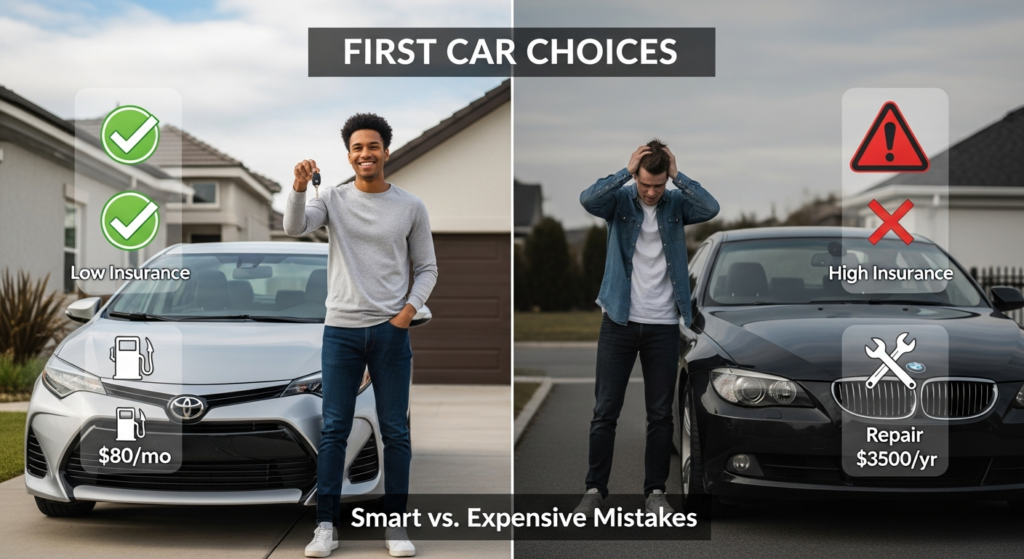

I still remember the pit in my stomach when I helped my younger sister buy her first car three years ago. She’d saved $4,000 from her part-time job and was dead set on a 2008 Nissan Altima with 140,000 miles because it “looked cool.” I had to be the bad guy and talk her out of it. Why? Because I’d learned the hard way that your first car isn’t about what looks good—it’s about what won’t destroy your bank account.
Here’s what nobody tells you: the sticker price is just the beginning. Insurance, maintenance, gas, registration—these costs stack up fast. After five years of working with new drivers and their families, I’ve seen too many people make expensive mistakes. I’m Priya Verma, and I’ve spent half a decade helping young adults navigate their first car purchases without going broke. Today, I’m going to share what actually works, not the generic advice you’ll find everywhere else.
The truth is brutal: most “beginner car” lists are written by people who’ve never had to explain to a 19-year-old why their insurance just jumped to $350 a month. I’ve sat through those conversations. I know what matters and what’s just noise.
Why Most First Car Advice Misses the Mark
Every article tells you to “buy reliable and safe,” but nobody breaks down what that actually means for your wallet. They recommend Honda Civics without mentioning that certain model years have transmission problems. They push SUVs without calculating the real cost of filling a 20-gallon tank twice a month.
I don’t do that. I’m going to show you the actual numbers, the hidden costs, and the specific models that won’t leave you stranded—financially or literally.
The Real Cost Breakdown Nobody Talks About

Before we get into specific cars, you need to understand where your money actually goes. This isn’t about the payment. It’s about total ownership cost.
Monthly Ownership Costs for a Typical First Car:
| Expense Category | Low End | High End | What Affects It |
|---|---|---|---|
| Insurance | $150 | $400 | Age, car model, location, driving record |
| Gas | $80 | $200 | Fuel economy, commute distance |
| Maintenance | $50 | $150 | Car age, brand reliability |
| Registration/Taxes | $30 | $100 | State, car value |
| Total Monthly | $310 | $850 | Your choices matter |
See that spread? That’s the difference between smart choices and expensive ones. A new driver making minimum wage brings home around $1,200 per month. If your car costs eat $850, you’re done before you start.
The Insurance Reality Check
Here’s where most first-time buyers get blindsided. Your insurance rate depends heavily on what you drive. Sporty cars, high-theft models, and vehicles with poor safety ratings will crush your budget.
I learned this when my nephew bought a 2006 Dodge Charger. He paid $3,500 for the car. His insurance? $320 per month. That’s $3,840 per year—more than the car cost. Six months later, he sold it at a loss and bought a Toyota Corolla. His rate dropped to $185.
Cars That Kill Your Insurance Rates:
- Anything with a V8 engine
- Two-door sports cars
- Models with high theft rates (older Honda Accords, Civic Si)
- Cars without modern safety features
- Luxury brands (even old ones)
Insurance-Friendly First Cars:
- Sedans with four doors
- Models with high safety ratings
- Cars with anti-theft systems
- Newer vehicles with automatic braking
- Brands known for reliability
The Sweet Spot: Age and Mileage
Everyone says “buy used,” but what does that actually mean? I’ve found the sweet spot is 5-8 years old with 60,000-90,000 miles. Here’s why.
Cars depreciate fastest in the first three years. Someone else already took that hit. But go too old, and you’re buying someone else’s problems. That 15-year-old car might be cheap upfront, but you’ll pay for it in repairs.
My sister ignored this. She wanted maximum car for minimum money. That Altima she almost bought? It needed a transmission six months after she looked at it. The owner had to junk it. She would’ve been out $4,000 with no car.
Specific Models That Actually Work
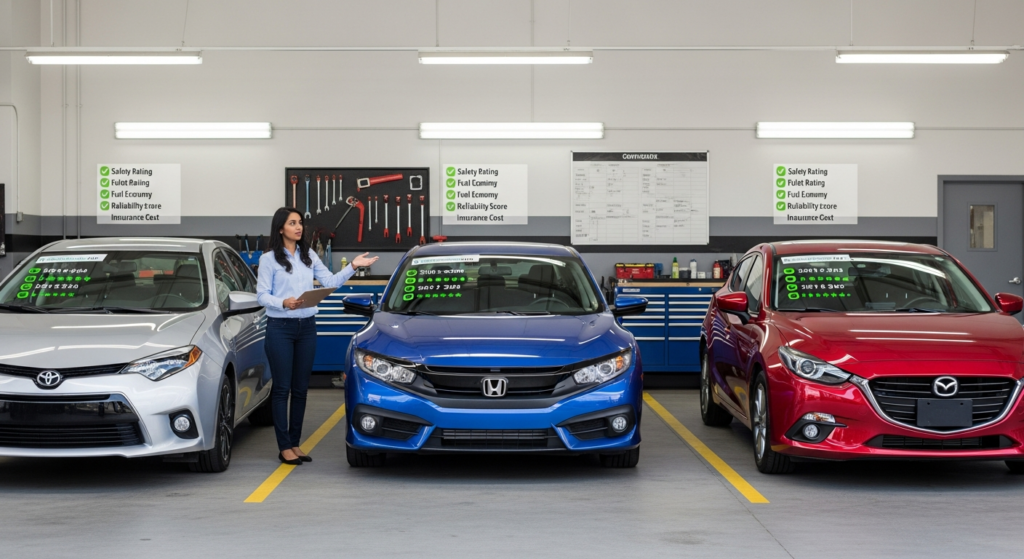
Let me get specific. These aren’t just “good cars.” These are vehicles I’ve personally seen new drivers own without financial disasters.
Toyota Corolla (2015-2018)
I recommend this more than any other car. Not because it’s exciting—it’s not. But because it simply works.
Why it makes sense:
- 30-35 MPG combined
- Cheap parts
- Insurance companies love them
- You’ll find them everywhere
What to watch for:
- Check for oil consumption issues in 2014 models
- Make sure the CVT transmission fluid was changed
- Look at service records
Price range: $12,000-$16,000
Honda Civic (2016-2019)
The Civic edges out the Corolla slightly in driving feel. It’s more fun but costs about the same to own.
Why it works:
- Better handling than most economy cars
- Strong resale value
- 32-38 MPG
- Available with Honda Sensing safety tech
Avoid: 2015 and earlier CVT models had some issues. Stick with 2016 or newer.
Price range: $13,000-$17,000
Mazda3 (2014-2018)
This is my personal favorite for drivers who want something that doesn’t feel like a penalty box.
The upside:
- Actually fun to drive
- Premium interior for the price
- Good fuel economy
- Reliable
The downside:
- Slightly more expensive to insure than a Corolla
- Smaller back seat
- Rust issues in salt belt states
Price range: $11,000-$15,000
Hyundai Elantra (2017-2020)
Don’t sleep on Hyundai. They’re not the cheap brand they used to be.
Why I like it:
- Excellent warranty (often transferable)
- Loaded with features
- Cheap to maintain
- Good safety ratings
Watch out for: Earlier models (2011-2016) had engine problems. Stick with 2017 or newer.
Price range: $11,000-$15,000
Honda Fit (2015-2019)
Perfect for city drivers or anyone who needs space without buying an SUV.
The case for it:
- Best cargo space in its class
- 33-36 MPG
- Incredibly reliable
- Low insurance costs
The catch:
- Road noise on highways
- Basic interior
- Holds value so well it’s pricier used
Price range: $12,000-$16,000
Cars to Absolutely Avoid
I’m going to save you from some expensive mistakes. These are cars that sound good on paper but will wreck your budget.
The “Affordable Luxury” Trap:
Old BMWs, Mercedes, and Audis seem like a steal. A 2012 BMW 328i for $8,000? Sounds great. Until you need brakes ($800), or the water pump fails ($1,200), or literally anything breaks. Parts cost 3-4 times what they do for a Honda. Insurance is higher. Premium gas required.
I watched a friend buy a 2010 Audi A4. Beautiful car. Within a year, he’d spent $3,500 in repairs. He sold it and bought a Civic.
The Modified Car Disaster:
That Civic Si with a cold air intake and exhaust sounds fun. But it’s been driven hard, probably not maintained right, and your insurance will be astronomical. Pass.
High-Mileage “Deals”:
A 2010 car with 180,000 miles for $3,000 might seem smart. It’s not. Major components—transmission, engine, suspension—are all near end of life. You’re buying a ticking time bomb.
The Financing Question
Should you finance your first car? I have strong opinions here.
If you have cash, use it. Car payments trap you. They limit your options if something changes. But I get it—not everyone has $12,000 sitting around.
If you must finance:
- Put down at least 20%
- Keep the loan under 48 months
- Don’t roll negative equity from a trade-in
- Shop rates at credit unions first
Red flags to avoid:
- Loans longer than 60 months
- Interest rates above 8%
- Payments above 15% of your take-home pay
- “Buy here, pay here” lots
I’ve seen 72-month loans on used cars. By the time you pay it off, the car’s worthless and you’ve paid thousands in interest. Don’t do it.
The Pre-Purchase Inspection: Non-Negotiable
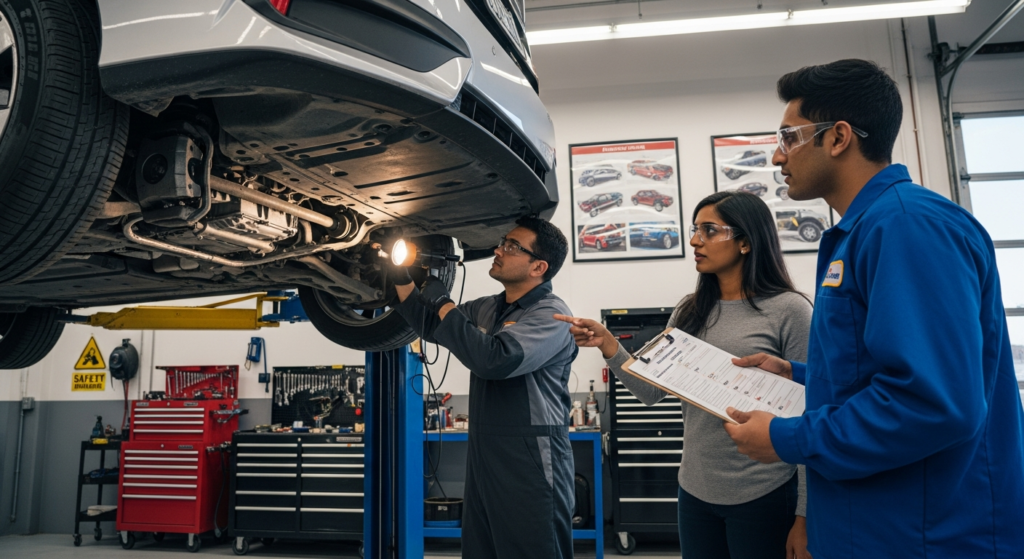
Never, ever skip this step. It costs $100-150 and can save you thousands.
Find a mechanic who specializes in the brand you’re buying. Tell them you’re considering purchasing and need a thorough inspection. Good mechanics will spend 45-60 minutes checking everything.
What they should check:
| Component | Why It Matters | Red Flags |
|---|---|---|
| Engine | Core reliability | Oil leaks, weird noises, check engine light |
| Transmission | Most expensive repair | Slipping, delayed shifts, fluid condition |
| Suspension | Safety and cost | Worn bushings, leaking shocks |
| Brakes | Safety critical | Thin pads, warped rotors, leaking lines |
| Frame/Body | Accident history | Rust, misaligned panels, paint overspray |
| Electronics | Modern headaches | Non-working features, warning lights |
Walk away if they find major issues. The seller won’t fix them, and you’ll inherit expensive problems.
Registration, Taxes, and Hidden Fees
Budget an extra $1,000-1,500 beyond the purchase price. Seriously. This covers:
- Sales tax (varies by state, usually 6-10%)
- Registration and title fees
- Documentation fees
- License plates
- Smog check (if required)
Some dealers try to sneak in “documentation fees” of $500-800. These are often negotiable. Push back.
Maintenance: The First Year Budget
Even reliable cars need maintenance. Budget for these in year one:
Expected Costs:
- Oil changes (2-3): $120-180
- Air filter: $30-50
- Cabin filter: $20-40
- Tire rotation: $50-80
- General inspection: $0-50
Might Need:
- New tires: $400-600
- Brakes: $300-500
- Battery: $150-200
- Wipers, bulbs, etc.: $50-100
Set aside $100 per month for maintenance and repairs. If you don’t need it, great—you’re building an emergency fund.
Gas Costs: Do the Math
This is simple but important. Calculate your actual fuel cost.
Formula: (Monthly miles driven ÷ MPG) × local gas price = monthly fuel cost
Example: You drive 800 miles per month. Gas is $3.50 per gallon.
- With a truck getting 18 MPG: (800 ÷ 18) × $3.50 = $156
- With a Civic getting 35 MPG: (800 ÷ 35) × $3.50 = $80
That’s $76 per month or $912 per year difference. Over five years of ownership, that’s $4,560. Fuel economy matters.
The Negotiation Strategy
Most new drivers overpay because they don’t negotiate. Here’s my approach:
Before you contact the seller:
- Research fair market value (KBB, Edmunds, local listings)
- Know your absolute maximum price
- Get pre-approved for financing
- Have cash ready
When negotiating:
- Start 10-15% below asking price
- Point to specific issues from the inspection
- Be ready to walk away
- Never reveal your maximum budget
Private sellers are usually more flexible than dealers. But dealers offer some protections and occasionally certified pre-owned warranties.
Insurance Shopping: The Actual Process
Don’t just go with your parents’ company. Shop around. Call at least three insurers.
Questions to ask:
- What’s the rate for this specific VIN?
- What discounts am I eligible for?
- What happens if I take defensive driving?
- Can I add myself to a parent’s policy instead?
Sometimes staying on a parent’s policy (even paying them your share) is cheaper than your own policy. Run both numbers.
Discounts to request:
- Good student (usually 3.0+ GPA)
- Defensive driving course
- Low mileage
- Safety features
- Bundling
- Paid in full
Red Flags When Buying Used
I’ve seen every scam and shortcut. Watch for these:
- Seller won’t allow inspection
- Title issues (“lost title,” “title in mail”)
- Rushed sales (“other buyers interested”)
- Price too good to be true
- Won’t meet at their address
- Odometer looks tampered with
- VIN doesn’t match paperwork
- Excessive air fresheners (hiding smells)
- Fresh undercoating (hiding leaks)
Run the VIN through Carfax or AutoCheck. It’s worth $40 to avoid a flood-damaged or salvaged car.
The Unsexy Truth About Reliability
Reliability isn’t exciting. A Corolla won’t make your friends jealous. But you know what’s even less exciting? Calling out of work because your car won’t start. Asking friends for rides. Spending your weekend at a mechanic’s shop.
I’ve owned fun cars and boring cars. The boring ones let me save money, take trips, and not stress. That matters more at 18 than having something flashy.
Making the Final Decision
You’ve done your research. You’ve found a few candidates. Now what?
My decision framework:
- Does it fit my budget (purchase + insurance + gas + maintenance)?
- Is the inspection clean or manageable?
- Can I afford unexpected repairs?
- Will this meet my needs for 3-5 years?
If you answer yes to all four, buy it. Don’t overthink it. Analysis paralysis costs you money too.
Common Questions About First Cars
Should I buy from a dealer or private seller?
Private sellers are usually cheaper. Dealers offer some protections and financing. For your first car, I lean toward private party if you can get a good inspection. You’ll save $1,000-2,000.
Is it worth paying more for lower mileage?
Sometimes. If one car has 60,000 miles and another has 90,000, and they’re $2,000 apart, the lower mileage might be worth it. But don’t pay $4,000 extra for 20,000 fewer miles. That’s not good value.
What if I can only afford a car with high mileage?
Then you need a bigger emergency fund. If you’re buying a car with 120,000+ miles, have at least $2,000 saved for repairs. Major components could fail soon.
Should I buy extended warranties?
From dealers? Usually no. They’re expensive and full of exclusions. But if you’re buying a used car with 80,000+ miles and can get a good third-party warranty for under $1,000, it might be worth it. Read the fine print carefully.
The Bottom Line
Your first car is a tool, not a statement. Buy something that won’t break you financially so you can actually enjoy being mobile. I’ve seen too many new drivers buy the wrong car and end up stressed, broke, or both.
The Corolla might be boring. The Civic might not turn heads. But they’ll get you where you need to go reliably and affordably. That’s what matters.
Five years from now, you’ll have built credit, saved money, and maybe you can buy that fun car. But right now, make the smart choice. Your future self will thank you when you’re not eating ramen because your car payment and insurance are crushing you.
And if you ignore everything else I’ve said, remember this: get the pre-purchase inspection. That $150 is the best money you’ll spend in this process. It’s saved me from more disasters than I can count.
Choose smart. Drive safe. Keep your money.