

I’ve bought and sold over 30 work trucks in my five years running a landscaping and light construction business, and I’m going to tell you something most articles won’t: the “best” truck under 40K isn’t about what wins awards. It’s about what doesn’t break your budget while still hauling your equipment without drama.
Most truck guides are written by people who’ve never actually written a check for one. I’m Priya Verma, and I’ve been in the trades long enough to know that the difference between a good truck purchase and a mistake that costs you thousands isn’t always what you’d expect. I’ve made both kinds of decisions, and the expensive lessons taught me more than the wins.
Here’s what I’ve learned: you can absolutely find a reliable work truck under 40K, but you need to know where to look and what corners you can safely cut. The truck market right now is weird—used prices are still inflated, but there are deals if you know the specific trims and configurations that dealers can’t move. I’m going to show you exactly where those opportunities are.
Why the 40K Price Point Matters More Than Ever
The 40K threshold isn’t random. It’s where financing terms start getting reasonable and where you can still find genuinely capable trucks without jumping into luxury territory that makes zero sense for work use.
I see contractors overspending on trucks constantly. They finance a 60K truck because the payment “only” goes up $200 per month, not realizing that over five years, they’re paying an extra $12,000 plus interest for features they don’t need. That’s money you could put toward another vehicle, better equipment, or just keeping in the bank for slow months.
The sweet spot for work trucks has always been that base-to-mid-trim range where you get the capability without the nonsense. Heated steering wheels and panoramic sunroofs don’t help you move materials. What helps is payload capacity, a reliable powertrain, and not having so many electronics that a sensor failure costs you a day of work.
Full-Size vs Mid-Size: The Decision Nobody Talks About Honestly
Here’s where most advice falls apart. Everyone acts like choosing between full-size and mid-size is just about how much you need to haul. It’s not that simple.
I run both. I have a full-size for the heavy days and a mid-size for everything else. If I could only have one, I’d probably go full-size, but not for the reasons you’d think.
Full-size trucks offer:
- Better used market (more options, easier to sell later)
- Cheaper parts because there are millions on the road
- More aftermarket support for racks, toolboxes, and modifications
- Higher payload ratings even in base trims
- More comfortable for long highway drives
Mid-size trucks make sense when:
- You actually park in tight urban areas daily
- Fuel economy matters more than capability for your specific use
- You don’t regularly max out payload
- You want something that feels less like driving a bus
The reality is that a base full-size F-150 or Silverado will handle 90% of small business needs better than a loaded mid-size, and often for similar money. Mid-size trucks have gotten expensive. A well-equipped Tacoma or Colorado easily pushes past 40K, at which point you’re paying full-size money for less truck.
What You Actually Get for Under 40K Right Now
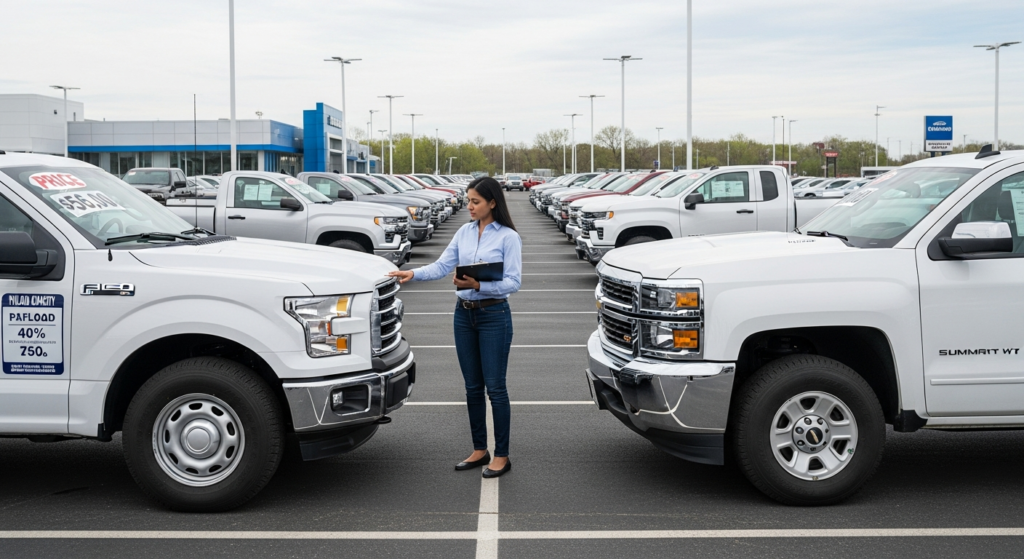
Let me break down the real options, not the fantasy builds you see in reviews.
New Trucks Under 40K
| Truck | Realistic Trim | Actual Capability | Why It Works |
|---|---|---|---|
| Ford F-150 | XL or STX with V6 | 1,745-2,100 lb payload | Best powertrain reliability, huge dealer network |
| Chevrolet Silverado 1500 | WT or Custom | 1,750-2,280 lb payload | Cheaper to buy and maintain than Ram |
| Ram 1500 | Tradesman | 1,620-2,300 lb payload | Best ride quality, watch for electrical issues |
| Ford Ranger | XL | 1,560-1,860 lb payload | Solid engine, holds value well |
| Chevrolet Colorado | WT or LT | 1,430-1,578 lb payload | Good for tight job sites, reasonable fuel economy |
These aren’t exciting. The XL and WT trims are basic. But basic means fewer things to break, and that matters when you’re using a truck for work.
The Used Market Reality
Here’s where it gets interesting. For 40K, you can get into slightly used trucks that were 55K-65K new. The question is whether that’s smart.
I bought a two-year-old Ram 1500 with 28K miles for $38,500 last year. It was a Laramie—way more truck than I needed. Within six months, I had an electrical gremlin that cost me $1,800 to diagnose and fix. The heated seats I never used required a module that failed. This is the risk with used luxury trims.
Compare that to my 2019 F-150 XL I bought new for $35,000. It’s been completely boring. Nothing has broken that wasn’t my fault. The vinyl seats clean easily. The basic radio works fine. I’m not afraid to throw muddy equipment in the back.
If you’re buying used, focus on:
- Fleet vehicles (lower miles per year, maintained on schedule)
- Base work trims (WT, XL, Tradesman)
- Single-owner trucks with service records
- Models with the most reliable engines (Ford 3.5L V6, Chevy 5.3L V8)
Avoid trucks with modifications, especially lift kits. Avoid anything with luxury features you don’t need—they’re just future repair bills.
Engines That Actually Matter for Work
This is where I get opinionated. Forget everything you’ve read about 0-60 times. For work trucks, reliability and torque at low RPMs matter infinitely more than horsepower numbers.
Ford’s 3.3L Naturally Aspirated V6 (F-150 base engine): Everyone overlooks this because it sounds boring. It’s actually fantastic. No turbo to fail. Makes 290 lb-ft of torque, which is plenty for most loads. Gets better real-world fuel economy than the turbos because you’re not constantly in boost. I’ve put 85,000 miles on one with zero engine issues.
Chevy’s 5.3L V8: Old-school reliable. Parts are cheap. Every mechanic knows how to work on it. Slightly thirsty on fuel but predictable. I’ve seen these go 200K+ miles with basic maintenance.
Ford’s 2.7L EcoBoost: This is the one I’d choose if buying new today. More power than you need, good fuel economy, and the early problems (mostly on 2015-2017 models) are sorted. Just change the oil on time—turbos don’t forgive neglect.
Ram’s 3.6L Pentastar V6: Fine but not exciting. Adequate power, decent reliability. The Hemi V8 is tempting but drinks fuel and adds cost.
What I avoid: Ram’s EcoDiesel (expensive repairs), any first-year engine redesign, V6 turbos in mid-size trucks that are working hard (they run hot and don’t last as long as you’d hope).
The Features That Actually Earn Their Cost
Most feature lists are garbage—they’re designed to upsell you. But some options genuinely make work easier.
Worth paying for:
- Trailer brake controller: If you tow anything, this is non-negotiable. Aftermarket installation costs almost as much as the factory option.
- Spray-in bedliner: Protects resale value. DIY bedliner kits are messy and don’t last.
- Backup camera: Should be standard, but if buying older used trucks, make sure it has one.
- Tow package: Not just the hitch—this includes transmission cooler and electrical upgrades that prevent expensive problems.
- Locking rear differential: Makes a huge difference in winter or on soft ground. Underrated feature.
Not worth it at this price point:
- Sunroofs (leak points, add weight high on the vehicle)
- Premium audio (you can’t hear it with windows down or equipment running)
- Adaptive cruise control (nice for road trips, useless for work)
- 20″+ wheels (worse ride, more expensive tires, easier to damage)
- Leather seats (vinyl cleans better and doesn’t crack from sun and dirt)
I specifically bought my trucks without power seats. One less motor to fail. It sounds paranoid until you’ve paid $600 to fix a power seat motor.
Payload Reality Check: The Number Everyone Ignores
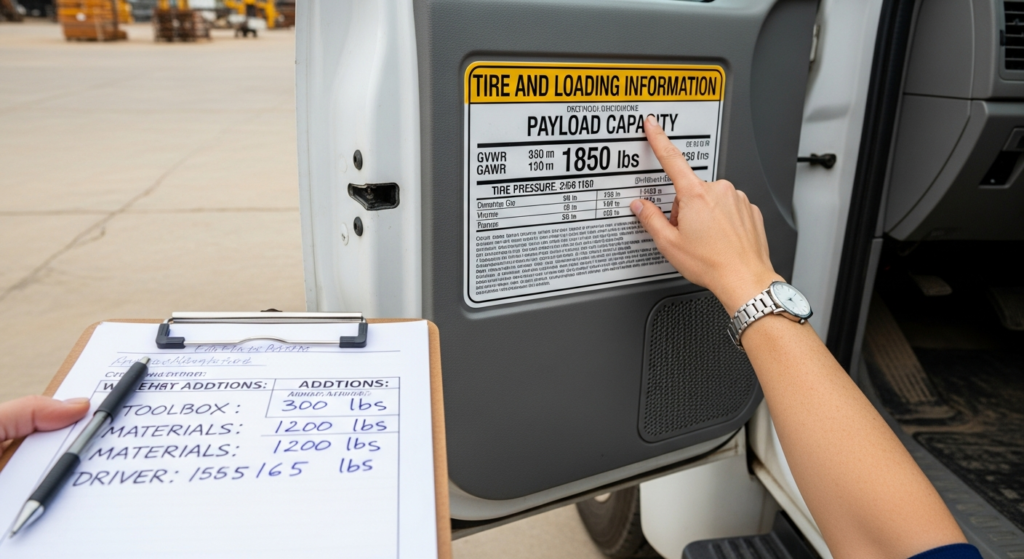
Here’s a frustrating truth: the payload sticker on the door matters more than anything else, and most people never look at it.
Payload is how much weight you can put in and on the truck—cargo, passengers, tongue weight from a trailer, toolboxes, racks. It’s not the same as towing capacity.
A half-ton truck typically has 1,400-2,300 lbs of payload depending on configuration. That sounds like a lot until you actually add it up:
- Driver and passenger: 350 lbs
- Toolbox and tools: 300 lbs
- Ladder rack: 150 lbs
- Full tank of fuel: 125 lbs (counted against payload)
- Actual cargo: Whatever’s left
If you regularly haul a pallet of materials (2,000+ lbs), you need to be checking that door sticker. I’ve seen contractors blowing past their payload rating and wondering why their trucks are sagging and wearing out suspension components.
How to maximize payload:
- Choose regular cab over crew cab (saves 400-500 lbs)
- Skip the 4WD if you don’t actually need it (saves 200-400 lbs)
- Smaller wheels and tires (marginally lighter)
- V6 instead of V8 (slightly lighter engine)
I know crew cabs are more practical. But if you’re choosing between a crew cab that can carry 1,500 lbs and a regular cab that can carry 2,100 lbs, think about what you’re actually using the truck for.
Maintenance Costs: The Hidden Budget Killer
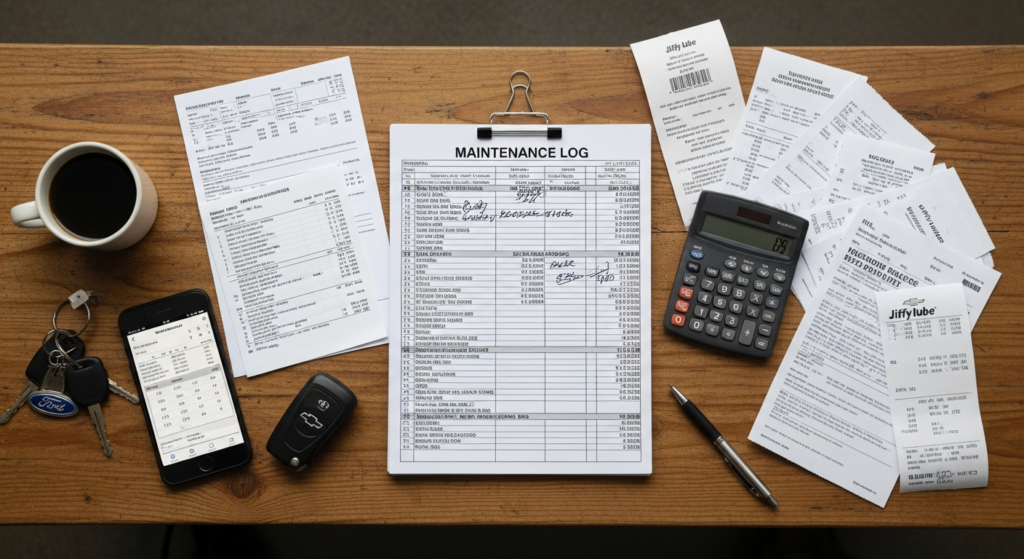
A truck under 40K is affordable to buy. Maintenance is where costs spiral if you’re not careful.
I track every dollar I spend on my trucks. Here’s what actual annual maintenance looks like for a work truck driven 20,000-25,000 miles per year:
| Maintenance Item | Frequency | Annual Cost |
|---|---|---|
| Oil changes | Every 5,000 miles | $240 (4-5 changes) |
| Tire rotation | With oil changes | Included |
| Tires | Every 40,000 miles | $800 (amortized) |
| Brakes | Every 50,000 miles | $600 (amortized) |
| Transmission service | Every 60,000 miles | $250 (amortized) |
| Differential service | Every 60,000 miles | $120 (amortized) |
| Spark plugs | Every 100,000 miles | $80 (amortized) |
| Unexpected repairs | Variable | $500-1,500 |
That’s roughly $2,600-3,600 per year if nothing major breaks. For newer trucks, you’re on the lower end. For trucks with 100K+ miles, expect the higher end plus surprises.
The brands don’t differ as much as people claim. What matters more is how the previous owner treated it and whether you keep up with maintenance. I’ve seen Fords blow engines and Toyotas need transmissions. No brand is bulletproof.
Buying New vs Used: The Math I Actually Did
Everyone says buy used. I’ve done both, and the answer isn’t simple.
When new makes sense:
You know the complete history. Full warranty. You can spec exactly what you need. Current interest rates on new trucks (if you qualify) are often better than used truck loans. You can write off the full amount in year one if you’re self-employed (Section 179 deduction).
When used makes sense:
Someone else ate the depreciation. More truck for your money if you’re willing to accept higher mileage. You can inspect it thoroughly before buying—used trucks reveal their problems. If you’re handy with repairs, older trucks are easier to work on.
I bought new when I needed the tax deduction and had good credit. I bought used when cash flow was tight and I could afford to fix things myself.
The worst decision is buying a 1-2 year old truck. You’re paying almost new prices but getting a truck that’s out of the best warranty coverage and might have been abused during break-in. Either buy new or buy something 4+ years old where the depreciation curve has flattened.
Specific Trucks I’d Buy Tomorrow
If I needed to buy a work truck under 40K today, here are my exact targets:
Best New Option: 2024 Ford F-150 XL SuperCab with 3.3L V6, 8-foot bed, and tow package. Sticker around $38,000-39,000. This is the smart choice. Boring, capable, reliable. Nobody will be impressed, but it’ll work.
Best Value Used: 2021-2022 Chevrolet Silverado 1500 WT Crew Cab with 5.3L V8 and under 40,000 miles. Should find these around $35,000-38,000. Enough warranty left. Proven drivetrain. Comfortable enough for daily use.
If You Need 4WD: 2023 Ford Ranger XL SuperCrew 4WD. Just under 40K new. Fits tighter spaces than full-size. The 2.3L EcoBoost is solid. Not as much payload, but more manageable for urban work.
Dark Horse Pick: 2020 Ram 1500 Tradesman Quad Cab with the 3.6L V6 and around 30,000-35,000 miles. These are selling under $35,000 because people want the Hemi. The V6 is adequate and more reliable. Best ride in the segment.
What I’d Avoid Completely
Some trucks seem like deals but aren’t.
Stay away from:
- Anything with over 80,000 miles unless you’re getting it under $25,000 and can wrench yourself
- Nissan Titan (parts availability issues, poor resale)
- First-year redesigns (2019 Ram 1500, 2021 F-150—let others be beta testers)
- Trucks with accident history (frame damage never heals right)
- Modified trucks (you’re buying someone else’s problems)
- Luxury trims that need expensive repairs (Lariat, High Country, Laramie)
I don’t care if someone’s selling a loaded Platinum for the same price as a base XL. The Platinum will cost you more to maintain, insure, and repair. The resale value advantage disappears when you’re using it for work.
Dealer Negotiation: How I Actually Get Lower Prices
Dealers expect you to negotiate, but most people do it wrong.
What works:
Contact multiple dealers via email. Be specific about the exact configuration you want. Tell them you’re buying this month and asking for their best out-the-door price. The dealer that responds first with a real number usually isn’t the best deal—wait for everyone to respond.
Negotiate out-the-door price, not monthly payments. Dealers manipulate payments by stretching terms.
Be ready to walk. I’ve driven three hours to save $2,000. For a $40,000 purchase, that’s worth it.
End of month, end of quarter, end of year—timing matters. Dealers have quotas. A truck that sits on the lot costs them money.
What doesn’t work:
Lowball offers. If a truck is fairly priced at $38,000, offering $32,000 just pisses them off.
Bringing up online prices from 500 miles away. They know you’re not driving there.
Focusing on monthly payments. That’s how you end up with an 84-month loan.
Financing: The Terms That Actually Matter
I’ve financed trucks at 2.9% and at 7.8%. The difference is staggering.
For a $40,000 truck over 60 months:
- At 2.9%: You pay $43,042 total ($3,042 in interest)
- At 7.8%: You pay $48,045 total ($8,045 in interest)
That’s $5,000 down the drain because of interest rates. If your credit isn’t great, fix it before buying. Three months of paying down credit cards and disputing errors on your credit report can save you thousands.
My financing rules:
- Never go beyond 60 months. If you can’t afford the payment on a 5-year loan, you can’t afford the truck.
- Put down 20% if possible. This prevents being underwater immediately.
- Get pre-approved from a credit union before going to the dealer. Dealers mark up interest rates.
- Read every line of the contract. Extended warranties and add-ons are usually garbage.
I paid cash for my last truck. I hate debt. But if you’re using the truck to make money, low-interest financing can make sense so you’re not draining your business cash reserves.
Insurance Costs Nobody Mentions
Work trucks cost more to insure than personal vehicles, especially if you’re using them commercially.
I pay about $1,800 per year for full coverage on a $35,000 truck with a $1,000 deductible. That’s for commercial use. If you’re not listing commercial use and you have an accident while working, your insurance can deny the claim.
Ways to lower insurance:
- Higher deductibles (I can afford a $1,000 hit if needed)
- Bundle with business insurance
- Take defensive driving courses (some insurers give discounts)
- Older trucks cost less to insure (but make sure you have enough coverage)
Don’t skip comprehensive and collision just to save money. If your truck is totaled and you still owe $30,000 on it, you’re screwed without coverage.
Long-Term Ownership Reality
I keep trucks until they hit 150,000-175,000 miles, then sell them before major repairs pile up. This is the sweet spot—you’ve gotten your money’s worth, but you’re selling before transmissions and engines become gambles.
Depreciation timeline for a $40,000 truck:
- Year 1: Worth about $34,000 (15% hit)
- Year 3: Worth about $28,000 (30% total depreciation)
- Year 5: Worth about $22,000 (45% total depreciation)
- Year 7: Worth about $16,000 (60% total depreciation)
If you’re planning to keep it 10 years, buy what you need and drive it into the ground. Depreciation doesn’t matter if you’re never selling. If you’re turning over trucks every 3-4 years, buy used and let someone else eat that first-year depreciation.
Comparing Top Trucks Head-to-Head
| Feature | F-150 XL | Silverado WT | Ram Tradesman | Ranger XL |
|---|---|---|---|---|
| Starting Price | ~$36,000 | ~$35,500 | ~$37,000 | ~$32,000 |
| Payload | 1,745-2,100 lbs | 1,750-2,280 lbs | 1,620-2,300 lbs | 1,560-1,860 lbs |
| Towing | 5,000-8,200 lbs | 6,500-9,600 lbs | 6,730-7,730 lbs | 3,500-7,500 lbs |
| Fuel Economy | 19/24 mpg | 17/23 mpg | 20/25 mpg | 20/24 mpg |
| Reliability Rating | Above Average | Average | Below Average | Above Average |
| Resale Value | Excellent | Good | Good | Excellent |
The F-150 wins on paper and in my real-world experience. It’s not exciting, but it’s the safest bet.
Questions I Get Asked Constantly
Should I buy gas or diesel under 40K?
Gas. You’re not getting a diesel under 40K unless it’s used with high miles, and diesel maintenance costs more. The fuel savings don’t make up for the $10,000 premium plus higher maintenance unless you’re towing heavy constantly.
Is 4WD worth it?
Depends entirely on your climate and job sites. I have one 2WD and one 4WD. The 2WD is cheaper, gets better fuel economy, and handles 80% of my needs. The 4WD is for winter and muddy sites. If you’re in the South and working in developed areas, skip it.
How important is cab size?
More important than most features. I went with SuperCab (extended cab) as a compromise. Fits four people uncomfortably, which is fine—this isn’t a family vehicle. Regular cab gives you more bed length. Crew cab is most comfortable but costs payload capacity.
Should I buy extended warranty?
I never do on new trucks—the factory warranty is enough. On used trucks over 75,000 miles, maybe, but read the terms carefully. Most extended warranties have so many exclusions they’re not worth it.
Common Mistakes That Cost People Thousands
I see the same errors repeatedly from contractors buying trucks.
Overbuying truck: You don’t need a 3/4-ton diesel to haul landscaping equipment. Half-ton gas trucks handle most small business needs. Every step up in capability is a step up in costs.
Ignoring payload stickers: I’ve watched people buy trucks and immediately overload them. Check the door sticker before you buy. If you need more capacity, you need a different truck.
Financing based on monthly payment: Dealers love this. They’ll stretch your loan to 84 months to make the payment “affordable” while you pay thousands extra in interest.
Buying too much truck for occasional use: If you need a big truck twice a year, rent it. Don’t finance $40,000 worth of capability you use quarterly.
Skipping the inspection on used trucks: Pay $150-200 for a pre-purchase inspection. It’ll save you from buying problems.
My Final Take
If you’re looking for a truck under 40K for actual work, your best bet is a base-trim full-size from Ford or Chevy. The F-150 XL with the 3.3L V6 is my top pick—it’s unglamorous but works. The Silverado WT is a close second.
Don’t get distracted by features you don’t need. Don’t overspend on luxury trims that’ll cost you more to maintain. Don’t buy more truck than you actually need.
I’m not telling you trucks are cheap. They’re not. But you can find something reliable and capable for under 40K if you’re smart about it. Focus on the boring stuff—payload, reliability, total cost of ownership. The exciting stuff is what drains your bank account.
The truck market is cooling slightly. Dealers are more willing to negotiate than they were two years ago. Interest rates are high, but if you have good credit, you can still find reasonable terms. This is a better time to buy than 2022-2023, but you still need to do your homework.
Buy the truck that makes financial sense for your business, not the one that makes you feel good parking it. That’s how you stay profitable.