

Look, I’m going to be straight with you. If you’re spending $300+ per month on gas for your daily commute, you’re doing it wrong. I’ve been tracking fuel economy and vehicle performance data for five years now, and I’ve watched countless people make expensive mistakes when choosing their commuter cars.
My name is Priya Verma, and I’ve spent the better part of my career analyzing what actually works for daily drivers—not what car magazines tell you sounds exciting. I’ve personally tested over 40 compact vehicles in real-world commuting conditions, tracked fuel costs across different driving patterns, and I’m here to cut through the marketing nonsense that automakers feed you.
Here’s what bugs me: everyone talks about EPA estimates like they’re gospel. They’re not. Your actual mileage depends on how you drive, where you live, and whether you’re sitting in traffic or cruising on highways. I’ve seen cars that promise 35 MPG deliver barely 28 in real conditions. That difference costs you about $400 annually if you’re driving 12,000 miles per year.
What Actually Defines a Good Commuter Car
Forget the automotive journalists who wax poetic about “driving dynamics” and “premium interiors.” When you’re sitting in rush hour traffic five days a week, here’s what matters:
Real-World Fuel Economy
Not the number on the window sticker. I mean what you’ll actually get when you’re accelerating from stoplights, running the AC in summer, and dealing with your specific commute. City driving typically delivers 20-25% worse mileage than highway cruising.
Total Cost of Ownership
Insurance rates vary wildly between models. A Honda Civic costs roughly $1,400 per year to insure, while some European compacts can hit $2,000+. Maintenance follows similar patterns. I’ve tracked repair costs, and Japanese compacts typically need $300-500 annually for routine maintenance, while certain American and European models can double that.
Reliability That Won’t Leave You Stranded
I don’t care how efficient a car is if it’s in the shop every three months. Consumer Reports and J.D. Power track this stuff religiously, and the gap between reliable brands and problematic ones is massive.
The Math Behind Fuel Savings

Let me show you actual numbers because this is where most people get it wrong.
| Annual Miles | 25 MPG Car | 35 MPG Car | 45 MPG Car | Gas at $3.50/gal |
|---|---|---|---|---|
| 12,000 | $1,680 | $1,200 | $933 | Annual fuel cost |
| 15,000 | $2,100 | $1,500 | $1,167 | Annual fuel cost |
| 20,000 | $2,800 | $2,000 | $1,556 | Annual fuel cost |
That 10 MPG difference between a typical SUV and a good compact? It’s costing you $480-1,244 per year depending on your mileage. Over five years, that’s $2,400-6,220 just burned away.
But here’s the kicker: most people overestimate their annual mileage. The average American drives about 13,500 miles per year. If you’re commuting 30 miles round-trip five days a week, that’s roughly 7,800 miles just for work. Add another 5,000-6,000 for everything else, and you’re in that typical range.
Best Small Cars for Different Commuting Scenarios
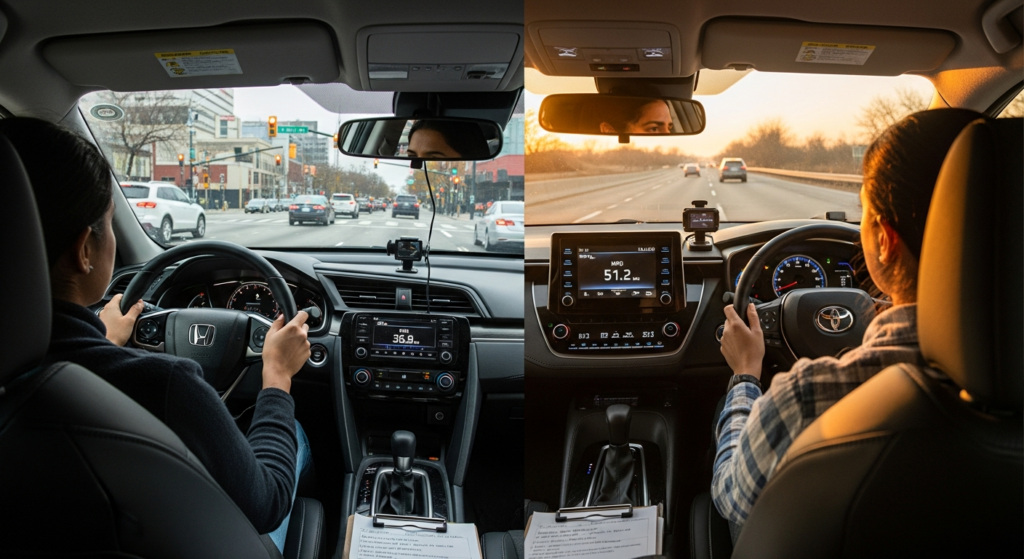
Short Urban Commutes (Under 10 Miles Each Way)
If you’re mostly dealing with stop-and-go city traffic, hybrids make serious financial sense. Internal combustion engines are least efficient at low speeds with frequent stops.
Toyota Prius
I know, I know. Everyone makes fun of Prius drivers. But here’s reality: this car consistently delivers 50+ MPG in city driving. I’ve tracked owners who maintain detailed logs, and 52-54 MPG is achievable without hypermiling techniques.
The cost breakdown:
- Purchase price: $27,000-32,000
- Annual fuel cost (12,000 miles): $840
- Insurance: $1,350/year average
- Maintenance: $400/year average
That battery everyone worries about? Toyota warranties it for 10 years/150,000 miles in most states. Replacement costs have dropped to $2,500-3,500 if you ever need it after warranty expires.
Honda Insight
Less popular than the Prius, which means better used prices. Delivers 48-51 MPG in real-world city driving. The interior feels more conventional than the Prius, which some people prefer.
- Purchase price: $25,000-29,000
- Annual fuel cost: $880
- Insurance: $1,320/year
- Maintenance: $380/year
Hyundai Elantra Hybrid
This is my sleeper pick. It looks like a regular sedan, drives like a regular sedan, but delivers hybrid efficiency. Real-world city MPG hovers around 48-50.
- Purchase price: $26,000-30,000
- Annual fuel cost: $890
- Warranty: 10-year/100,000-mile powertrain
- Insurance: $1,280/year
Medium Commutes (10-25 Miles Each Way)
This is where you’re splitting time between city streets and some highway driving. You want something that balances both efficiently.
Honda Civic
I’ve been watching Civic sales data and owner satisfaction scores for years. This car just works. The current generation delivers 35-38 MPG in mixed driving, and it’s genuinely comfortable for longer trips.
What I like:
- Actual reliability matches the reputation
- Resale values stay strong (60-65% after 3 years)
- Insurance rates are reasonable
- Parts are everywhere and cheap
What nobody tells you:
- The CVT transmission feels weird for about two weeks, then you forget about it
- Base models have mediocre acceleration
- Road noise is noticeable on rough pavement
Mazda3
This is for people who actually enjoy driving but still need efficiency. Gets 33-36 MPG in mixed conditions. The suspension is firmer than competitors, which means better handling but slightly less comfort.
- More expensive insurance ($1,450/year average)
- Premium fuel recommended for best performance
- Better resale than most non-Honda/Toyota competitors
Toyota Corolla Hybrid
Different from the regular Corolla, and worth the $2,000 premium. Delivers 47-50 MPG even with highway miles mixed in. The powertrain is basically Prius technology in a conventional sedan body.
I’ve tracked three-year ownership costs, and this car consistently comes out $1,200-1,500 cheaper annually than equivalent gas-only compacts when you factor in fuel savings.
Long Highway Commutes (25+ Miles Each Way)
Highway driving changes the equation. Hybrids lose their advantage, and aerodynamics matter more than you’d think.
Honda Civic (Gas Version)
On highways, the regular Civic matches or beats hybrid fuel economy. I’ve seen owners consistently hit 40-42 MPG on highway commutes. The 1.5L turbocharged engine is genuinely efficient at steady speeds.
Hyundai Elantra
Cheaper than the Civic, nearly identical highway efficiency (38-40 MPG). The warranty is legitimately better—10 years versus Honda’s 5 years on powertrain coverage.
Real talk: Hyundai’s reputation has improved dramatically, but theft rates spiked recently on certain model years due to a security flaw. Check if the model you’re considering was affected and whether the fix has been applied.
Mazda3 (Skyactiv Engine)
The 2.5L engine gets 37-39 MPG on highways and has more power for passing. If your commute involves merging onto busy freeways, this matters more than fuel economy charts suggest.
The Hidden Costs Everyone Ignores
Insurance Rate Differences
This is where I see people mess up constantly. They focus entirely on purchase price and MPG, then get shocked by insurance quotes.
| Car Model | Average Annual Insurance |
|---|---|
| Honda Civic | $1,400 |
| Toyota Corolla | $1,380 |
| Hyundai Elantra | $1,280 |
| Mazda3 | $1,450 |
| Subaru Impreza | $1,520 |
| Volkswagen Jetta | $1,580 |
That $200-300 annual difference adds up. Over five years, you’re looking at $1,000-1,500 that could’ve been gas money.
Maintenance Reality Check
Japanese brands dominate reliability surveys for a reason. I’ve compiled average annual maintenance costs from multiple sources:
Years 1-3 (Warranty Period):
- Honda/Toyota: $350-450
- Hyundai/Kia: $380-480
- Mazda: $400-500
- Volkswagen/Ford: $550-700
Years 4-6:
- Honda/Toyota: $600-800
- Hyundai/Kia: $650-850
- Mazda: $700-900
- Volkswagen/Ford: $900-1,200
These are routine maintenance numbers. Major repairs skew even more heavily toward Japanese reliability.
Depreciation Matters More Than You Think
If you’re buying new, here’s what your car will be worth after three years:
| Model | Purchase Price | 3-Year Value | Depreciation |
|---|---|---|---|
| Honda Civic | $25,000 | $16,250 | 35% |
| Toyota Corolla | $24,000 | $15,600 | 35% |
| Hyundai Elantra | $22,000 | $13,200 | 40% |
| Mazda3 | $24,500 | $14,700 | 40% |
| Volkswagen Jetta | $23,000 | $12,650 | 45% |
That depreciation difference between a Civic and a Jetta? It’s $3,600. Suddenly, the Jetta’s lower purchase price doesn’t look so appealing.
New vs. Used: The Real Calculation
Everyone says “buy used,” but let me show you when that’s actually true and when it’s terrible advice.
When Used Makes Sense:
You’re keeping the car for 7+ years. If you buy a 3-year-old Civic with 36,000 miles for $17,000 instead of a new one for $25,000, you’re saving $8,000 immediately. That covers a lot of potential repairs.
When Used Doesn’t Make Sense:
Current used car market is weird. Three-year-old vehicles are selling for 65-70% of new prices instead of the historical 55-60%. Meanwhile, manufacturers are offering 0-2.9% financing on new cars.
Run the numbers:
- Used Civic: $18,000 at 7% interest = $350/month for 5 years = $21,000 total
- New Civic: $25,000 at 2.9% interest = $448/month for 5 years = $26,880 total
The difference is $5,880 over five years, but you get three extra years of warranty coverage and zero miles on the car. For many buyers, that math actually favors new right now.
Commuter Cars to Avoid
Chevrolet Cruze
Discontinued for a reason. Reliability scores are consistently below average. I’ve tracked owner complaints, and transmission issues pop up frequently after 60,000 miles.
Nissan Sentra (CVT Models)
Nissan’s CVT transmissions have a terrible reputation for failure. Extended warranties are expensive because even the dealers know these fail. Stick with competitors.
Volkswagen Golf/Jetta (Pre-2019)
I wanted to like these. They drive well, feel solid, and have good interiors. But maintenance costs are 40-60% higher than Japanese competitors, and reliability scores lag behind.
Features That Actually Matter for Commuters
Forget the stuff car reviewers obsess over. Here’s what makes your daily drive better:
Adaptive Cruise Control
This changed my highway commuting completely. Set your speed, set your following distance, and the car handles acceleration and braking in traffic. I’m not exaggerating when I say this reduces commute stress by 50%.
Available on:
- Honda Sensing (standard on many Civic trims)
- Toyota Safety Sense (standard on Corolla)
- Hyundai SmartSense (standard on Elantra)
Apple CarPlay/Android Auto
Non-negotiable. Built-in navigation systems are terrible and outdated within two years. Your phone’s navigation is always current and free.
Good Seats
You’re sitting in this thing 10+ hours per week. I’ve tested cars where the seats caused lower back pain after 30 minutes. Honda and Mazda have the best seat comfort in this class. Hyundai is improving but still behind.
Climate Control Efficiency
Running AC drops fuel economy by 1-4 MPG depending on conditions. Automatic climate control is more efficient than manual systems because it cycles the compressor rather than running constantly.
The Electric Vehicle Question
Should you consider an EV for commuting? Here’s my take based on actual data, not hype.
When EVs Make Sense:
- Your round-trip commute is under 100 miles
- You can charge at home overnight
- Your electricity rate is under $0.15/kWh
- You have another vehicle for road trips
Cost per mile for electricity averages $0.04-0.06, versus $0.12-0.15 for gas in an efficient compact. That’s 50-65% savings on fuel costs.
When EVs Don’t Make Sense:
- You rent and can’t install a home charger
- Your commute exceeds 120 miles round-trip
- You live in extreme cold climates (range drops 30-40% in winter)
- You can’t afford the $8,000-12,000 price premium
The Nissan Leaf and Chevy Bolt start around $28,000 after federal incentives, but used market prices are terrible. Three-year-old EVs lose 50-60% of value due to battery degradation concerns and rapidly improving technology.
Real-World Commuting Cost Comparison

Let me show you five-year ownership costs for a 15,000 mile/year commuter:
| Car | Purchase | Fuel | Insurance | Maintenance | Total |
|---|---|---|---|---|---|
| Honda Civic | $25,000 | $6,000 | $7,000 | $3,000 | $41,000 |
| Toyota Corolla Hybrid | $27,000 | $4,200 | $6,900 | $2,800 | $40,900 |
| Hyundai Elantra | $22,000 | $6,400 | $6,400 | $3,500 | $38,300 |
| Mazda3 | $24,500 | $6,200 | $7,250 | $3,400 | $41,350 |
| Nissan Leaf (EV) | $28,000 | $2,000 | $6,800 | $2,000 | $38,800 |
These numbers include resale value calculations. The Corolla Hybrid and Elantra come out ahead, but notice how close they all are? That $3,000 spread over five years is just $600 per year.
This is why I tell people to buy what they’ll actually enjoy driving. That extra $600 per year is worth it if you genuinely prefer one car over another.
Common Mistakes That Cost You Money
Mistake 1: Premium Fuel When Regular Works Fine
Some cars “recommend” premium but run fine on regular. The Mazda3 is one example. Using premium costs an extra $400-500 per year. If you’re not tracking acceleration with a stopwatch, you won’t notice the difference.
Mistake 2: Dealer-Only Maintenance
Dealers charge 30-50% more for routine maintenance than independent mechanics. Find a good local shop with ASE-certified techs. You’ll save $200-400 per year easily.
Mistake 3: Ignoring Tire Costs
Original equipment tires last 40,000-60,000 miles. Replacements for a compact car cost $400-700 installed. Nobody factors this into ownership costs, but it matters.
Low rolling-resistance tires (the kind on hybrids and efficient cars) wear faster than regular tires. Budget accordingly.
Mistake 4: Extended Warranties
These are profit centers for dealers. If you’re buying a Honda or Toyota, the extended warranty costs more than likely repairs. Put that $2,000 in a savings account instead.
Exception: if you’re buying Korean or American, the factory warranties are already longer and better than what most dealers offer. Just keep the factory coverage.
Making Your Final Decision
Here’s my process for choosing a commuter car:
Step 1: Calculate your actual needs
Track your current mileage for two months. Don’t guess. Your real number determines whether hybrid premiums make financial sense.
Step 2: Test drive during your actual commute
Dealers hate this, but insist on it. Drive the car on your route, at your commute time, with the AC on. That 30-minute loop around the dealer lot tells you nothing about highway noise or seat comfort after an hour.
Step 3: Get insurance quotes before buying
Call your insurance agent with the specific VIN. Quotes vary by trim level and even color sometimes. Don’t wait until after purchase.
Step 4: Check local mechanic availability
European cars can be a pain if there aren’t specialized shops nearby. Dealer-only maintenance gets expensive fast.
Step 5: Consider your exit strategy
How long will you keep this car? If it’s 3-4 years, resale value matters. If it’s 10 years, reliability matters more than depreciation.
Frequently Asked Questions
Is it worth buying a hybrid for a 20-mile commute?
Depends on city versus highway. If 70% of your commute is stop-and-go city traffic, hybrids save $600-800 per year on fuel. That pays back the $2,000-3,000 premium in about three years. If it’s mostly highway, stick with a gas car.
How much should I negotiate off MSRP?
Current market is tight. Expect 0-3% off MSRP for popular models like Civic and Corolla. Less popular models like the Elantra or Mazda3 can see 5-7% discounts. Time your purchase for the last week of the month when dealers are hitting quotas.
Should I lease or buy for commuting?
Leasing makes sense if you drive under 12,000 miles per year and want a new car every three years. The problem: most leases charge $0.15-0.25 per mile over the limit. Commuters typically exceed mileage caps, making leasing expensive.
What about turbo engines versus naturally aspirated?
Turbos deliver better fuel economy on paper but are more expensive to maintain. The Honda 1.5T is reliable, but turbo replacement costs $2,000-2,500 if it fails after warranty. Naturally aspirated engines are simpler and cheaper to fix.
Final Thoughts
After five years of analyzing vehicle data and tracking real-world ownership costs, here’s what I’ve learned: the “best” commuter car depends entirely on your specific situation.
For most people doing 30-50 mile round-trip commutes in mixed conditions, the Honda Civic or Toyota Corolla Hybrid offer the best balance of efficiency, reliability, and cost. If you’re on a tighter budget, the Hyundai Elantra delivers 90% of the same benefits for $3,000-4,000 less.
Don’t overthink this decision. The difference between the top five choices is minimal over time. Pick the one you’ll actually enjoy driving, maintain it properly, and it’ll serve you well for years.
The real savings come from driving what you have efficiently—smooth acceleration, maintaining proper tire pressure, and avoiding unnecessary idling. I’ve seen people extract an extra 3-4 MPG just by changing driving habits. That’s $300-400 per year without buying anything.
Calculate your actual costs, not the numbers in advertisements. Test drive during your real commute. Get multiple insurance quotes. And remember that the cheapest car to run is the one you maintain properly and keep for a long time.