
I’ve been working as an automotive technician and service advisor for five years now, and I’m tired of watching people get blindsided by tire replacement costs. Last month, a guy came into my shop absolutely furious because his “routine” tire replacement for his Tesla Model Y cost him $1,400. He thought I was ripping him off. I wasn’t. That’s just what those tires cost.
Nobody talks about the real numbers until you’re standing at the counter, credit card in hand, wondering how four pieces of rubber can cost more than your monthly rent. I’m Priya Verma, and I’ve watched enough customers go pale at the checkout counter to know that tire costs are one of the biggest hidden expenses of car ownership that nobody properly explains.
Here’s what really frustrates me: dealerships and car salespeople never mention this stuff during the purchase. They’ll tell you about the heated seats and the fancy infotainment system, but they won’t tell you that replacing the tires on your new BMW X5 every 30,000 miles will cost you $1,200 to $1,600 each time. That’s not an accident. It’s intentional omission.
I started tracking actual tire replacement costs across different vehicles after I got sick of the surprised reactions. What I found confirmed what I already suspected: the gap between what people think tires cost and what they actually pay is enormous. And it’s getting worse.
Why Your Tire Replacement Costs More Than You Think
Most people walk into tire shopping with a number in their head based on what their parents paid 15 years ago, or what they paid for their last economy car. That mental math breaks down fast when you’re dealing with modern vehicles.
The base tire cost isn’t the whole story. When someone asks me what tires will cost, they usually mean just the rubber. But that’s like asking what a house costs and only counting the lumber. Here’s what you’re actually paying for:
Tire purchase price – This varies wildly based on your vehicle. A basic all-season tire for a Honda Civic might run $80-120 per tire. That same tire for a pickup truck? $150-200. Performance vehicle? $200-400 per tire. Electric vehicles with specialized low-rolling-resistance tires? Add another 20-30% to whatever you were thinking.
Mounting and balancing – Every shop charges this separately. Expect $15-30 per tire. Some places advertise “free installation” but they’ve just hidden this cost in the tire price. I prefer honest pricing.
Valve stems – These should be replaced every time. Rubber valve stems cost $3-5 each. TPMS (tire pressure monitoring system) valve stems run $5-10 each. Skip this and you might deal with a slow leak three months later.
Disposal fees – Your old tires have to go somewhere. Most shops charge $3-5 per tire for disposal. Some states mandate this fee.
Alignment check – Not always included, but you should get one. Costs $75-150. Skip it and your new tires might wear unevenly, cutting their life in half.
Road hazard warranty – Optional, usually $15-25 per tire. I recommend it for expensive tires.
Add it all up and what looked like a $400 tire job suddenly hits $600-700 before you blink.
Vehicle-Specific Tire Replacement Costs (The Numbers Dealerships Hide)
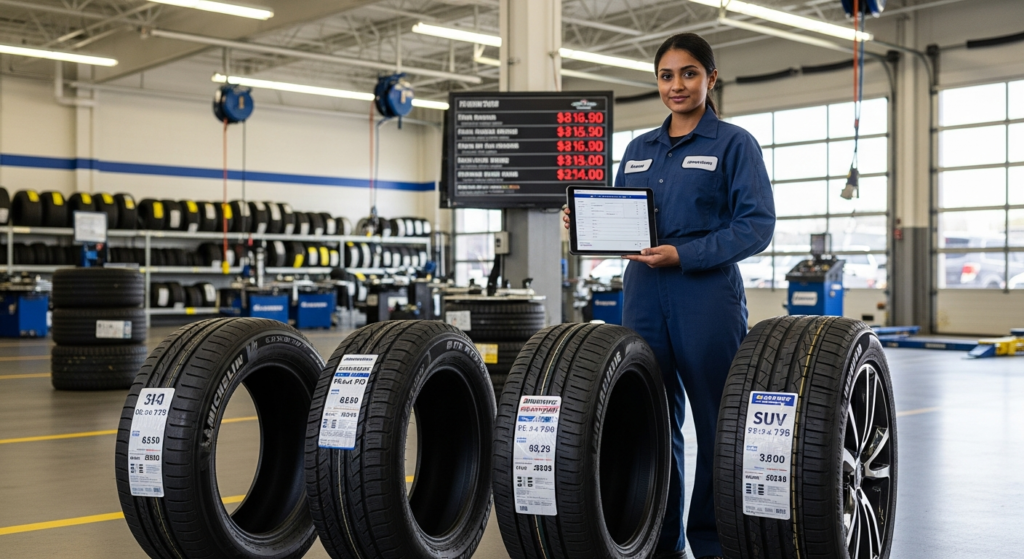
I pulled real numbers from actual invoices I’ve processed over the past year. These aren’t theoretical prices from tire websites. These are what people actually paid, including all fees.
| Vehicle Type | Tire Cost Per Set | Service Fees | Total Average Cost | Replacement Frequency |
|---|---|---|---|---|
| Compact Cars (Civic, Corolla, Mazda3) | $320-480 | $120-180 | $440-660 | 50,000-70,000 miles |
| Midsize Sedans (Accord, Camry, Altima) | $480-640 | $140-200 | $620-840 | 45,000-65,000 miles |
| Full-Size Trucks (F-150, Silverado, Ram) | $600-1,000 | $160-220 | $760-1,220 | 40,000-60,000 miles |
| SUVs (CR-V, RAV4, Explorer) | $560-880 | $140-200 | $700-1,080 | 45,000-60,000 miles |
| Performance Cars (Mustang GT, Camaro SS, 370Z) | $800-1,400 | $160-240 | $960-1,640 | 20,000-35,000 miles |
| Luxury Sedans (BMW 5-Series, Mercedes E-Class) | $800-1,200 | $180-260 | $980-1,460 | 30,000-45,000 miles |
| Electric Vehicles (Tesla Model 3/Y, Rivian) | $720-1,200 | $160-220 | $880-1,420 | 25,000-40,000 miles |
| Sports Cars (Corvette, Porsche 911) | $1,200-2,000 | $200-300 | $1,400-2,300 | 15,000-25,000 miles |
Notice the pattern? The more expensive the vehicle, the more expensive the tires, and the faster they wear out. That’s the part nobody mentions when you’re test-driving that shiny new sports sedan.
The Hidden Variables That Destroy Your Budget
Staggered Fitments Kill Your Wallet
If your car has different size tires on the front and rear (common on performance and luxury cars), you can’t rotate them. This means they wear unevenly and you might need to replace all four even if only two are worn. I’ve seen customers need rear tires at 18,000 miles and fronts at 25,000 miles. Two separate purchases instead of one.
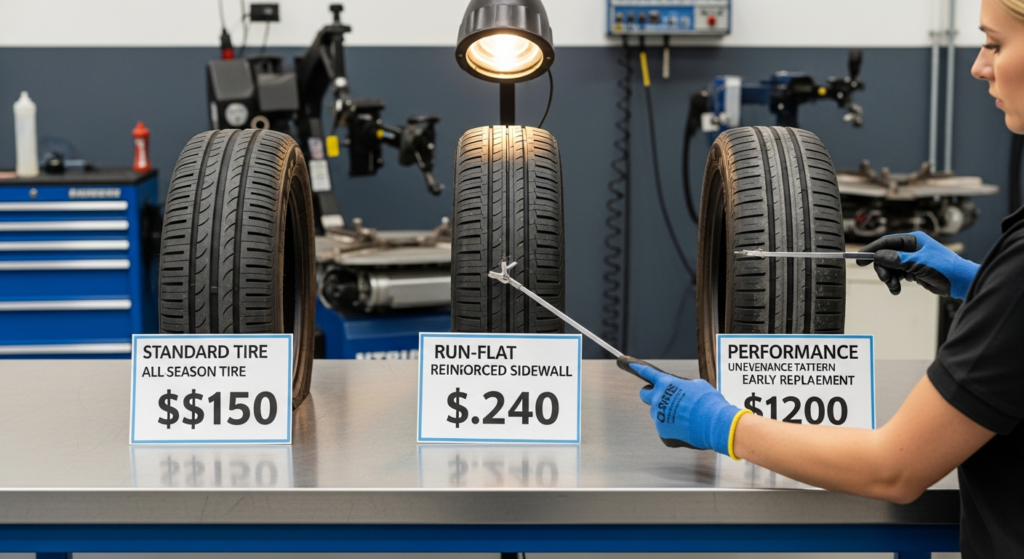
Run-Flat Tires Cost 40-60% More
Many BMWs, some MINIs, and select other luxury vehicles come with run-flat tires. These let you drive after a puncture, which sounds great until you see the price. A regular tire might cost $150. The run-flat version? $240. And they wear faster because the reinforced sidewalls create more friction.
Ultra-High Performance Summer Tires Are a Money Pit
Summer performance tires on sports cars give you amazing grip. They also last about as long as a gallon of milk. I’ve seen Michelin Pilot Sport 4S tires on a Mustang GT wear out in 18,000 miles. At $280 per tire plus installation, that’s $1,300 every 18 months for an average driver. Nobody tells you this at the dealership.
Electric Vehicles Eat Tires Faster
The instant torque from electric motors is fun. It’s also murder on tires. EVs are heavier than comparable gas cars and put more stress on tires during acceleration. Tesla Model 3 Performance owners regularly report needing new rear tires at 15,000-20,000 miles. The fronts last longer, but you’re still looking at more frequent replacements than a traditional car.
All-Wheel Drive Means All-Four Replacement
Here’s a brutal truth about AWD vehicles: many manufacturers require replacing all four tires if one gets damaged, even if the others have plenty of tread left. The difference in diameter between a new tire and a worn tire can damage the AWD system. I’ve had to deliver this news to customers who thought they were just replacing one tire for $150 and ended up spending $800.
Tire Brand Reality Check (Stop Believing the Internet)
The tire forums and Reddit threads will tell you that cheap tires are fine and expensive tires are a scam. I’ve mounted thousands of tires. That advice is garbage.
Budget Tires ($50-90 per tire)
Brands like Douglas, Westlake, Lionhart. These exist for a reason: people need cheap tires. But understand what you’re buying. The rubber compound is harder, so they last longer but grip worse. The tread pattern is basic. Wet weather performance is mediocre at best. For a commuter car in a dry climate? Fine. For anything else? You’re compromising safety to save $200.
Mid-Tier Brands ($90-150 per tire)
Cooper, Hankook, Kumho, Falken. This is where I tell most customers to shop. These companies make legitimate tires with good performance and reasonable longevity. A set of Hankook Kinergy GT tires will cost you $500 installed and last 50,000-60,000 miles on a sedan. That’s solid value.
Premium Brands ($150-250 per tire)
Michelin, Bridgestone, Continental, Goodyear (premium lines). Better rubber compounds, more sophisticated tread designs, longer warranties. Worth it if you drive a lot, live somewhere with harsh weather, or just want the best. A set of Michelin Defender T+H tires might cost $800 installed but they’ll last 70,000-80,000 miles and perform better in every condition.
Ultra-Premium Performance ($200-400+ per tire)
Michelin Pilot Sport, Bridgestone Potenza, Continental ExtremeContact. These are for performance and luxury vehicles. If your car came with these from the factory, you really should replace them with the same. Downgrading to cheaper tires on a sports car doesn’t just reduce performance—it can actually be dangerous because the car’s handling characteristics were designed around those specific tire capabilities.
The Maintenance Factors Nobody Calculates

Proper Tire Inflation Adds 10,000 Miles of Life
I check tire pressure on every vehicle that comes through my bay. Maybe 1 in 10 has all four tires properly inflated. Underinflated tires wear faster on the edges. Overinflated tires wear in the center. The difference between 28 psi (underinflated) and 35 psi (correct) can cost you 10,000 miles of tire life. That’s real money.
Alignment Is Non-Negotiable
If your car pulls to one side, your steering wheel sits crooked, or your tires are wearing unevenly, you need an alignment. This costs $75-150 but can save you from replacing tires 20,000 miles early. I’ve seen tires with 8/32″ tread on one side and completely bald on the other because someone skipped the $100 alignment after hitting a pothole.
Rotation Intervals Matter More Than You Think
Rotate your tires every 5,000-7,000 miles. Front-wheel drive cars wear fronts faster. Rear-wheel drive and performance cars wear rears faster. Regular rotation evens this out and can extend overall tire life by 15,000-20,000 miles. Most shops charge $20-40 for rotation. Do the math: $100 in rotations over the life of your tires versus buying a new set $800-1,200 earlier.
Regional Cost Differences That Nobody Mentions
Tire prices aren’t the same everywhere. I’ve compared prices with other technicians across the country and the gaps are significant.
| Region | Cost Modifier | Why It’s Different |
|---|---|---|
| Rural Areas | -10% to -15% | Lower overhead, less competition, smaller inventory |
| Major Cities | +15% to +25% | High rent, labor costs, premium locations |
| Coastal Areas | +10% to +20% | Higher cost of living, shipping costs |
| Midwest | Baseline | Most competitive pricing, central distribution |
| Mountain States | +5% to +15% | Winter tire demand, specialty fitments |
| Sun Belt | -5% to +10% | Year-round demand, no winter tire inventory |
A set of tires in Manhattan might cost $1,200 while the same tires in rural Missouri cost $900. Same brand, same model, same size. Location matters.
Buying Strategies That Actually Work
Shop Online, Install Local
Tire Rack, Discount Tire Direct, and similar sites often beat local prices by 10-20%. They ship to a local installer. You pay separately for mounting and balancing but still save money. I’ve had customers save $200-300 this way on premium tires.
Warehouse Club Memberships Pay for Themselves
Costco’s tire prices include mounting, balancing, rotation, and lifetime flat repair. For a family with multiple vehicles, this can save $500-1,000 per year. Same with BJ’s and Sam’s Club.
Don’t Buy Tires One at a Time Unless You Absolutely Must
Single tire replacements cost more per tire due to labor. Plus, mismatched wear patterns can cause handling issues. If two tires are worn, replace both. If three need replacement, just do all four.
Black Friday and Memorial Day Sales Are Real
Tire manufacturers run legitimate promotions around major holidays. Rebates of $70-100 per set are common. I’ve seen customers save $150 on a tire purchase just by waiting two weeks for a sale.
Avoid Financing Unless You Need It
Many tire shops offer payment plans. Interest rates run 15-30% APR. A $1,000 tire purchase financed over 12 months can cost you $1,150-1,200 total. If you need financing to afford tires, your emergency fund needs work.
Warning Signs Your Tires Need Replacement
Don’t wait until you’re stranded. Here’s what I check:
- Tread depth below 4/32″ – Legal limit in most states is 2/32″ but you should replace at 4/32″ for safety
- Uneven wear patterns – Indicates alignment or suspension issues
- Cracks in sidewalls – Age-related deterioration, replace immediately
- Bulges or blisters – Internal damage, tire failure imminent
- Vibration at highway speeds – Could be balance issues or internal belt separation
- Age over 6 years – Even with good tread, rubber degrades
The penny test everyone talks about? That only checks for the legal minimum. That’s too late. Use a tread depth gauge ($5 at any auto parts store) and replace at 4/32″.
The True Cost of Ownership Math
Let me break down what tires actually cost you over the life of a vehicle.
Honda Civic (50,000 miles per set, $600 per replacement)
- 100,000 miles = 2 sets = $1,200
- 200,000 miles = 4 sets = $2,400
Ford F-150 (45,000 miles per set, $900 per replacement)
- 100,000 miles = 2.2 sets = $2,000
- 200,000 miles = 4.4 sets = $4,000
BMW M3 (25,000 miles per set, $1,600 per replacement)
- 100,000 miles = 4 sets = $6,400
- 200,000 miles = 8 sets = $12,800
That BMW’s tire costs alone over 200,000 miles equal the purchase price of a used Civic. This is why I get frustrated with people who don’t factor tire costs into their vehicle choice.
Common Tire Replacement Mistakes
Replacing Only Two Tires on an AWD Vehicle
I’ve already mentioned this but it bears repeating: AWD systems can be damaged by diameter differences between tires. Subaru specifically states that tire diameter variance can’t exceed 1/4″. A new tire versus a half-worn tire exceeds this. The repair bill for a damaged AWD system? $2,000-5,000.
Mixing Tire Brands or Models
All four tires should match for optimal performance and safety. Different tread patterns respond differently to steering inputs. On wet roads or during emergency maneuvers, mismatched tires create unpredictable handling.
Ignoring Load Ratings
Pickup truck owners: your tire’s load rating matters. Downgrading to a cheaper tire with a lower load rating can be dangerous when hauling or towing. The tire’s sidewall lists its load index. Match or exceed your vehicle’s requirements.
Buying Tires Before You Need Them
Tires degrade with age even if not used. Buying tires on sale and storing them in your garage for a year means they’re already a year old when installed. Rubber oxidation starts immediately.
Skipping the Road Hazard Warranty on Expensive Tires
On cheap tires, skip it. On expensive performance or EV tires, buy it. I’ve seen customers with $300 tires get a sidewall puncture at 5,000 miles. With the warranty, they get a prorated replacement. Without it, they’re out $300.
Questions People Actually Ask Me
Can I replace just one tire if the others are still good?
Technically yes, but it’s rarely a good idea. The new tire will have a different tread depth, which affects handling. On AWD vehicles, don’t do it. On front-wheel or rear-wheel drive, you can sometimes get away with replacing one tire if the others have 80% or more tread remaining and you can find the exact same tire model.
How long do tires really last?
The treadwear warranty is marketing, not reality. A tire rated for 60,000 miles might last 40,000 miles if you drive aggressively, or 70,000 miles if you drive gently. Age matters too—replace tires over 6 years old regardless of tread depth. Rubber deteriorates even when the tire isn’t being used.
Are tire insurance plans from dealerships worth it?
Usually no. These cost $500-1,000 and have so many exclusions they rarely pay out. Sidewall damage, improper maintenance, alignment issues—all excluded. You’re better off saving that money in your own emergency fund and using it for actual tire replacements.
Do I really need the expensive tires my car came with?
If you drive a performance vehicle or luxury car, yes. The handling characteristics were engineered around those tire specifications. Downgrading to cheaper tires changes braking distance, cornering grip, and ride quality. On a regular commuter car? Mid-tier tires are usually fine.
What This Means for Your Next Vehicle Purchase
Before you buy your next vehicle, calculate the tire replacement costs over your expected ownership period. This single factor can swing the total cost of ownership by thousands of dollars.
A luxury SUV might cost $800 more per month in payments than a midsize sedan. But if the SUV’s tires cost $1,200 every 40,000 miles versus the sedan’s $600 every 60,000 miles, you’re looking at an additional $3,000-4,000 in tire costs over 150,000 miles. That’s not nothing.
Ask the dealership or check online for the exact tire size on any vehicle you’re considering. Look up replacement costs. Calculate how many sets you’ll need over your ownership period. Add it to your total cost of ownership spreadsheet.
Electric vehicles deserve special attention here. That instant torque wears tires faster. The batteries make them heavier, which increases wear. And many use specialized low-rolling-resistance tires that cost more. Factor in replacing tires every 30,000-35,000 miles instead of 50,000-60,000 miles.
The Bottom Line Nobody Wants to Hear
Tire replacement costs are going up, not down. Larger wheel sizes, performance requirements, EV specifications—all these trends push prices higher. The average tire replacement cost has increased about 35% in the last five years.
You can’t avoid this expense. Tires wear out. It’s physics. But you can plan for it, budget for it, and make smarter decisions about when and what to buy.
Stop believing the $400 tire job exists for most modern vehicles. It doesn’t. Expect $600-800 for a basic sedan, $800-1,200 for trucks and SUVs, and $1,200-1,800 for performance and luxury vehicles. Build this into your vehicle budget from day one.
And please, maintain your tires properly. Check pressure monthly. Rotate every 5,000-7,000 miles. Get alignments when needed. These simple actions can extend tire life by 20,000 miles or more. That’s $500-1,000 staying in your pocket instead of going to tire companies.
The next time you’re shopping for a vehicle and the salesperson is going on about heated seats and advanced safety features, ask them how much a set of tires costs and how often you’ll need to replace them. Watch them squirm. Then get the real numbers from a tire shop before you sign anything.