
I’ve spent the last five years helping buyers navigate car purchases across state lines, and I’m constantly shocked by how many people overpay simply because they didn’t look 50 miles in the other direction. Last month, I watched a client save $4,200 on a Honda CR-V by driving two hours into a neighboring state. Same trim, same color, same mileage—dramatically different price tag.
Here’s what nobody tells you: the car market isn’t national. It’s a patchwork of regional economies, each with its own pricing logic. I’m Priya Verma, and I’ve been working as an automotive consultant since 2020, specializing in cross-state purchases and market analysis. I’ve processed over 300 transactions where buyers crossed state lines, and I’ve seen patterns that dealers hope you’ll never notice. What started as helping a friend compare prices in California versus Nevada turned into a full-time focus on regional arbitrage opportunities.
Most people assume a $35,000 MSRP means the same thing everywhere. That assumption costs them thousands. I’m going to show you exactly where prices diverge, why it happens, and how to exploit these differences without getting burned by hidden costs.
Where Price Gaps Actually Exist
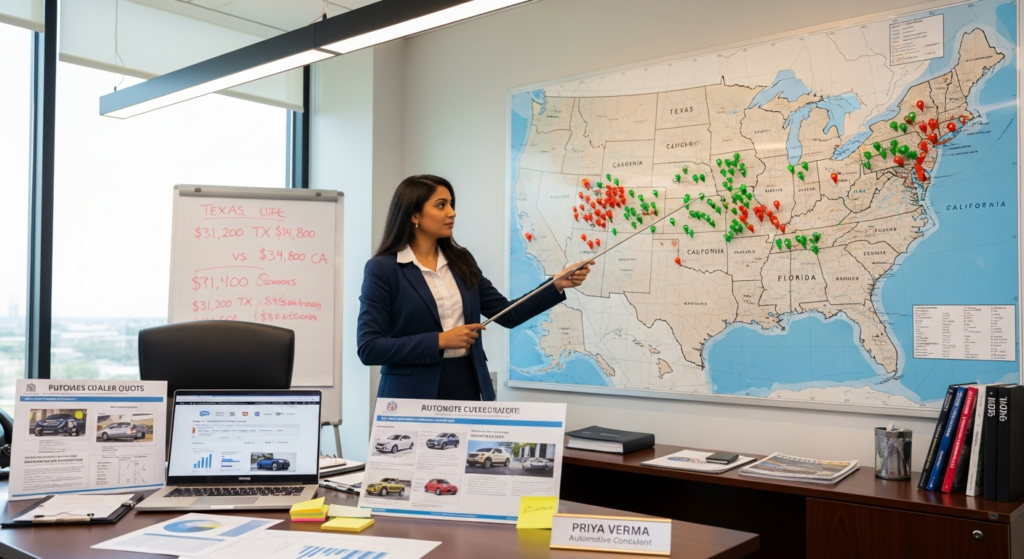
The biggest price differences I see aren’t random—they follow predictable patterns tied to local economics and demographics.
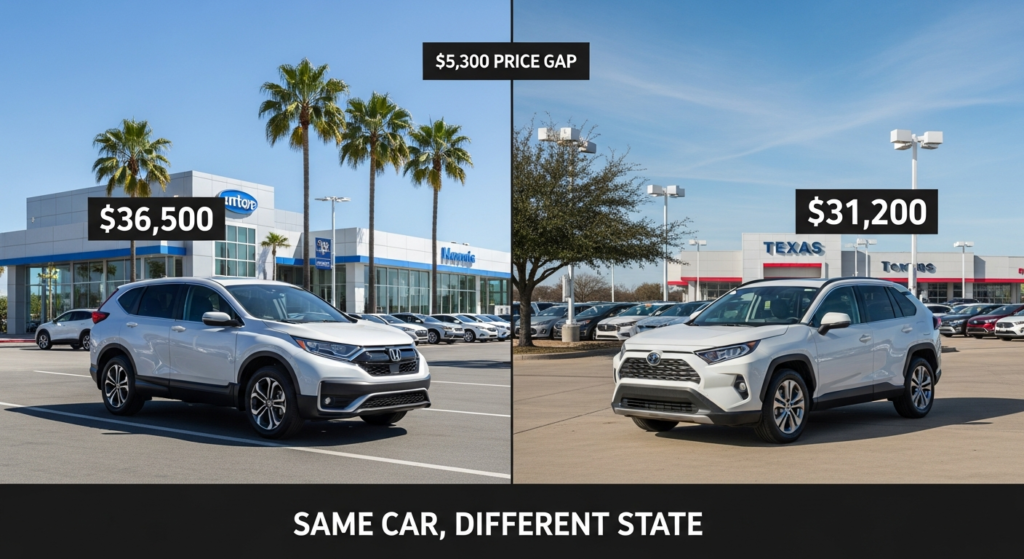
High-cost coastal states versus inland states create the most dramatic gaps. I regularly see $3,000-$6,000 differences on popular midsize SUVs between California and Arizona, or between New York and Pennsylvania. A Toyota RAV4 that lists at $32,000 in Phoenix might carry a $36,500 sticker in Los Angeles, and dealers won’t budge much because inventory moves fast.
Urban versus rural markets within the same state can vary by $2,000-$4,000. I helped a buyer in rural Montana find the exact Subaru Outback they wanted in Billings for $3,100 less than the Missoula dealership was asking. Population density drives this—dealers in cities have higher overhead and know buyers have fewer alternatives.
State tax structures create artificial pricing pressure. Oregon has no sales tax, which sounds great until you realize dealers price accordingly. They know buyers are calculating the total cost, so they build some of that “savings” into higher sticker prices. I’ve seen Oregon dealers price vehicles $1,500-$2,000 higher than Washington dealers on identical inventory.
Here’s a comparison I pulled from actual listings last month:
| Vehicle | Texas Price | California Price | Price Gap | Miles from Border |
|---|---|---|---|---|
| 2024 Honda CR-V EX | $31,200 | $34,800 | $3,600 | 850 miles |
| 2023 Ford F-150 XLT | $42,500 | $46,900 | $4,400 | 850 miles |
| 2024 Toyota Camry SE | $27,300 | $29,900 | $2,600 | 850 miles |
| 2023 Jeep Grand Cherokee | $38,700 | $43,200 | $4,500 | 850 miles |
The pattern holds across vehicle types. California’s higher costs of living, stricter emissions requirements, and massive population create sustained price premiums.
Why These Gaps Exist
The generic advice tells you “supply and demand” without explaining what that actually means in practice. Let me break down the real mechanisms.
Regional demand patterns vary wildly. Pickup trucks command premium prices in Texas and the Mountain West because they’re status symbols and practical vehicles. That same F-150 sits longer on lots in Massachusetts, forcing dealers to discount. I watched a Silverado languish in Boston for 47 days before the dealer cut $4,000 off the price. In Houston, that truck would’ve sold in a week.
State-specific regulations add direct costs. California’s emissions standards require special equipment that adds $300-$500 to the vehicle cost. That’s before you factor in the dealer’s markup on compliance paperwork. I’ve reviewed purchase agreements where California dealers charged $895 for “emissions certification fees” that don’t exist in other states.
Local tax environments reshape the entire calculation. Compare these effective costs:
| State | Sales Tax | Registration Fee (Year 1) | Total Tax Burden on $35,000 Car |
|---|---|---|---|
| Oregon | 0% | $225 | $225 |
| California | 7.25%-10.25% | $450 | $3,038-$4,038 |
| Texas | 6.25% | $380 | $2,568 |
| Florida | 6% | $425 | $2,525 |
| Montana | 0% | $215 | $215 |
Dealers in high-tax states can’t do much about this, but they also know buyers are locked into these costs if they register locally. That reduces price pressure.
Inventory allocation from manufacturers creates artificial scarcity. Automakers send more trucks to Texas, more AWD vehicles to Colorado, more convertibles to Florida. When you’re shopping for a less-common configuration in your state, dealers have leverage. I helped a client find a specific Mazda CX-5 trim in Tennessee that wasn’t even being shipped to their home state of Alabama. The Tennessee dealer discounted it because it was unusual for their market.
Cost of living variations affect dealer overhead. A dealership in San Francisco pays triple the rent of a dealer in Boise. That overhead gets baked into pricing. The San Francisco dealer needs higher margins just to keep the lights on, while the Boise dealer can work on volume with smaller per-unit profits.
Calculating Your Real Savings

You can’t just subtract one price from another. I’ve seen too many buyers get excited about a $4,000 price gap, then lose $3,200 to costs they didn’t anticipate.
Transportation costs vary dramatically by method. If you’re driving yourself, calculate fuel costs at current prices—not what you hope they’ll be. A 500-mile trip in a vehicle averaging 25 MPG costs roughly $80 in fuel each way at $4/gallon. Add a hotel night if needed ($100-$150), meals ($40-$60), and your time value.
Professional transport runs $0.50-$1.50 per mile depending on distance and route popularity. I recently arranged transport for a client from Nevada to Illinois—1,650 miles for $990 through a broker. That ate into their $3,400 price advantage, but they still came out $2,410 ahead.
Registration requirements get complicated when you cross state lines. Most states require you to register the vehicle in your home state within 30-90 days. Some states charge sales tax based on where you register, not where you buy. This is critical: buying in Oregon to avoid sales tax doesn’t help if you live in California—you’ll pay California’s sales tax when you register.
Here’s the real math on a scenario I handled last month:
Vehicle: 2024 Subaru Outback Limited
Home State: Washington (9.3% combined sales tax)
Purchase State: Montana (0% sales tax)
Distance: 650 miles
- Montana dealer price: $37,200
- Washington dealer price: $41,500
- Apparent savings: $4,300
Actual costs:
- Montana sales tax: $0
- Washington use tax (paid at registration): $3,460
- Round-trip fuel: $180
- Hotel: $130
- Title/registration fees: $275
- Net savings after all costs: $255
That’s barely worth the 13-hour drive. The buyer ultimately negotiated better with their local Washington dealer instead.
States with the Biggest Price Advantages
I track regional pricing trends continuously, and certain states consistently offer better deals.
Florida has massive inventory turnover and fierce competition among dealers. The state’s population and tourism mean constant demand, but also constant supply. I’ve found excellent prices on sedans and crossovers here, particularly on previous model years that dealers need to clear. The lack of state income tax also means dealers can operate with slightly different economics.
Texas offers strong pricing on trucks and SUVs—counterintuitive given the demand, but the volume is so high that dealers compete aggressively. I’ve seen $3,000-$5,000 discounts on F-150s and Silverados that California dealers wouldn’t touch. The state’s business-friendly environment keeps overhead lower.
North Carolina and Tennessee sit in sweet spots—lower costs of living than coastal states, but strong enough economies to support healthy dealer competition. I regularly find deals here that beat both Florida and Texas on import brands like Honda, Toyota, and Subaru.
New Hampshire has no sales tax, but unlike Oregon, dealers haven’t fully adjusted pricing upward yet. If you live in Massachusetts or Vermont, the 1-2 hour drive can save you $2,000-$3,500 after accounting for your state’s use tax.
States to avoid for price shopping:
- California: High demand, strict regulations, expensive overhead
- Hawaii: Obviously, but I still get asked—shipping costs obliterate any possible savings
- Alaska: Same issue, plus limited inventory
- New York/New Jersey: High overhead, captive markets
- Colorado: Strong economy and limited nearby alternatives keep prices high
Border State Strategies That Actually Work

Generic advice tells you to “shop around.” That’s useless. Here’s what I actually do for clients.
Identify your search radius based on savings potential. For every $1,000 in potential savings, I’m willing to expand the search by 200 miles. A $5,000 gap justifies looking 1,000 miles away. A $1,500 gap? Stay within 300 miles or it’s not worth it.
Focus on border communities where dealers compete directly. I’ve found killer deals in places like:
- Texarkana (Texas/Arkansas border)
- Kansas City (Kansas/Missouri border)
- Portland (Oregon/Washington border)
- Bristol (Tennessee/Virginia border)
Dealers in these markets know buyers shop both sides. They’re more willing to negotiate because they see it daily.
Time your purchase around end-of-quarter and end-of-year sales goals. This magnifies regional differences. A dealer in a slow market facing quota pressure will discount more aggressively than a dealer who’s already hit targets. I helped a buyer get an extra $2,100 off a vehicle in March (Q1 end) by targeting a dealer in rural Indiana who was behind on quarterly numbers.
Use specific pricing databases correctly. I rely on TrueCar, Edmunds dealer inventory, and Cars.com’s zip code comparison tool. Set your home zip code, then compare against zip codes in target states. Don’t just look at advertised prices—many dealers post artificially low prices online. Call and get out-the-door quotes in writing via email.
Leverage manufacturer incentives that vary by region. This is insider knowledge most buyers miss. Toyota might offer $1,500 extra rebate in the Southeast to move inventory, while California gets $500. Ford does the same with regional dealer cash programs. Ask specifically about “regional incentives” and “dealer cash”—not all dealers volunteer this information.
Registration and Tax Complications You Can’t Ignore
This is where buyers screw up constantly. You cannot avoid your home state’s sales tax by buying elsewhere unless you’re moving states.
How sales tax actually works across state lines: When you register a vehicle in your home state after buying elsewhere, you pay your home state’s “use tax”—which is functionally identical to sales tax. Washington doesn’t care if you bought in tax-free Oregon; you’re paying Washington’s 9%+ rate when you register.
Exceptions that create real savings:
- Alaska, Delaware, Montana, New Hampshire, Oregon: No sales tax states. If you live here, you genuinely save by buying locally.
- Trade-in credits: Some states (like California) let you deduct the trade-in value from the taxable amount. If you’re trading in a $15,000 car and buying a $35,000 car, you only pay sales tax on the $20,000 difference. Not all states offer this, so buying out-of-state might actually cost you this benefit.
Registration timeline requirements:
Most states give you 30-90 days to register an out-of-state purchase. You’ll need:
- Bill of sale from the dealer
- Title (or manufacturer’s certificate of origin for new cars)
- Odometer disclosure statement
- Proof of insurance in your home state
- Emissions testing results (if your state requires it)
Temporary permits: The selling state will issue a temporary tag valid for 30-60 days. This lets you drive home legally. Don’t assume you can just keep using it—your state will eventually notice and hit you with penalties.
Financing Across State Lines
Banks and credit unions don’t care where you buy, but the process gets messier when you’re not local to the dealer.
Pre-approval is non-negotiable for out-of-state purchases. I won’t let clients leave their home state without a pre-approved loan in hand. Dealers will try to beat your rate, but you need a fallback. I’ve seen dealers refuse to honor quoted prices when buyers couldn’t secure financing.
Credit union advantages intensify out-of-state. Many credit unions offer better rates than dealer financing, and they’re more flexible about remote transactions. My local credit union offers 3.49% on used cars versus the 5.99% the dealer offered. That’s $1,400 saved on a $30,000 loan over five years—money that makes the trip worthwhile even if the price gap is smaller.
Watch for dealer financing tricks in unfamiliar markets. Some dealers inflate the purchase price when you finance through them, offering a “discount” if you pay cash. This is legal but scummy. Always get the cash price first, then ask about financing as a separate question.
Multi-state title processing takes longer. Expect 4-6 weeks instead of 2-3 weeks for your title to arrive. The selling state’s DMV processes it, then sends it to your state’s DMV, then to your lender if financed. Plan accordingly if you’re refinancing or selling soon.
Inspection and Verification from a Distance
Never buy an out-of-state vehicle sight unseen unless it’s certified pre-owned with a strong warranty. I don’t care how good the photos look.
Hire a local inspection service. Companies like LemonSquad charge $150-$250 to physically inspect a vehicle before you commit. They’ll catch issues the dealer “forgot” to mention. I’ve saved clients from nightmare purchases three times this year alone using pre-purchase inspections.
Demand detailed photos and videos. I make dealers send me:
- 360-degree walkaround video
- Close-ups of each wheel and tire
- Photos of the engine bay
- Interior shots showing all screens and controls working
- Undercarriage photos showing no rust or damage
If a dealer resists, that’s a red flag. Walk away.
Get everything in writing via email. Verbal promises mean nothing. I want the exact price, fees broken down line by line, and confirmation that this is the out-the-door price before I have a client travel.
Verify VIN-specific details. Make sure the VIN matches every document. Check the VIN against:
- CARFAX or AutoCheck reports ($40 well spent)
- NHTSA recall database (free)
- Manufacturer warranty lookup (free on most brand websites)
I caught a dealer trying to show one vehicle but sell another by catching a VIN mismatch. They “accidentally” mixed up two similar cars. Sure they did.
When Buying Out of State Backfires
I’ve seen enough disasters to know when crossing state lines is a terrible idea.
You need warranty service frequently. If you’re buying a brand-new vehicle with concerns about reliability, having the selling dealer 800 miles away creates hassles. Yes, any authorized dealer can perform warranty work, but resolving disputes with the selling dealer becomes complicated from a distance.
The vehicle needs immediate repairs. If that “great deal” in Florida has a check engine light or needs new tires, you’re eating those costs on top of transportation. Factor in $500-$1,500 for potential immediate maintenance when buying used out of state.
You’re financing through the dealer and they require in-person signing. Some states mandate physical presence for certain paperwork. If you can’t complete the transaction remotely, factor in multiple trips or walk away.
The price gap is under $1,500. My rule: if total savings after all costs don’t exceed $1,500, buy locally. The hassle factor, risk of something going wrong, and time investment aren’t worth it for marginal savings.
You’re buying a rare or modified vehicle. The more unusual the vehicle, the harder it is to verify condition remotely. I will not let clients buy modified trucks or rare sports cars from out of state without seeing them in person. Too many variables, too much risk.
Real Examples from My Client Work
Last year, I helped a couple relocating from Colorado to North Carolina. They needed a Toyota Highlander and found one in Denver listed at $48,500. North Carolina dealers were listing the same trim at $44,200. They assumed they should buy in Colorado before moving.
Wrong. Once we factored in:
- Colorado’s higher sales tax (8.75% vs NC’s 3%)
- The hassle of registering in CO then transferring to NC within 60 days
- North Carolina’s better dealer incentives ($1,000 regional rebate CO didn’t have)
They saved $3,100 by waiting and buying after they moved. Sometimes the lower sticker price is a trap.
Another client wanted a Ford Bronco. Illinois dealers had nothing in stock under $52,000 for the trim she wanted. Wisconsin dealers 90 miles north had three in stock at $48,800.
The math worked:
- Price difference: $3,200
- Round-trip fuel: $45
- Wisconsin sales tax: 5.5% ($2,684)
- Illinois use tax credit for Wisconsin tax paid: -$2,684
- Net savings: $3,155
She drove up on a Saturday, completed the purchase, and drove home the same day. That’s how it should work when conditions are right.
Negotiating Leverage When You’re Shopping Multiple States
Dealers hate losing sales to out-of-state competition. Use this to your advantage.
Present competing out-of-state quotes to local dealers. I make sure these quotes include:
- Exact VIN
- Itemized price breakdown
- Date (must be within 7 days)
- Dealer contact info
Then I tell the local dealer: “I’m willing to buy here to avoid the trip, but you need to match this price or get within $500.” This works about 60% of the time in my experience.
Don’t bluff with fake quotes. Dealers can smell BS, and they’ll call you on it. Only use real quotes from real dealers who are actually willing to sell at that price.
Leverage end-of-month timing. Dealers care most about monthly quotas. If you walk in on the 28th with a competing out-of-state quote, you have maximum leverage. The dealer might lose $500 in profit to hit their monthly goal and earn incentive bonuses.
Be ready to walk. I’ve walked out of dealerships with clients at least 20 times in the past two years. Half the time, the dealer calls back within 24 hours with a better offer. The other half, we buy from their competitor.
Technology Tools That Find Price Gaps
Stop manually searching individual dealer websites. That’s insane.
CarGurus’ distance filter lets you set a maximum distance and see price variations by market. I use this to identify regional clusters with lower prices, then drill down.
AutoTempest aggregates listings from multiple sources and shows you map-based price clustering. You can literally see that vehicles in Montana are cheaper than vehicles in Washington when you view the map layer.
TrueCar’s Market Average pricing shows you regional variations when you change zip codes. Plug in different zip codes across state lines and watch the “average market price” shift by thousands.
Edmunds’ incentive finder breaks down manufacturer incentives by region. This is critical—a $1,000 rebate in one state can evaporate in another. Make sure you’re comparing apples to apples.
I spend about 3-4 hours per client doing this research upfront. It consistently identifies opportunities that ad-hoc searching misses.
Insurance Implications of Cross-State Purchases
Your insurance company doesn’t care where you bought the car, but you need coverage in place before you drive off the lot.
Call your insurer before you leave. Give them the VIN and purchase date. They’ll add it to your policy immediately. Most insurers now do this over the phone or through their app in under 10 minutes.
Temporary insurance from the dealer is expensive and limited. Some dealers offer “drive-away” insurance for $50-$150. It’s essentially a rip-off unless you have literally no other option. Use your existing policy.
Rates don’t change based on purchase location. Your insurance company rates based on where you garage the vehicle, not where you bought it. Buying in a cheaper state doesn’t reduce your premiums.
Related FAQs
Can I register a car in a different state than where I live to save on taxes?
No, this is illegal. You must register your vehicle in your state of primary residence. Some people try using a relative’s address in a no-sales-tax state—this is tax fraud and can result in penalties, back taxes, and potential criminal charges. Not worth it.
Do dealers charge extra fees for out-of-state buyers?
Some do. Watch for “out-of-state documentation fees” ranging from $150-$500. This is negotiable—push back hard. I’ve gotten these fees removed about 70% of the time by threatening to walk away. There’s no legitimate reason for this charge; it’s pure profit padding.
How do I handle state emissions testing when buying out of state?
The selling state’s emissions standards don’t matter. What matters is your home state’s requirements. If you live in California, you need a vehicle with California emissions equipment, even if you buy it in Nevada. Check with your state’s DMV before purchasing to ensure the specific vehicle qualifies. Some dealers know these requirements; many don’t.
What happens if the dealer goes out of business before my title arrives?
This is rare but catastrophic when it happens. Make sure the dealer is established and financially stable. Check Google reviews going back 2-3 years. If the dealer does fail, you’ll need to work with your state’s DMV and possibly an attorney to secure your title. This can take 6-12 months and cost $1,000+ in legal fees. Another reason to favor larger, established dealerships for out-of-state purchases.
Final Thoughts
Buying a car across state lines isn’t some magic trick that always saves money. It’s a calculated decision that requires actual work—researching prices, understanding tax implications, verifying vehicle condition, and honestly assessing whether the savings justify the hassle.
I’ve saved clients an average of $2,800 on out-of-state purchases over the past five years, but I’ve also talked dozens of people out of making purchases that looked good on paper but fell apart under scrutiny. The difference between success and disaster is doing the boring work upfront: verifying quotes, calculating real costs, inspecting thoroughly, and being honest about whether the math actually works.
If you’re within 300 miles of a state border and you’re seeing price gaps over $2,000 after accounting for taxes and transportation, it’s usually worth pursuing. Anything less than that, and you’re probably better off negotiating harder with local dealers using those out-of-state quotes as leverage.
The car market’s regional fragmentation isn’t going away. If anything, inventory constraints and dealer pricing power have made these gaps more pronounced over the past few years. Learn how to spot legitimate opportunities, avoid the traps, and you’ll consistently pay less than buyers who don’t look past their local market.